Friday, June 17, 2016

GREECE 2016 - 8 - ORGANIC BLACK MULBERRIES "MURRA" AND MORE


Social solidarity clinics of Greece are carrying quite a burden of health care to those who can't afford it
 
After a very successful workshop on childhood adversity and its impact on adult health with the pediatricians of the Solidarity Clinic, Sofia and Michaeli offered me to go to his village to pick fruits, right off the branches. I am thrilled with the opportunity. Solidarity Clinic is still in the back of my mind, though. Apparently, it started in Crete to provide health care to those who don’t have health insurance such as refugees, minorities, immigrants, etc.
 
Good volunteer doctors of Greece providing care to Syrian refugee children
 
My colleagues tell me that the goal of this movement was to show the need, to convince the government that structured system of care was needed for these populations and eventually as the government built the needed services Solidarity Clinic would leave the social network to governmental entities. These clinics, now spread to all over the country are run totally by volunteer pediatricians, psychiatrists, psychologists, internists, etc. Unfortunately, although the founder of the Solidarity Clinics is the Minister of Health in Greece, right now, the need for them is still not extinct especially after the Syrian refugee influx. I admire my young colleagues affectionately, who are basically working two jobs, one paid at half salary and the other not at all. No wonder democracy and communal participatory life style were established on this land.

Church at the entrance to Michaeli's village Pantanassa 

We load into Michaeli’s car, at 8:30; Manoli, Michaeli and Sofia’s son, Dimitri, Manoli’s friend, and myself. We are heading to Michaeli’s village. He has a house in the village, cherry, apricot, and peach trees and a small vineyard that he shares with his brother. Unfortunately, due to climate change, his cherry trees stopped producing. His apricot trees are doing fine. It is beautiful countryside as we leave the National Road behind and dive into the depths of the island. Road is meandering up and down, over and around cliffs and hills, through and above valleys and canyons into the mountain land.
 
Manolis and his friend Dimitri conversing while waiting for Michaeli change cars
 
They point to the Moni Arcadi (Arkadi Monastery) across one of the valleys, where a heroic resistance was held against Ottomans in 1866, when 943 people finding refuge in the monastery eventually blew themselves up by exploding their storage of gunpowder into that subsequently drew attention of the rest of the world to Greek liberation movement. All through my life, I was told Ottomans were good to locals, when they conquered, rather invaded a land. I guess they forgot to add "as long as the locals were submissive". If they were honorable enough to resist, slaughters were imposed upon them to teach a lesson to the rest, which was never shared with us new generations to keep the “hate the Greeks” card always available to keep domestic issues under control.

Our unplanned but welcome coffee break in Pantanassa 

We finally arrive at his village, Pantanassa. He parks and brings another car that he keeps at the village parking lot to drive around the village, only going to his fields. Just as we turn a corner, he spots a police car in front of the kafennia in the village and stops abruptly. It takes me some time to understand that he is worried about the police giving him a ticket since the car in the village is somewhat disheveled, although fully functional. Very smart move, we also park and have a seat at the kafennia and order coffee! It would have never occurred to me, no wonder my daughter claims I am gullible at times. Greeks’ and Turks’ mind works sooooo similarly. In Turkish, there is an expression “There is no end to list of solutions in democracies”, our unplanned coffee break proves the relevance of the expression! As we enjoy our coffee and chat away with the kafennia keeper kiriya, the police leave, after paying for their coffee, though (in Turkey, I doubt police pay for anything especially in such a small village). We are now ready to head to the field just half a km outside of the village.

Ambulatory vegetable seller (manav in Turkish and Greek) takes me back to my childhood

The trees are loaded with apricots, but my fellow apricot pickers are disappointed as soon as they break an apricot or two since most fruit is infested by mini-worms, some worms barely visible and only to a trained eye, others well established households roaming and devouring the core of the fruit. We pick only those that seem to be untouched by the worms. MIchaeli gets rid of some that I pick, I guess he can tell even by looking at the fruit that it is infested. We move on after picking a box of apricots, but a mulberry tree catches our attention. Black mulberry, at that, which I hadn’t had for a long time. We are all interested in picking and Michaeli reports his friend who owns the tree will never pick them.
 
 
Apricot branches are sweeping the ground, albeit, most are wormy: the cost of organic farming at times...
 
Four sets of hands get to work right away. We make sure to feed ourselves as well as picking to take home. I notice all of a sudden that my hands and forearms are covered with streaks and patches of burgundy color red mulberry juice. Oh my, how in the world will I be able to lecture to a group of professionals this afternoon! The boys calm me down with local wisdom: if, after washing my hands with soap and water, I rub them with mulberry leaves from the same tree, the stains will all go away. I can’t believe this, but still pick a handful of leaves to take home. Believe it or not, upon return to my hotel room, following my shower, the rubbing takes away the entire color except for a slight hue on my nailbeds, now I am safe to present myself professionally.

Michaeli and Manolis observing and testing apricots for worms and taste. 

On the way out of the village, Michaeli stops at his vineyard and trims the vines. Although I am helping them, all of a sudden my attention is drawn to the precious very fresh leaves that are cut off, which will rot on the ground. I assign myself to picking the leaves that are appropriate to stuff to make stuffed grape leaves for Sofia’s family. Although, the gentlemen are disinterested in my endeavor at this point, they will be very pleased next week, to have let me do it when one of our dinners together has dolmadakia that Sofia and I will make as the central dish. Sofia is worried though; observing how much the boys enjoy the dolmadakia, now they will demand her to make it for them, which is very time consuming a delicacy. We decide to get together whenever they crave for dolmadakia…

Life is produced in a village at all times: Pomegranates in the making for the fall  across from the kafennia

I am so grateful that Sofia and Michaeli open up their home and lives to me like this. As a Fulbright scholar and an anti-touristic tourist I appreciate this all too natural not even an effort greatly. Becoming a member of her family for two weeks is what makes my Fulbright experience so very unique allowing me have a very steep learning curve about Cretan culture, Greek history and politics from different points of view since all three members of her family have different political views! Both Sofia and I feel we are now bonded forever as friends beyond colleagues. Perhaps that is one treasure I will take with me from this trip, a gift from Fulbright. 
Michaeli, the gentle boss of all good things...


I must have been so busy eating mulberries, I neglected to take a picture of my fellows picking them!


Monday, June 13, 2016

GREECE 2016 - 7 - DOORS AND WINDOWS OF CRETE AMONG OTHER THINGS


Now that I am established in Rethymno and I don’t have a car for some days, I can start exploring this lovely town in more depth than I was able to do 5 years ago. I am staying at the Liberty Hotel, which is conveniently located to walk to Sofia’s house, to the waterfront, to the old town, to Laiki (farmer’s market held every Thursday); everything is in 1 km radius from my hotel. I am thrilled that my fitbit will not embarrass me in Crete! Moreover, the owner is a family, at times their children are running around and the elderly great grandmother is also the receptionist occasionally. With her broken English and my broken Greek, I discover she is a Greek nationalist and is nto very fond of Turks. However, she also has a forgiving grandeur on her face perhaps because of my Cretan roots or because I do my best to learn Greek? After going to bed at 1 am, which has now become routine in Greece!, I can barely wake up at 9 am, which will also become routine soon.  

 
An old falling apart door in an elegant doorway in Rethymno
 
I start strolling through the back streets of Rethymno. All these buildings must hold, buried or revealed so many stories of multiple generations. This brings to mind the spectacular award-winning movie titled “My grandfather’s people” (Dedemin insanlari in Turkish) by Cagan Irmak. This movie depicts very truthfully and artistically that Turkos (muslim Greeks) and Christian Greeks actually understood very well that they were of the same mold perhaps not knowing what had led them to hold onto their good old or to convert to a new religion. Ottomans, I learn bit by bit, were not that benign after all as the official Turkish history teaching professes “Ottomans were not brutal with natives of the lands they conquered, they let them speak their language and practice their religion”. It is not so at all!, I learn this time, since I have read more and I hear this in the voices and hearts of people that I talk to.

Another old door, fading away into nothingness, but locked, nonetheless...
 
One memory from years ago, when I had visited my Greek friend from 1970s in Thessaloniki was so striking when she had told me “When our mothers got upset with us as a child, their weapon was ‘Turkos are coming, come inside', or ‘if you don’t do this, I’ll give you to Turkos’”. Why would generations of mothers instill such fear in their children's hearts if they themselves were not so afraid of Turks? There are multiple heroic resistance stories from all over Crete on how they were in the end massacred by the Ottomans. Those were the commendable rebels, I assume, who wanted their freedom and refused slavery, overt or covert to the Ottomans. Ottomans on the other hand labeled these people as “gavur infidels” and sold their war mongering to the people of the mainland, who were paying taxes to cover the cost of the wars as “We are spreading Islam, the God’s gospel to infidels”. Does it sound familiar with the contemporary American rhetoric of “We are spreading democracy and carry the banner of the free world?” when invading, Afghanistan, Iraq, Vietnam and other distant lands?  

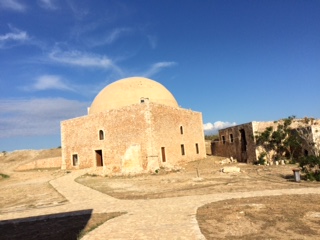
The mosque Ottomans built at the highest point of the Fortezza, Venetian castle in Rethymno 

I am fascinated with the doors and windows as well as some of the old facades of the buildings that come across my path. Some are old, left to their fate, disheveled, but in a way still standing against the punches of time even if they are made of merely wood with metal hinges and handles clearly in aches and pains that have traversed decades perhaps a century or longer. In Chania, I will see later that some business owners very clearly used these “as is” facades to their advantage and created a very authentic atmosphere, where the tables and chairs are located within the standing ruins of what once must have been pretty impressive residential structures or other architecturally meaningful buildings.

Some of the old doorways stand majestically against time 

Some more renovated and well-kept buildings have a unique door style, usually with two panes each with a metal handle. Most of these interesting doors have a metal handle either in the shape of an elegant woman’s hand or lion’s head, or some other form. Before electricity, these elements were the tool to let the hosts know of a visitor at the door. These doors come in all colors: bright green, blue, brown, tan, red, you name it. Some new doors are embedded in a doorway with old arch made of stone. It is not clear whether some of these are made to look old or whether they are indeed old. I saw one house though, the old arched doorway was filled with stone and a new contemporary doorway was opened for the new door. Who knows why. Most shops are elegantly built into old stone buildings, which provide preservation of history, too. I wonder if these buildings are owned by the occupant businesses, or rent and if so by whom. It does look like there is a system of preservation in place, though, I hope is true, which makes sure these buildings are preserved into future generations as they are.
 
 
Entry to a store, you breath history at every turn in Crete
 
As I walk through the streets of Rethymno and Chania, I discover many Turkish names such as Hamam Sokaki (Turkish Bath Street), Terzi so and so (Tailor…), Hamam (Turksih Bath), etc… One of my colleagues at a dinner tells me "We have so many Turkish words in Greek, but we don't use them anymore". With every example this rhetoric continues “We used to say… we don’t any more…” My friend Michaeli tells me all the songs muslim Cretans used to sing are disappearing, if not already. Of course once you cleanse an ethnicity from the society, it is not only individuals that disappear, along with them a culture fades away with its vocabulary, with its music, and the color they used to add to the locality. I also wonder if Greek language has gone or is going through cleansing itself from Turkish words as Turkish has tried to cleanse itself from Arabic and Persian for a long time until religious right started winning power.  They have all the right to do that, I hope it is not as a result of excessive nationalism, though.

Sokaki = Street (Turkish is preserved)

The Venetian Rimondi fountain that replaced an earlier version of 1588 in 1626 is, certainly one of the landmarks in Rethymno. This fountain was one of the public drinking water sources in town. My second stop is the Archeological Museum, which has a nice collection of artifacts starting in neolithic times (3500-4000 BC) all the way to neo classical period. From there I head to Fortezza, the Venetian fortress with touches from the Ottomans here and there. The centrally located mosque they built is visible from pretty much most of the town. As I walk into the chapel at the entrance of the fortezza, I find an interesting activity going on:
 
Over 400 year old Rimondi fountain in Rethymno
 
A group of young men are working on putting up a series of photographs, clearly getting ready for an exhibition. I apologize and tell them I won’t bother them, but one young man, named Yorgo, who seems to be their leader tells me to feel free and walk around. At least half of the photographs are already put up with interesting themes and sceneries from all over the world. Then he tests me about what my reading was about the art that is posted already. He tells me their goal for this competition was to explore depiction of human existence across borders. He invites me to the opening reception on the 8th. I definitely would like to, but can’t promise. I hope I can. 
 
The most impressive and expressive photograph from the exhibition-in-the making I walked into in the castle

As I approach the mosque, I see a young man on top of a huge rock, which seems to be the highest point of the Fortezza from where I am. I holler at him, he must be at the highest point. He is friendly but tells me that the mosque seems to be at a higher point from where he is. Soon I am on top of the same rock. His name is Hankle, a PhD student in German archeology. He tells me he is planning to hike over the mountains south of Rethymnon to Kronoss in the east.
 
 
The selfie taken by Hankel from Germany in the castle: It is very clear that we are not dealing with the issues the above young man from Pakistan is..
 
I tell him about my plans to hike through the Samaria Gorge. At some point, we start discussing how terrible a condition Greeks are in. He opposes my compassion when I tell him doctors in this country are being paid only 17-1800 euros a month. He is making 1200 euros a month without paying any taxes, because he is a student, so they are on the same boat. His position is “but they still live in mansions”.
 
 
Serene Aegean beyond the Fortezza
 
I have to mention to him that those who live in mansions and who suffer living on 1700 euros a month may not be the same people. I am sure both of us are left with questions in our minds. I wondering if Greek nation is indeed in as dire a condition as is portrayed; he, wondering if what he hears in Germany is not the full truth. I hope someday I can understand how Greece accumulated and how the European Union allowed them to accumulate such huge amounts of debt.

 
Windows are framed as beautifully as the doors in some houses 

Day is coming to an end. This time, I am heading toward the west of town, past the Fortezza, Last night, I had admired the people, who had all crowded the foothills of the Fortezza right around the dusk. Tonight I will join them. As I walk around the Fortezza’s northernmost point, I start getting a glimpse of a chain of cafes and curbside restaurants in the distance. Plan has been made, I will have my dinner in one of those and devour another unforgettable sunset. I find a restaurant named Fournaki, my waitress is Nectaria. She has jet black hair (how do they find such artificial color is beyond me), very striking make-up with bold colors. She tells me “You have a finesse!” I really don’t know if she understands what this means, since she doesn’t have that comprehensive English skills, but I take it with an appreciative smile. She is happy, I am happy. The sunset is indeed beautiful, subtle, but touching…
 
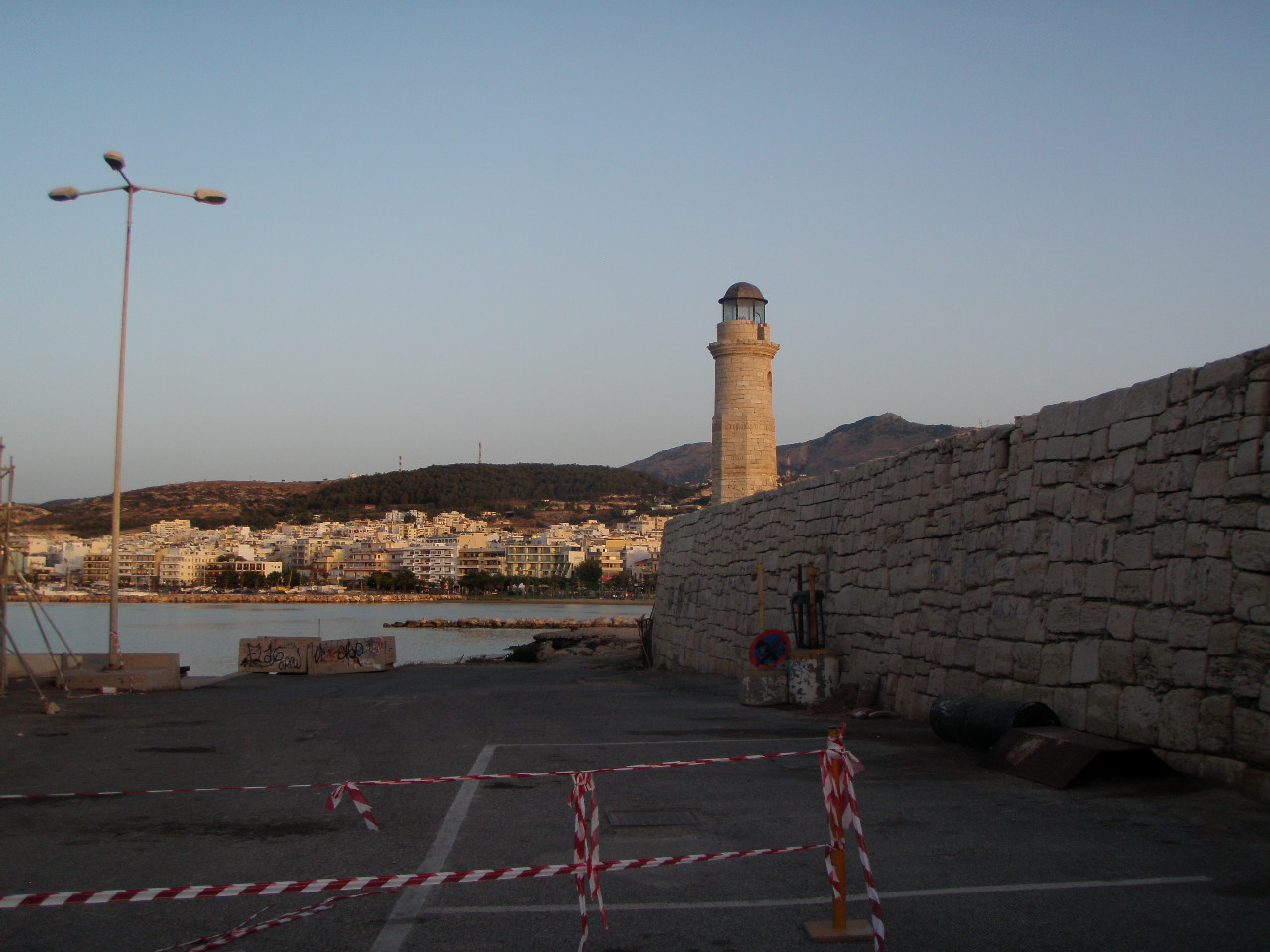
Light tower radiates with warmth at sunset
 
My belly is full with delicious lamb chops, time to go to a delicious sleep after reading my “Maps to Lost Lovers” some more. Although the amount of physical and emotional torture people have to go through because of the very thing, their religion that is supposed to give them strength and support is distressing beyond imagination, I can't put this book down: The author weaves love with guilt, human needs with shame, society with individual, violence with tenderness with such talent of using words that, nobody is a hero in the book, nobody is a monster, nobody is solely a victim, nobody solely a martyr, they are all human beings with failings and heroisms molded into each one of them. All guided with their experiences... I wish all religions on earth went through appropriate reforms so that each and every one of us can b-r-e-a-t-h with no orthodoxy suffocating us at no level...
Beautiful Lilbyan Sea to the South of Crete

Saturday, June 11, 2016

GREECE 2016 - 6 - PHILOSOPHY, POLITICS, HISTORY AND SIESTA


After a turbulent 12 hours in Heraklio, I finally arrive in Rethymno. My dear friend Sofia is waiting for me at the bus terminal in Rethymno with her elegant, soft, kind presence. We have been planning this project for such a long time: When the Fulbright Scholar Specialist program matched us, especially around two projects, one in Athens and the other in Crete, we were ecstatic. And now we both are looking forward to our teaching activities as well as strengthening our friendship as I spend two weeks in Crete. She announces right away that I will have lunch with them every day, which will turn out to be the best part of my stay in Rethymno, little do I know at the point.

 
My friend Sofia and her husband preparing lunch for our first mesimeriyano
 
She knows, being of Cretan origin, I love hortas (the wild greens picked by natives from the nature in Crete, boiled and treated with olive oil, salt, and lemon juice into delicious and healthy salads) and fish. She very kindly made fish and horta for me for our first lunch. I am grateful. Sofia is a Professor of Psychology and the vice-chair at the Department of Psychology at the University of Crete, Rethymno campus. She is a very knowledgeable researcher, whose specialty is prevention and that is how we got connected in the first place in 2010.
 
 
Fresh produce stands and stores are all over Crete and Rethymno
 
Her husband Michaeli is a retired architect and a very competent farmer as well as a patriotic Cretan just like my grandparents were: “No place has it better than in ‘Crete mou’” is something I heard until my grandparents died and this is Micaheli's rhetoric at every turn, too. As the days go by, I will discover that Michaeli is a "larger than life" type of a man, and his heart is his best treasure that he has. I am pleasantly surprised that their 22 year-old son Manoli, who is already a world citizen and has freed himself of all patriotic ownership issues is also in Crete.
 
 
Manoli, Sofia's son with his friend in his father's village: we will pick apricots!
 
Ever since I had heard in 2010 that  his position about the Aegean Sea ownership fights between Greece and Turkey was “Aegean belongs to nobody but its fish”, I had “fallen in love” with the boy, without even having seen him. Our lunch conversations will prove that this is a young man who has a brilliant head over his shoulders, who sees Greece and Greek history as it is just as I want to believe that I see Turkey and Turkish history in all their objectivity. He wants to do good for the entire world not only for Crete, not only for Greece. His kind of young people, I still trust and hope will save the world from all the ugliness of global capitalist system and its atrocities in some parts of the world.  

Aegean belongs to nobody but its fish: I like that idea!
 
Every day, our lunch get-togethers turn into pleasant community gatherings, which will become the time of the day that I will await most excitedly with Sofia’s delicious cooking, my desire to learn Greek better, Michali’s desire to continue learning English beyond his 28 years of efforts, and Manoli’s efforts invited by me to help me understand the contemporary Greek history putting everything into class struggle context, which resonates very well with me. Michali is also very well versed on ancient Greek history and philosophy. I can check with Michaeli, whether I interpreted what I learned in the last several months by reading lots of books on Greek history and philosophy in compliance with the actual facts and truths. We certainly also will share with one another personal experiences and how Crete and Cretan culture played a role in who we all became.
 
 
Philosophers are Michaeli's domain, contemporary politic Manoli's at Sofia's house
 
Sofia and Michaeli are two of the warmest people I am lucky to have in my life. Michaeli will soon become a brother to me with his Cretan protective male attitude and generosity. Sofia with her American-Cretan combination persona is a woman after my  own heart, as a woman, as a friend, as an intellectual, and a world citizen caring about the disadvantaged in the world exactly the way I do. No wonder it was a “love at first sight” when I first met her in 2010 over a collegiate collaboration that I had sought in Crete. Crete will have multiple new influences on me as the days unfold. Living, be it partially, a few hours a day with my dear friend's family in Crete is such a gift for me and even a bigger eye opener than what I had felt in 2010 during my first encounter with Crete regarding my roots out of Crete. 

We haven't gotten into the Trojan Horse in our discussions yet in Sofia's house.
 
Not only Crete but overall Greece have changed my entire time orientation. Before coming here, I thought I could never stay up beyond midnight, let alone have a siesta in the middle of the day! My experience brings back to mind the Turkish saying "Big bite of food is OK, big claims are not". Here I am in Crete, exhausted from the marathon of the last three months and especially the last week of training activities in Athens, getting up at 6 and not going to bed until 1 am lately. On the day of my arrival to Rethymno, with the emotional exhaustion of the last 24 hours, I fall asleep for couple of hours before flowing into the evening excitement of Rethymno over a stroll into the old town. I take it as an outlier, the assumption will turn out to be wrong.

 
Café Hellinica metrio, mono, is a great delight after lunch (Medium sugar, single shot Greek Coffee)
 
After our lovely visits over lunch, Michaeli excuses himself for his daily siesta. That is, I think, what has triggered my attempt at the same. Being exhausted for such a long time, the attempt turns out to be successful. First day 2.5 hours of siesta feels exceptionally refreshing, and since then my average daily sleep including siestas is 10-12 hours. This rest gives me the strength to take a long walk through the old town, along the waterfront, on top of the breaks on the Aegean every evening until 10-11. One evening, having walked across town, looking for gluten free bread without success, I find myself at the western end of old town by the Venetian fortress (Fortezza) at a mini-cafe on top of the cliff looking down at the rocky shore, my face toward the beautiful sunset.
 
One of many spectacular sunsets I will savor in Rethymno every evening...
 
The silhouettes of the people right below the fortress half a km away from where I am are becoming one with the cliff as small protrusions against the beautiful pink-orange background of the sky gradually losing its previous fire into the night. The rocks below piercing the Aegean with intent and confidence create a sharp contrast as they turn black with the still blue of the sea, which will soon also turn into black. I know where I will be the next day at sunset: Right on top of the cliff below the fortress to share with my anonymous peers what they have enjoyed tonight...


Infamous Light Tower of Rethymno at dusk


Thursday, June 9, 2016

GREECE 2016 - 5 - KIND KIND PEOPLE OF CRETE

Heraklio, Crete… Wow, the airport has grown in the last 5.5 years since my last visit here tremendously. In 2010, all rental car companies were in the main airport building; it was very easy to find mine, and with only few people passing by here and there I didn't have to struggle through a crowd at all. Now, not only I find myself in an instantaneous flood of people, but also whoever I ask about my rental car company, they either don't know about it or are telling me some rental car companies have desks out in the rental car parking area and some have shuttles to go to their off-site location. Despite November versus June consideration, there is some change in the air. 

National Library in Athens
 
I finally find my shuttle just as described by some of the wise informants, and the first gesture of Cretan kindness becomes apparent. The young Cretan man, seeing my limp since I fell in a tour bus spraining my ankle just before going to the airport in Athens, takes both of my luggage and relieves me from the burden of that work very gently. I discover that he doesn't do this because he expects a tip, since when I give him his tip, he refuses it at first with embarrassment! I am dumb founded and notice how Americanized I have become. How can I forget in parts of the world, before capitalism takes over all relationships, people do things for one another just out of the goodness of their hearts. Once all is measured through the lens of $$$, every kindness acquires a price as in all corners of America.
 
Heraklion is the largest city in Crete
 
He carries my luggage up the steps into the office of Gold Car. I get in line behind the only couple in front of me. It is time to get my driver’s license and credit card out and I reach into my purse to find them. I take out the credit card from where it was supposed to be, but my driver’s license is not there. The first thought is I must have put it with the “to-be-less-used” items like health insurance card, etc. It is not there, either! Hmmm, there is something wrong here. Time to be mindful and see if I can recall the sequence of events of the last evening when I was getting done with my packing back at home.
 
Venetians did build quite strong fortresses in Crete including the one in Heraklion
 
To my surprise, a scary scene comes to mind very clearly now! As I was checking the cards in my wallet to choose which ones I would take with me and which ones not, I recall a mindless moment of looking at my driver’s license and thinking “I won’t need this” and putting it back into its slot in my wallet to remain dormant with its fellow cards in my purse, which went to its safety in my walk-in closet! That was May 27th, and until June 4th, I indeed didn't need it. But now I do, and my driver's license is resting peacefully back in Iowa City! I know how I did this: I forgot to put it in the long list of things to take with me on international trips since I usually use public transportation abroad, and didn’t move away from that list to think whether I might have forgotten something I would need! This is a first, and I sense that there may be no solution to this.

My friend Sofia's son is always reading something
 
With the calm of knowing what the outcome will be, I approach the desk and tell the clerk, who has a warm, soft face and kind looks “I feel like we have a dilemma here that we may not be able to solve, but here is the situation:” I have all his attention and very compassionately, too. I tell him the whole story. I will never forget the human interactions that took place in the next 24 hours with multiple people, who tried to make my situation better not only in Crete but also across Atlantic. When I got to the rental car place to discover I hadn't brought my driver's license with me, I had wondered what good would come out of this as I always do every time I face a no-solution in the moment situation. 

 
Sofia and Michaeli preparing our first lunch
 
Here is what the lesson turns out to be out of all my mindlessness. I now know better than ever that I have a village back in Iowa City, willing to put everything aside to help me with any problem, that is why it feels home to me. My dear neighbor/friend Kate, who always waters my plants when I am away, several friends of mine I alerted to inform Kate of the dilemma, since she was the one with a key to my house, my dear chosen brother Don, who left everything aside and rushed not only photographs of my license but also the actual driver’s license to Crete as fast as possible are some of those precious members of my village across the ocean.

Stewed fish, potatoes, horta and salad will be followed with apricots and peaches from Michaeli's own farm
 
 
And these Cretan people, who know nothing about me, yet, feeling my difficulty in the depths of their heart. Where does this exceptional nicety, willingness to help, and kindness come from? Looking at Costas’ face at the rental car place (we know each other’s name now) anybody can see the deep desire to make it happen for me along with the helplessness generated by the knowledge that there is nothing he can do. I will see time and time again in Crete, this child-ish innocence come out in each and every Cretan that I will connect with to do their best to help, when the situation requires it. Costas calls a nearby hotel when we both understand compassionately that there is no way I can have a car tonight and makes a reservation for me.
The drive from Heraklion to Rethymnon reveals wild gems of the nature
 
And Yorgo (the driver of the shuttle) carries my luggage back to his shuttle one more time with compassion and understanding and is happy to drive me to the hotel at no cost. Again he is very shy in accepting the tip I give him after finally carrying my luggage to the hotel lobby. I am sure both Costas and Yorgos will have a story to tell in the next several years about a crazy Cretan-Turkish-American woman with white hair, who looked like a smart lady but didn’t have her driver’s license with her upon picking up a rental car!!! As my brothers like to believe and joke about “Sister, there is no cross-Atlantic trip you take that doesn’t have a story attached to it” (to be exact they usually like to say a ‘major reportable event’, vukuat in Turkish), in a way they are right. Perhaps, one day, I should write about my travel vukuats! Food for thought.

Another view from high up of the Aegean on the way to Rethymnon
 
And here I am on an unplanned bus trip from Heraklio to Rethymno. After spending an uneventful evening at the Sofia Hotel at the airport, during which I made calls to my friend Sofia, who was expecting me in Rethymno on the 4th of June, and texted and e-mailed my friends across the ocean, plans have been made. Sofia mou, with her typical Greek/now Cretan hospitality offers to come pick me up from Heraklio, of course, I won’t have her do that. I can easily catch a bus and add that experience into my repertoire of experiencing Crete.  Don sends me photos of my driver’s license, but he will send me the license to Sofia’s address as soon as he can. With this plan in place I fall into a peaceful sleep.

Infamous Rethymno light tower
 
In the morning, I learn at the hotel that there is a bus leaving the bus terminal in Heraklio to Rethymno every hour. That is very comforting. I give it another try to see if Gold Car will rent me the car with the photos of my driver’s license. The new clerk at the office is also as kind as his fellow from the night before, but his manager is a business man, and the answer is a kind, sad (the clerk's) and definite (the manager's) “No”. Option is clear, take a taxi to the bus terminal, a ticket to Rethymno and enjoy the scenery, which I recall to be beautiful and awe-inspiring. We are following a route along the coast, which brings memories of 2010, when I was driving the same stretch that brought Lenea into my life and started this blog in the first place. Today, the emerald Aegean seems to be more vibrant with surf capped with big white energy.

The serenity of Rethymno harbor at dusk
 
As I enjoy the vistas, I am also reading my book “The Map of Lost Lovers” by Nadeem Aslam, given to me by my dear friend Marcia, a long-time artist in Iowa City, with whom my road has crossed last thanksgiving at a common friend’s house and since then we became sisters, at least in my heart. She is an avid reader and we exchange thoughts and feelings about the books we have read, often. This one, she just dropped on my lap to take to Greece, and I am grateful that she did. Everywhere I go I take it with me. It accompanies the whispers and roars of the Aegean as I sip my wine to witness the pink, red, orange, and violet sunsets of Rethymno. The last thing I touch before melting into my delicious sleep at Liberty Hotel every night is again this amazing book.   

First sunset in Rethymno, light tower in the distance
 
Nadeem, I must say is the coming Gabriel Garcia Marquez of this century. The content of his writing is so insightful, so analytical, and self-critical, assuming he might have grown up a Muslim then chosen a secular life  style. His technique is almost more impressive than Marquez’, making what initially seems to be the theme of his novel the murder of two lovers in religious context, which eventually turns into merely a subtext leading the way to many more important overriding themes he wants to share with the reader: the violent history of Pakistan and India involving the conflict between Islam and Hinduism staged and encouraged by the British, the personal histories of multiple individuals under the immeasurable oppression of Islam and with such humanistic approach, allowing them feel and be aware of the multiple layers of oppression they have to endure in the name of a merciless God and religious culture. And much more…

Two Greek boys are running toward the sun