Sunday, September 22, 2013

TURKEY AUGUST 2013 -11- HANNAH CEREMONY BEFORE WEDDING

8.10.2013 HANNAH CEREMONY BEFORE WEDDING

Hanna festivities are over! It was so much fun to immerse in modernized tradition, since pure tradition is not really my thing. My brother Mehmet and his wife Kezban came over to my mother's house yesterday for breakfast. There was a small glitch at the end of breakfast when my niece Melike, who is soon to be married called us frantically being concerned about a sensation in her eye and whether she'd be able to wear her contacts for the Hanna festivities and for her wedding in two days. Kezban, who is an anesthesiologist came to our help: She offered Melike to be seen at the hospital where Kezban worked. Pheww, that was quite a help. It turned out it wasn't anything other than dry conjunctiva.


Right after the beauty parlor visit, women all beautified

Around 11:30 am, Mehmet drove me to Melike's house where we did some more last minute cooking and greeted and hosted Melike's friends that started arriving from multiple cities for her wedding weekend. Melike's maternal uncle and other relatives also joined us throughout the day. It was a strange feeling to be hosting a wedding, for the first time in my life. So far, I always went to weddings hosted by others. Having just one daughter, who is swamped with professional engagements, no wedding any time soon for her; and one niece, no surprise that this is the first time I am somewhat responsible to make sure others are comfortable at “our” wedding festivities. I am an aunt after all, in Turkish culture considered half-a-mother.


My sisters-in-law and I just before leaving for the Hannah festivities

One of the details about Turkish weddings is that core family members go to a beauty parlor during the day of evening festivities, and have their hair done. I am not much of tradition, especially of this sort, but have one single niece after all, I decided to join the crew. It was fun to observe the communal spirit of women beautifying themselves asking for opinions of the group members, feeling satisfied, when everybody verified, each member had a fantastic hair-do or make up. However, I felt more like an anthropologist than an aunt when all the rest was all about how they could be their best in appearance.


My niece and I in front of the banner for her Hannah party

Finally, all of us improved in facade, returned home to have a late lunch, early dinner with all the food we fixed the day before. We had made turkish stuffed grape leaves, mixed stuffed vegetables, eggplant salad, barbunya beans, kiymali borek (pastry with ground beef and onions) and ispanakli borek (pastry with spinach and cheese, we made both), and desserts... it was great to see people enjoy our production as they scattered in small groups to all over the house with their plates and drinks. I had to take a nap before leaving for the "kir kahvesi" (country cafe) Atlihan in a village, famous for its kir kahvesi places, that are all multi-functional, nowadays I learn. They may serve as a breakfast place, restaurant, simple cafe, and lately, I guess, they also organize wedding ceremonies of small caliber.

Outdoors wedding setting in the country 

Sure enough, Atlihan kir kahvesi was ready for us all. They had put out tables and chairs donned with white table clothes and chair dresses to the ground. Although what was underneath was simple plastic, the coverings made the chairs and the entire place look very elegant. The youngest females were assigned to be responsible for the candy and cologne job. In Turkish tradition, two-three young girls stand by the door/gate of where the wedding is held and offer guests a very light cologne with lemon scent and candy/chocolate. This lemon cologne actually may be served to guests under any circumstance, even when people visit one another in their homes. It is not very perfumy, especially in hot summer days, the alcohol in it evaporating rapidly gives a sense of refreshment. I personally like it a lot. Clearly everybody else did, too, nobody refused it. Hand full of lemon cologne found its way to the guests’ necks and arms helping them cool off a bit more. Serap. my sister-in-law, my brother, and Melike's inlaws-to-become were lined up at the entrance to greet the guests. I joined the crew being the only aunt Melike had.


My brother bringing our mother to the Kir Kahvesi

I assumed people didn't know me, thus, I introduced myself to people as Melike's aunt, "hala". Turkish is very descriptive in that regard like Spanish. Every relationship has a different title, allowing one identify whether it is a paternal or maternal relative. It was cute to see the expression on people’s faces, one of “Oh my, so this is the woman” as if they had heard about me, “the woman, who is across the ocean and God knows when she will return for good” and finally here I was! This way, Mustafa, the groom's halas (paternal aunts) and teyzes (maternal aunts) introduced themselves to me, too in delight. I felt we were much more connected this time around. They seemed to be all well-intentioned, genuine people far from pretense. I liked Mustafa's family so far quite a bit.

Melike and Mutafa doing ballroom dancing

Melike had made some nice touches throughout the place in her preparations. Evil eye beads were scattered across the tables around the central bouquets. She had us tie colored chiffon scarves around the posts all over the place, which purked up an all-white space. The hannah parade was something else. All single women were invited to go inside to prepare for the parade. They were all given a short bride's head piece to wear  as well as scarves to wave during the parade. When the entire parade was ready, Melike led the crew with a semitransparent red scarf over her head and face, covering the upper half of her body. No wonder she had chosen a dark red dress, which was very becoming to her with her temporary scarf, now. One of Melike's friends was carrying the bowl full of hannah paste to be applied to Melike's hand then to be distributed to whoever wanted to apply it to their hands. Three candles lit on top of the hannah bowl were the only source of lighting all around us at that moment. As they started walking toward the stage, it turned into a traditional folkloric line dance, called halay in Turkey. After the youth all got on the stage dancing halay, we all joined in and made the line dance into an eternal circle wound into itself numerous times.


Hannah parade with all single girls and women lined up on the stage

Finally, my dear Melike was "entrapped' in the heart of the circle. Somebody brought two chairs into the circle and had Melike and Mustafa sit side by side. As one of Melike's friends was applying hannah into Melike's palm, Melike's mother-in-law snuck in a gold coin into the middle of the hannah lump in Melike's palm! All was quickly wrapped with a piece of cloth and her hand went into a red semitransparent glove. This is traditionally the time, the bride is expected (!) to shed tears since this moment supposedly represents the fact that the bride is departing from her father's home and is moving into her husband's household.

Melike trying to heold her tears back: It is the tradition for the bride to cry!

As much as I enjoy the backdrop of certain traditions with some aspects, I can't help recalling what they actually represent in political economy context: All these rituals in fact refer to a young woman being exchanged between two households in the context of feudal relationships, after which she will become “working hands” for the husband's family. For the sake of that, the husband's family is expected to pay whatever it takes to get her! To pay dowry to the bride’s father, if not in western Turkey, in eastern Turkey for sure is still a common practice. None of this applies to Melike and Mustafa of course since they are just playing with the idea of traditionalism during their wedding, but it does apply to scores of women and men in more traditional settings in the country, not only that, all around the world.


I bet in 1800-1900s, I would be called a "bad American" for having rhytym just like African Americans

Once hannah ceremony was over, we were back to dancing. Melike was in her element. Mustafa and she did two ballroom dances (apparently, it became a custom to take dance lessons for the bride and the groom to look professional during the wedding, each and every moment of which is video-recorded in Turkey, too, nowadays. In fact, there were times, I felt as if the hannah ceremony was being performed for a video-production rather than it being recorded in its natural course. Little did I know, the same will be repeated, much worse at the wedding itself. Once the traditional Turkish group dances resumed, the two sides of the families intermingled much better, dancing in mixed groups.I must say, everybody visited the stage to dance at least once, some of us, pretty much not leaving the dance floor. I wished my daughter had been there with us, she not only would have enjoyed herself thoroughly, but also would have made Melike much happier.

The bride's mother dancing with the folk dance group

When I had to leave half an hour early since my mother wasn't able to hold up any more, this was the longest she could sit on a chair for a long time, the dancing was still continuing full fledge. I learned later on that the young people, the bride, the groom and their friends went to a night club to continue dancing until 4 am in the morning. I recalled fondly, the days, my friends and I used to dance until early hours of the morning a few decades ago. That is youth, I thought. as young at heart as I feel, my entertainment engagements usually end around midnight nowadays....

Just before the hannah application

Tuesday, September 17, 2013

TURKEY AUGUST 2013 -10 - RAMADAN AND BAYRAM IN TURKEY AFTER MORE THAN A DECADE

8.8.2013 RAMADAN AND BAYRAM IN TURKEY AFTER MORE THAN A DECADE

Ramadan is over in the Muslim world. I have ambiguous feelings about this month and the culture surrounding it. My memories from childhood are very pleasant. My parents were the ones suffering the burdens of starvation and dehydration during those years, I simply enjoyed the enthusiasm around the festive dinner tables, called "iftar sofrasi", the unique foods that were only found at iftar tables, and of course the bayram that followed, which brought lots of allowances from grandparents, our own parents, older relatives, and even neighbors when we visited them through three days of bayram. the only negative memory I have from Ramadan is the fear the drummers triggered in me in the middle of the night. They strolled the neighborhoods to wake up people for an early breakfast, "sahur" before fasting started. Occasionally, when I got up with my parents for the sahur meal, I would look out the window to see the drummer strolling our neighborhood. His dark skin, most drummers were Roma people, fast pace in the solitude of the night with long shadows elongating in every which way, the sound of his footsteps when he didn’t beat the drum and the roaring sound of the drum scared me to death. I felt our street was invaded by some violent stranger.  When he and his team came to our door to ask for tip in the middle of Ramadan and on the first day of bayram, I would hide in fear in the most remote corner of the house and couldn’t understand why my parents were so friendly with such scary people.


When I reached late adolescence, the context changed totally. I was no longer a Muslim and I started seeing the Ramadan drummers as intruders to the lives of non-believers or non-fasters. I was almost looking for a way of punishing the poor drummers, who were just after a very modest income through tips. As upset as I was with the drumming tradition, I am glad I never insulted them other than telling the tip-seekers, "I do not fast, I am sorry." Had I had the wisdom of today, I think I would have tipped them anyway. I guess that is the way all over the world. In a country where at least 90% of the population is Muslim, traditions of Islam are imposed upon the minority non-Muslims, whether they are of other belief systems or non-believers. Even in the USA, although Christianity is not the choice of religion for such large majority, still, its traditions prevail.


This year is the first time in more than a decade, I spend time in Turkey during Ramadan. Thus, I have the opportunity to check my feelings and thoughts about the Ramadan traditions one more time. First of all, I now have discovered ear plugs, which did not exist in Turkey before I left the country to move to the USA. That, in and of itself takes care of a potential upset due to uncalled for drumming in the middle of the night. During the ten days of Ramadan I spent in Turkey this time, I did not wake up because of the drummers at all, thanks to my ear plugs. Perhaps because of this or the maturity that came with age, or the tolerance that I developed for attitudes and traditions that I don’t observe, I’ve been able to see the drummers, who visited every apartment building for tips this morning, simply through the tradition lens without anger or frustration. It is now, also fun to prepare a dessert for the potential guests that will visit my mother during the three days of Bayram. I smile thinking, how I never followed that tradition in my own home as an adult, since I was a nonbeliever and I took advantage of time off during bayrams and took off either up to the mountains or to the beaches. Throughout my childhood and adolescence, though, it was great fun to help my mother who would make several kinds of desserts for our guests.


It is fun to be with my family on a Bayram day after more than a decade if not longer. I made plans for an elaborate breakfast for my brothers and their families. It is almost expected, too, since I am now the oldest functional adult in my family, my mother being disabled. I bought the ingredients to make borek (Turkish pastry stuffed with a variety of ingredients) in addition to a variety of cheeses, pistachio helva, olives and greens. I learned from my mother how to make a unique Cretan style borek with zucchini. I had to slice the zucchini the night before so that it would release some of its juice to be drained over night. My brother Mehmet was anxious that making borek would take too long a time for Bayram breakfast: I am up at 6:30 am and borek is ready to go in the oven by 8. When I called my brother Mehmet, who lives in the same block with my mother that borek was in the oven already, I could tell I woke him up from a sweet morning sleep.


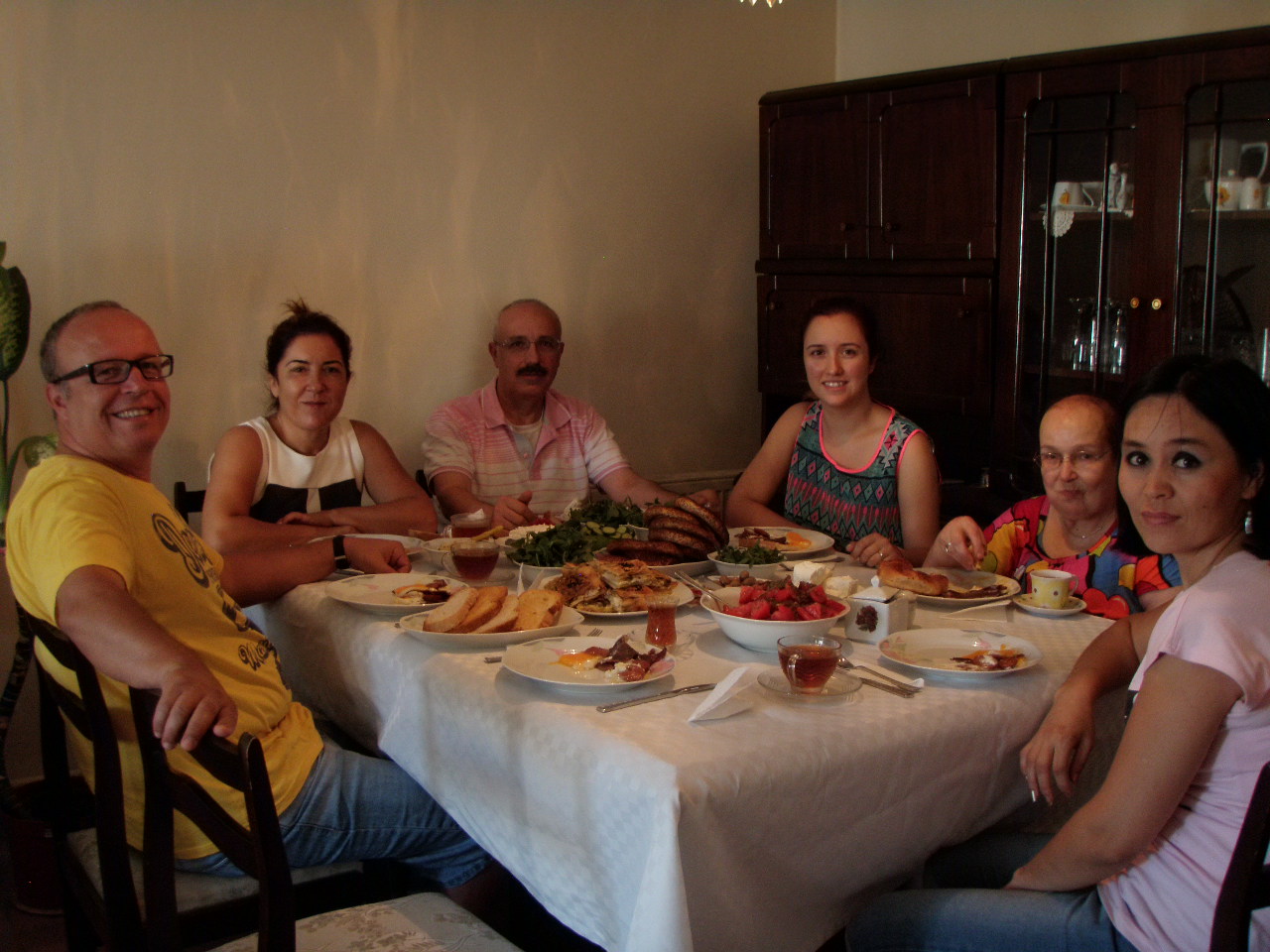
Both of my brothers, my older brother's wife and daughter (the younger's wife was on call) joined us for breakfast. We were all very pleased in an adolescent manner with the richness of our breakfast table, perhaps, all of us were experiencing a de ja voix from our childhood since our mother’s Bayram breakfast tables were just like this one. I am especially happy since I aimed at exactly this, to have my brothers experience a “just like Mom’s table”, it looks like it worked. Some of the items were first encounter for Firuza, she is ecstatic with not only the food, but also with having a proper and timely breakfast for the first time in a month.

Breakfast on Bayram morning with my entier family except for my younger sister-in-law


Later on she tells me she was more astonished with my cooking with her and treating her like a sister. I don’t quite understand and look at her, I bet quizzically. She explains "I told my mom, 'I had dinner with a professor', she was very impressed!". I crack up, but also feel a bit saddened. This alone is an indication for how traditional and almost cast-based the section of Uzbeki culture she is coming from must be. No wonder, she is constantly trying to take over what I do when we cook together, telling me "I'll do it, you go, sit." And the final resistance is that she doesn’t want to sit with us at the same table considering she is a servant. We finally convince her that to us, she is family and almost force her to sit at the family table to have breakfast with us. I am pretty sure, she won't believe where she will have come by the end of her time with my family in Izmir if and when she chooses to go back to Uzbekistan. I hope this experience helps her become her own person and be happy.  


Melike, my niece, who will soon be married

After breakfast, my sister-in law Serap, whose daughter Melike, my niece is getting married, and I go to their house in Bornova, about 25 kms away from my mother's house. My other sister-in-law had made stuffed grape leaves and dessert to help Serap's menu for the dinner she will have at her house for the core family members before her daughter's hanna ceremony the following day. Serap and I will cook stuffed vegetables, roasted eggplant and red pepper salads, zucchini patties, barbunya beans, cheese borek, and turkish meatballs with potatoes. Visitors tomorrow, will enjoy the variety of food quite a bit, I know. I feel at peace to be of some help to my only niece's wedding festivities. My last several days in Izmir before heading back home in Iowa City will be all about the wedding, which I am looking forward to.

My sisters-in-law just before leaving for the hanna celebration for Melike's wedding

TURKEY AUGUST 2103 - 9 - STRONG WOMEN OF IZMIR VERSUS UZBEKISTAN

8.7.2013 STRONG WOMEN OF IZMIR VERSUS UZBEKISTAN

Finally, I am done with the training activities. All went well and I am pleased that I created more connections in the country with key agencies to improve the response to not only child sexual abuse but also adult sexual assault.


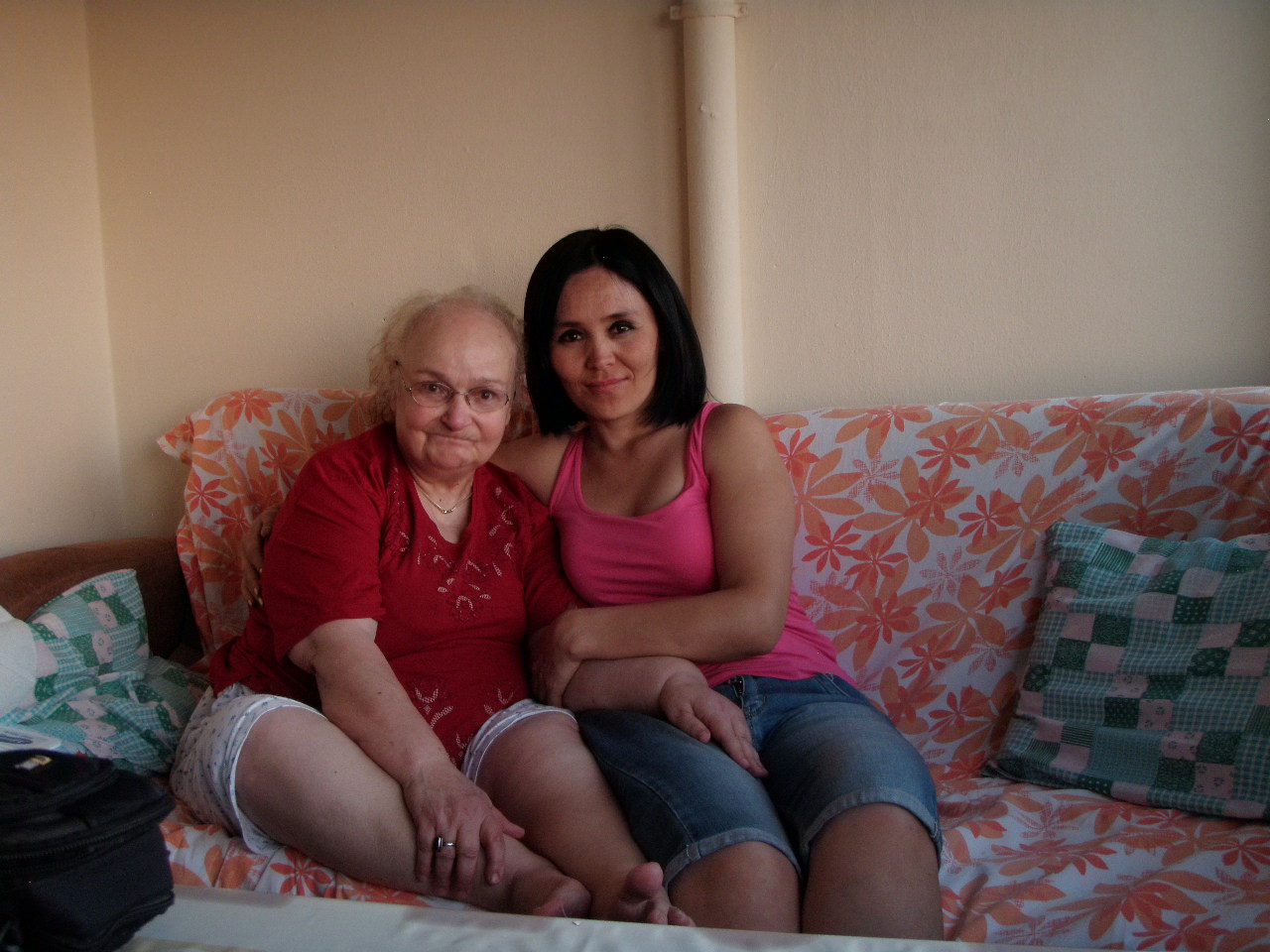
My disabled mother and her helper from Uzbekistan
Today, I had more time to spend with my mother and her helper. It is quite lovely to hear of her impressions of Turkey, rather Izmir and its people compared to her people in Uzbekistan. She figured out my "abla" (older sister) status in my family, her first question was about how women carry themselves in Izmir. "Abla, in Uzbekistan, women walk behind men, but here women are strong (demonstrates by thrusting her head backwards and bending her forearms upward at the elbows with her hands in a fist each) they walk in front of men, why is that?" I crack up “is that how she sees us Izmirite women, like sergeant majors?” She doesn’t know of course, that there are plenty of places in Turkey, too, where women have to “walk behind their men” in fact even in Izmir, if not literally at least to a certain extent metaphorically…


My brother and his wife certainly have a different relationship from the couple below from eastern rural Turkey
Soon it becomes clear that she cannot comprehend how in the world and why men she sees in and around my family are opening doors to women and offering them "right of way" if you will. I chuckle to her innocent disbelief and astonishment. I tell her unfortunately, it isn't that way in the eastern parts of the country and that Izmir is the most progressive province of Turkey and that is why men and women are the way they are in Izmir. I tell her one more thing: “I would live nowhere in Turkey but Izmir!” She tells me she knows she is lucky for living in Izmir and elaborates on how submissive women have to be in Uzbekistan. She tells me how her husband had taken away all her earnings when she lived in Uzbekistan after physically abusing her, which eventually made her leave her country and come to Turkey to make money without him being able to reach her.

In remote parts of Turkey one may see this as well.

It becomes clear that Uzbekistan is still in the dark ages of Islam, where men may simply say "Divorced", just as it was the case before the Independence War of Turkey in Turkey, and a woman would lose all her rights to her marriage. Of course my mother is semi-screaming from her spot "I would kick a man out of my house the moment he touched me with the flick of his finger", meaning violently. I fully support my mother’s statement. Firuza then shares with us that her mother is also encouraging her to leave her husband, for which she finds a lot of support in our kitchen; excited with the conversation, my mother has now moved to the kitchen, too..


My mother listening to our conversation with full attention

My mother and I start encouraging her to divorce him, which she states would cost her only $100. She is worried about her prospect to build a second family with her children, though. With her intelligence, I bet she will learn Turkish in no time and will have a very good chance for a second chance. But as one of my dear friends put it, this is not a problem x, for which there is an easy y solution. I recall how affectionately I had smiled to myself when I heard this approach from him, since my mind works very much like that, too upon hearing of a problem. I have seen enough in this life, though, as soon as I catch myself thinking in x-y mode, I also realize that there are very few situations in real life scenarios, where x-y modalities work. With this realization, I switch to "this is her problem, we can only offer her help, she has to make her own decisions" modality of thinking.


Firuza, innocent, sweet, full of hope for her future

Going back to Firuza's astonishment with how strong women are in Izmir, I can't help thinking one more time how relative everything is. Firuza is impressed with the amount of women's rights in Izmir, which is a place I left since I didn't feel I was free enough, individually in my family, culturally in my community, etc. Firuza is in another bout of disbelief when I mention to her about women's rights movement in the USA. She doesn't even have a concept anywhere near to that. When I explain to her the concept, she exclaims "There are no rights for women in Uzbekistan!"  In a way, I feel sad for her.  She has so much more to learn and accomplish to reach what she deserves. I hope, her time with my mother and family will empower her to protect and empower her children without submitting to a domestic violence perpetrator.  
The females of my family embracing Firuza as one of us

Monday, September 16, 2013

TURKEY AUGUST 2013 - 8 - SOGUCAK AND KEMERALTI, TWO AUTHENTIC AND DISTINCTLY UNIQUE PLACES

8 5 2013  SOGUCAK AND KEMERALTI, TWO AUTHENTIC AND DISTINCTLY UNIQUE PLACES

My brother Mehmet and I bought our summer house together, about 20 years ago. The cooperative we had joined in then, purchased the land first followed with the construction, which continued for 5-6 years. Eventually, when my mother and father moved in to enjoy it for 6 months of the year, I had already moved to the USA for good (not initially, but turned out to be so in couple of years). Thus, I haven't been able to stay there for more than a week per year; even that is rare. Mostly, every time I come to Turkey, I manage to visit our house for a few days, but it still feels mine, and I love it thoroughly. My brother Mehmet and his wife also love the place, the peace, quiet, and joy surrounding it; they take care of it beautifully, thus, it is always in pristine condition every time I return.

Our summer house in Sogucak surrounded with olive and other fruit trees
Our summer house is located in a complex that was built on top of a hill, adjacent to Sogucak village, a village looking down on the Aegean and on Kusadasi Bay. Sogucak houses three different styles of living in its bosom. The core belongs to the natives, in small typical countryside village homes built on the edge of family vegetable gardens, some, two-three story high, housing several families from an extended family, some small, humble shacks. The second life style is enjoyed by single summer house owners or those owning a house in a summer house complex, like my family. The third belongs to the European home owners or those renting a home from European owners of summer homes. Globalization created a lovely ethnic mixture even in Sogucak, as small a village as it is. The Europeans finding a home base in Sogucak are certainly those, who like to run away from commercial tourism; they seek authenticity, they are anti-tourists just like I, and it is very common for them to greet you in Turkish and learn Turkish to get by at least.

Greek island Samos across Kusadasi Bay from the terrace of our summer house
Thus, the native villagers do their own thing most of the time, with a few restaurants serving the passerby tourists, and temporary residents of the village alike. Female vendors set up shop in front of their homes; they put up a almost flat inverted wok on top of wood fire to make pastry, loaded with vegetables and cheese, or potato and cheese, or meat and onions: This pastry, called gozleme may serve as breakfast item, for lunch, of for snack along with afternoon tea. There is one specific gozlemeci (who makes gozleme) that I make sure to visit every time I come to the village. Zeynep, who makes her gozleme or bazlama (the filo dough for which is thicker than gozleme) in front of her house has a shop almost hanging down from her front yard onto the side-walk.  Her brother-in-law (Pasa) and sister-in-law, who live in the same courtyard in a separate house run a family restaurant at the most beautiful location in the village. I go there almost to meditate. Their restaurant occupies the border of their land that overlooks a ravine stretching toward the hillfoot on top of which is Sogucak. I sit at the most remote table in their open restaurant space looking at the bay with no obstacle in the visual field, all the way to Samos, the Greek island off Turkish shore. It is extremely meditative at any time of the day.

The view from where I had my coffee at Pasa's restaurant looking down on the Kusadasi Bay
With this goal in mind, I start strolling through the streets of our complex, than head out into the village, greet the young, and the old, women and men, kids and vendors, sitting on low standing stools in front of their homes, playing on the streets, or waiting for customers as I head toward Zeynep and Pasa's places.  Both are happy to see me. I ask Zeynep to prepare a gozleme for me to take home, my mother loves it as much as I do. Then I move to the restaurant to have a cup of Turkish coffee (my ritual here) as I savor the vistas down below along the coast all the way to Dilek Peninsula National Park 20 kms from our village. When I return home, just before dusk, it is time to break fast, we all respect Firuza's fasting; Firuza donned our dinner table with everything one could ask for, as we would call it in Turkish "the only thing missing is bird's milk". Throughout dinner, I think of how pleasant it is to spend time here in the village, hoping to return even if it is for one day in November, when I come back to Turkey for another teaching activity.


Sunset from the terrace of our summer house
Monday is my shopping day in Izmir. I bought several gifts for my loved ones in Iowa City, but I need some more. Kemeralti, the open street market is my destination. Although the main Kemeralti Street is only a few kms long, the entire conglomerate with its side streets might reach  a cumulative 10-15 kms of shops, vendors, restaurants, mini-malls,  passages, you name it. Since it is only a few days from one of the main religious holidays, called "bayram" in Turkish, it is all the more packed with people. Essentially, the streets are almost like a parking lot for barely moving people. Talk about personal space, which is reduced to zero cms right here in Kemeralti. It is suffocating at times, but I still like the fact that this crowd is proof that Kemeralti, a few hundreds of years of age is still alive, it hasn't succumbed to the huge malls lining the outskirts of every metropolis in the world as well as right here of my town.
My last stop is the Handcrafts Gift shop run by the Ministry of Culture, which is one of my favorite places in Izmir.  I am looking for a specific item this time. I'd like to buy handmade, silver earrings and a bracelet that this store used to carry to wear for my niece's wedding. The clerks, a middle aged man and a young woman tell me they don't carry much of what I am looking for anymore. I am worried, I ask them what is going on. They are open to unloading their frustration to an interested listener. They tell me in almost a chorus that the Ministry of Culture has stopped buying handcrafts from local artists since 2008 with the goal of closing the chain of such stores. It is like a stab in my chest: another attempt by the government to destroy unique cultural heritage of this land. They tell me, there are only 6 such stores across the country now, when Istanbul alone used to have 12, down to 2 recently. No wonder, the variety has been dwindling down over the last years. We start our criticism of the government, what else do I expect? Izmir, the most western city in the country, both literally and metaphorically that is socio-culturally, is certainly the most critical of the current government of all provinces and cities since it is also the most progressive city politically.
From the handcrafts store, I move to the waterfront. Pasaport is the name of a waterfront location, which has a pier where the boats that carry passengers from Konak, downtown to Karsiyaka, stop every other trip, it seems like. I find a table 2 ft away from the water and order a cup of Turkish coffee, while waiting for my friend. As I sip my coffee, the twins' peak is right across from me that brings memories of my childhood. The twins' peak in fact consists of two peaks, which was farther than the farthest imaginable location for me when I was a child. Little did I know then, that I would grow up and climb up to those peaks in my early thirties. After that first hike that I did with my outdoors group that I joined in 1991, I hiked over all the hills and mountains around Izmir Bay with and without Zeynep, my daughter, until we left Turkey to move to the USA. Every now and then, I hike around Izmir, but it is nowhere near my hikes in the national parks of the USA and those from 20-25 years earlier in Izmir.
 Finally, my friend Aytul arrives and we have a delightful chat. She is one of my friends that I make sure to carve at least a few hours out of our busy schedule to catch up since the last time we have seen each other. After departing from her, I visit my friend Bulent and Demet, who have lost Bulent's father and uncle, half a father figure for him two weeks from each other. It is sad to have to listen to the beautiful story of two brothers, who died back to back two weeks apart, one expected, the other totally unexpected. It is delightful to be able to bring a bit of joy to Bulent's life, whose lovely wife will be my guest for about three weeks in late August, early September, just in couple of weeks. Final destination for the day is Bostanli, a favorite neighborhood in Izmir, where my niece is starting a new life next week. They bought a beautiful apartment on the hills of Bostanli that overlooks the entire Izmir Bay from the north side. As soon as I enter the living room, I declare to my niece, "Wow, save one of your rooms for me for my next trip..." We all laugh.... At night, the bay and the lights all around it look like the necklace on a naked neck. It is very sweet to chat with my niece on her balcony for 15 minutes without anybody around us and help her vent her frustrations and feelings about the difficult process of organizing a wedding. It is great to hear that she and her husband-to-become both are planning to have a life independent from their parents. I do hope they may achieve that and be their own people, have a life that only they will decide upon.

My family in Turkey

Wednesday, September 4, 2013

TURKEY AUGUST 2013 -7- HOME SWEET HOME

HOME SWEET HOME

8.4.2013

I had thought I was done with swimming in Dalyan, at least, after we returned from the Koycegiz Lake, yesterday. But then, after my nap, seeing that my brother was still asleep, I hadn’t been able to resist the urge to swim around 7:30 pm one more time. Once I got out, then, I had thought, "OK, I am really done now, as soon as we get up tomorrow morning, we will get on the road." With that thought, I had rinsed and hung my swimming suit to dry, put away my beach shawl and goggles. I hadn’t thought of how addictive Dalyan might be, dragging you into it just one more time, and one more, and one… This morning, I woke up, my brother still asleep. With the first step out the door, that transformation set in with no warning. As if I had just arrived in Dalyan and had not had any taste of it, yet, as if the last three days with all their enjoyments had not taken place at all.
 
The little bend where I swam multiple times during our stay in Kano Hotel

I feel the same urge again, as if I am a Caretta caretta larva, as if my instincts whisper in my ear, to my muscles “move toward the water, find it, become one with it, in it... and in no time, I am back into my swimming suit, heading toward the southern end of the bend. I swim for about half an hour, again making a big circle in the safety of the bend, away from the boat traffic in the middle of the river. In another half an hour, I observe a tense expression on Mariana’s face, who also swam after I did. Mariana is one of my Dutch fellow residents at the hotel and she is looking and pointing at something on the water. A layer of engine oil on the surface of the until-now--the-perfectly pure and clean water is what she is pointing at. It isn't hard to find out what the problem is: looking around we all see that the little manual boat docked in front of one of the restaurants, two “doors” down had sunk! I feel bad for the river but also for my Dutch friends, since they seemed to enjoy the river so much and this unfortunate event perhaps would be the end of that enjoyment for at least some time.


Our Dutch friends as we are waiting for the river patrol to clear Kaya's boat

I exchange contact information with the Dutch team, with whom we spent a lovely afternoon on the river and Koycegiz Lake yesterday. It is quite possible we may encounter them in Izmir when Frank and Lillian stay at their house in Urla. Once we say our good-byes to everybody at the hotel, we head toward Ortaca back to my ice-cream place: I have to have another cup of that ice cream with gum flavor, who knows when I will return again. And sure enough the wife of the owner is there this time. On a Sunday, in Turkey, towns are usually empty, not because everybody goes to church, keeping in mind, this is mainly a Muslim country. However there is another religion in Turkey along the coastal line: The beaches… Literally, towns are almost evacuated from late Friday evening on through Saturday to return late on Sunday evening, even night. Thus, the ice cream place, being located 15-20 kms away from any beach is empty, with no customers. When I tell her what brings us to their shop (summarizing her my 1-month locum tenant position in town some 20 years ago and never having tasted ice cream with gum flavor, better than theirs), she gets excited and hangs out with us as we savor our ice cream. I learn much more from her and understand better why her husband was somewhat distant two days ago.

First of all, her attire is clear indication that they are devout Muslims, if not politically fundamentalists. My attire on the other hand, a dress with no sleeves the first time, and shorts and a tank top (worse yet in the eyes of a devout Muslim), the second time give me all the answers about why he wasn't as excited as his wife was to see a customer from 20 years before. Poor man, he might have been dealing with the “devil trying to get into him through me!” Anyway, she tells us they were from a village of Denizli, another province to the east of Mugla. Due to lack of jobs, he had moved his family to Ortaca more than 20 years ago, so they had just moved to Ortaca when I had rotated to the hospital in town as a young pediatrician. They bought a small ice cream, part of the negotiations for the sale of which was that the seller’s obligation to teach the buyer how to make ice cream!  He had no idea and skills on what he was getting himself into, that I call entrepreneurship...
After several batches of destroyed ice cream, they perfected it and the entire family consisting of 2 daughters and 2 sons started working in the shop along with the parents. Apparently, the daughters and one son married and moved away from Ortaca. The son becoming a police officer in Istanbul made me wonder whether he was one of those gassing and plastic bulleting the protesters in Gezi Park and Taksim, in June. I can't ask, though, fearing what I may hear. After a while, they had made enough money, they bought half of the current, very elegant patisserie, and they have been renting the other half for some time from a different owner, who is unwilling to sell it. They also convinced the one son left in Ortaca to learn the skill set and take over the shop, who is the main chef in the store right now. I tell my brother, this is a story you hear all the time in the USA, it looks like there are such success stories in Turkey, too. Roma Ice cream place is the name. Anybody, who goes to the southwest coast of Turkey must stop in Ortaca and try the gum-ice cream at Roma ice cream place. 
On the way to Izmir, we can't help buying another basket of fresh figs, sold by local roadside vendors, one third of which finds its way to our tummies before we arrive in Kusadasi, where our family summer house is located in an authentic village, Sogucak. As excited as I was about being and living in Dalyan and enjoying thoroughly, its holiday pleasantries, I am now as excited about homecoming, going back to my mother, who must have been counting the days to my arrival for at least a month now. It becomes another sweet reunion. Every time I come back home, my mother, who is disabled after a car accident of 2002 gives me a big hug with shaking hands and arms and plants kisses on my face numerous times, way more than the two kisses, one on each cheek, the traditional Turkish way. Once she's had enough of me, I hold her tremulous body (one of her residual neurological sequels) in my arms and rock her like an infant as we sit side by side on her couch. She likes it and gets a bit teary with excitement.


My mother and her attendant Firuza from Uzbekistan
Firuza, her new attendant from Uzbekistan, is a brand new uplifting addition to our family. She is a beautiful, crisp Uzbek woman, almost out of an Uzbeki airline magazine. Her face is but one big, warm, genuine smile. It is clear she's been curious about the big sister of this family, and soon, she feels comfortable enough to call  me "Abla", big sister, as my brother calls me in Turkish. Firuza is fasting, since it is Ramadan in the Muslim world nowadays. My brother was, too, who ended up becoming "seferi" (who travels in Turkish/Arabic) along with his sister. I am willing to take the responsibility of the sin! According to "my dear beloved God", as my taxi driver in couple of days will call God, fasting duty is waived for those who travel, rather postponed to after Ramadan.  He will have to fast as many days as he missed after Ramadan.

When Ramadan falls into summer months, it is a misery and to me a significant health risk. From dawn to dusk, 16-17 hours of no food, no liquid, as my brother puts it, "your body feels like on-fire" pointing to his skin. What better description of dehydration... Fasting during winter months is no big deal, 8-10 hours of fasting is nothing compared to summer fasting. Mehmet tells me that his sweet and clever wife Kezban used to do her catch-up fasting, (when she used to fast, she is not any more) during the winter months. This is how Turks play with Islam, and that's how "religious" my family is after all, which I adore.  

Firuza says she hasn't missed a day, yet. I get confused since my mother would miss several days due to her period, each Ramadan. She had explained it to me with "When you are 'dirty', you can't worship God", dirty referring to menstruation. That was the first teaching I had received about God being disgusted with women and their "dirty" days. That's how Islam makes women feel disgusted with themselves, too. Men are also encouraged to be disgusted with their women during the time of menstruation by being forbidden to “approach your women” when they are “dirty”. I was confused as an adolescent with all this “dirty” business:  I had thought God made us all, the way he wanted us to be. Why did God feel disgusted with something He gave to women? Why did God punish women like that? These questions would be answered in my mind in my 20s when I started learning more about not only Islam, but also other organized religions. I was astonished to discover that all monotheistic religions agreed upon women being weak, their physiological processes being dirty or disgusting, and the need for and duty designated to men to tame, control, and package it as “protecting” women.


My mother rading her book as she is resting after her shower
The mother I am holding in my arms right now, physically and cognitively reduced in some ways to a toddler's capacities, was a soft-spoken, mellow, but very strong woman. What I learned from her and other strong females of my family would force me to become an ever-inquisitive woman, which characteristic, then, wouldn't let me give in to all this unbelievable, unacceptable, and, to me, un-Godly patriarchal hierarchy.  Firuza, barely 30 years old, only 2 years older than my daughter already has 3 children! My jaw drops upon hearing her oldest, Ayse is 13 years old. Firuza became a mother for the first time at age 17, just like my mother. My mother's children arrived at ages 16,17, and 23, Firuza's at ages 17, 19, and 26. I wonder if this makes my mom empathize with Firuza more than other helpers she has had for the last 10 years of her disability. It fills my heart with affection toward both of them, since it looks like Firuza conquered my mother with her charm, innocence, and dedication to her.

Firuza's husband travels all over Asia and sells the goods he brings home, locally. Firuza's mother is responsible for caring for her children when Firuza works in Turkey to save enough money to buy a home upon her return. She shows me the pictures of her children. Such innocence on all three faces just like the one on Firuza's. I like her, and I am glad I bought a ring for her from an artist in Ortaca. She is ecstatic with her gift. She shows it to my mother with a big smile "Look mom, just like sultan Hurrem's". We all crack up...
Hurrem was one of the slave concubines, who was brought to Ottoman harem as a child. She initially became Suleiman the Magnificent's most favorite concubine using all her feminine charms, followed with rising to becoming his most favorite wife. Her influence on him led to many killings in the Ottoman palace. The soap opera "The magnificent century", in a way "enlightened" the Turkish society, and apparently, Turkic societies, as well, regarding the socio-cultural and political ins and outs of that era. However, how I interpret that soap from the perspective of discrimination and enslaving of ethnicities, women being used as property by men, women fighting with one another to be designated a more valuable property to the men exploiting them, and adding to the already prevailing chaos to rise up the steps of the ladder, serving the benefits of the ruling class, that is, men in an ugly societal organization, is totally different than that of the majority of the society.
Firuza had watched the soap from the perspective of Hurrem's jewelry, apparently. I feel for her, but feel sad and sorry for her and for us all, too. If she and millions like her cannot see beyond Hurrem's ring, how in the world will they be able to see the cultural bombardment from the elites of our societies, who are pouring all kinds of lies over us day in day out to rule us all, all the more easily, when they suck the best out of us and our societies? As my mind is busy with these questions, my brother brings down the dress they bought for my mother to wear at my niece's wedding in a few days, which is why I am in Izmir in the middle of the summer.

It may be a good opportunity to convince my mother to take a shower, which in her new cognitive level, is one of the tools she has been using to exert control over her body; resisting to take showers. Left to her devices, she never demands to take a shower, and when reminded, she invariably starts a big debate on how "I took one yesterday!" or "No, I don't need it now" or "I know when I need to take a shower" or "I know what I need better than you, do I tell you to take a shower?", which always makes us crack up since that is true, she doesn’t... But, we have created new tools, too. I always approach these arguments with "Of course, mom, you know what you need to do better than anybody. I am sure you'll make the right decision." That's how I had managed Zeynep when she was a little girl with her strong will. She would eventually arrive at the decision I would have liked her to. So does my mom.


My mother fresh and rested with my sisters in law, niece, and her friends after a shower
As I start chatting with my brother, I see her, with the corner of my eye, stand up and hear her "order" Firuza "bring my bathrobe down, I will take a shower" with a decisive voice. Valla, it worked one more time! Firuza is already on her flight upstairs pleased with the decision my mother made. Mehmet and I blink at each other while my mom walks toward the bathroom. I follow her, planting a kiss on her neck whispering in her ear "We may take a shower together, you know". She pretends to be snapping at me "Don't you have any shame?" but doesn't mind me closing the bathroom door behind the two of us and I can tell from past experience, despite all her resistance she will eventually enjoy our role reversal, me acting like her mother and she like my child. As she starts undressing, I do the same, which doesn't escape her. She protests "why are you undressing? I am the one to take a shower." I explain to her that I don't want my clothes get wet. She submits... 
MY mother arriving at the "Henna" party for my niece's wedding

I start rubbing her back as I whisper to her to relax and that I will take care of everything. She listens. I know that she doesn't allow her helpers to give her help with her showers past rubbing her back. I know that I am the only one she trusts with the most intimate privacies of her body. The natural sponge loaded with soap travels throughout her body, cleansing every single pore, groove, and crevasse. I know she feels like she is reborn.  Firuza comes in with her bathrobe and my dear baby-mother is now transferred to the safe hands of Firuza. By the time I get out of shower, she is already asleep, on her sofa, with her bathrobe still on, her face half covered with her head towel.  The love I feel for her flows out of my eyes, turns into an invisible stream and embraces this tiny body, sleeping in peace and purity. I murmur to myself "You cleansed my body too many times mother, it is not too much if I do this for you couple of times a year."