Tuesday, August 19, 2014

COLOMBIA AUGUST 2014 - 3 - LA FIESTA DE BOGOTA


8/3/14
We have a full day off today. A group of us would like to visit the Museo Nacional followed with a lunch excursion to Tabula, a restaurant Anthony Bourdain has visited and made famous in the USA. My colleague Martin has serendipitously come across Bourdain show on Bogota and Tabula just before his trip here. And we are all willing to follow him. Vickie and Alvaro our local colleagues from Medellin will also join us for lunch. After lunch we will venture to an open air market place at the outskirts of Bogota under the guidance of our elegant friend Vickie.

7th Avenue claimed by Bogotans on a Sunday

As we head toward the Museo Nacional on 7th avenue, our colleague Walter, a Cuban descendent, who is in almost full command of Colombian culture since he comes to Colombia several times a year, tells us that over the last decade or so, the municipality in Bogota has been closing all major roads to traffic on Sundays, so that families, children, bikers, strollers of all kinds from all walks of life can enjoy the urban outdoors and engage in physical activity. That is exactly what we observe, 7th avenue with its sidewalks have become a trail enjoyed by hundreds of bikers (albeit without helmets), families and children, dating young people enjoying a leisurely walk, roller bladders, and many more.... No wonder obesity is not as prevalent in Colombia as it is in Iowa, yet, when I declare that at the conference, my audience will chuckle that makes me wonder whether I haven’t seen all of Colombia and its problems, yet…

We find ourselves walking into the Bogota Festival

As we are enjoying this all too spontaneous, unexpected parade of Bogotan society, we realize that the northern end of the “parade” is much more colorful that turns into a true parade: La Fiesta de Bogota is unfolding before our eyes: the tropical vibrant colors on faces, arms, and attire, elegantly moving bodies in variety of dancing, meditative balancing of beautiful bodies over some 4-5 feet long sticks allowing dancers tower over all of us... All bring big smiles to the faces of everybody in my group. We all decide to take our time and walk along the parade in the opposite direction. We sometimes dance along with them on the sidewalk, sometimes try to listen to them in an attempt to understand the in-between-lines messages in the drama being displaced by some sections of the parade...

All kinds of extravaganza is allowed...

What is most interesting is that several processions have clear, thought provoking themes. Two of these are clearly very satirical about the Catholic Church: one brings the inquisition theme onto the stage with priests clad like klu klux klan members in black attire... The other clear out loud mocks priests! Many display human rights, women's rights, child rights and labor rights themes. In its colors, movements, and music this fiesta, may be very similar to those I saw in New York City or New Orleans, but in terms of content, there is much more thought, ideas, and camaraderie in this fiesta whispering out loud what Alvaro my Colombian colleague said in one of the dinners "Spanish took our gold and left their disease and religion with us" suggesting that the Colombian society needs to move on away from violence toward a sensible peace allowing all walks of society to flourish.

Why are their faces painted this way?

I embrace his thoughts with a fully open heart and mind especially when youth in the parade end up right up against our faces in their dance reaching out to us with an invitation to something humane, loving, and communal... Although I don't understand the words, body language is so very telling, I almost don’t need words. I like these people, the good people of Colombia coming from the schools, from the shops, from the many universities, and work places, expressing themselves openly and in peace...

Indigineous women claiming their rights?

We finally arrive at the Museo Nacional. My favorite part of the museum is the third floor Botero Hall. Although Botero Museum displays significant amount of Botero's signature style work with his large objects, men, and women, and children, and fruits, and animals, all in “hyper-alimented” form, this hall has a different feel. I approach one of the paintings. The boy in the painting looks like he is almost large, but not quite. I don't think it is Botero's. However, when I read the plaque, it sure is his. I look at the painting next to it. It is of expressionistic style, but figures are not large at all. I am again convinced it is not Botero's. It sure is, too. It downs on me that this must be a chronology issue and check the dates. Sure enough, Botero painted in a different style all together in 1950s and 60s.

Museo Nacional an old prison..

His large figures started appearing in late 1970s into 1980s. Now I look at all of them, they are not totally distinct from one another, really. The two styles actually blend in together over a continuum, I find clues to his emerging "large figures" style in the earlier ones, too. As many mentioned, one of the most important characteristics of this museum is that it was a jail one time. Fortunately, some visionaries decided to turn this architectural beauty into a museum rather than tearing it down to build a modern museum in its place just like Muse D'Orsay, which was once a train station and still carries the characteristics of such. I like such wise "two birds in one stone" approaches to history and art.

Is there a satirical message in this painting or not? 

After the museum, the highlight of the day will be our lunch at Tabula. We are all excited about it. It happens to be just behind the Museo Nacional. How convenient, we walk up a block into a lovely street on which a dozen or more old colorfully painted small homes are aligned on the left side. One of them is Tabula. We enter it, to the left is a space like a courtyard, which is the main restaurant hall. It is covered with a glass roof, hanging half way down to the wall, we saw from the street, which I thought was a separate building. Walter learns that the main restaurant was actually a parking lot at the end of the last century and was later on integrated into Tabula. We have a large square solid wooden table around which are very heavy, sturdy wooden chairs. I recall seeing Anthony Bourdain eating at local, very low key, humble eateries in his travels. This place doesn't look like one, I guess he tries high end places, too. What a pleasure, this way, we will try a high end restaurant in Bogota along with our Colombian friends, who have not tried this place before, either. 

Happy group of conference goers at Tabula

We have a fantastic lunch, with black beer, red beer, light beer, a wonderful Chilean red wine to start with followed with local bread and humus (this is the first sign, this place actually may be playing with fusion cuisine (reinforced with the name, that also sounds like middle-eastern). We are served multiple appetizers, side dishes and couple of main dishes, which we all savor. By the way, the tradition at this restaurant is that no one person orders their own food. Whatever we order is to be passed around and to be shared.

And on the street in front of Tabula after devouring their exceptional food

I love it, that is what we do when we go out at home, it creates such a community sense! After a period of elegance of allowing others to make the decision, some voices are heard more decidedly like Ben declaring "give me chorizo, I will be happy". So, one of our side dishes is that. Somebody mentions the variety of potatoes (I bet it is Teresa) in this country, we order a potato dish. Without yuca, a Colombian meal cannot be complete, we order that. Couple of salads, a lamb stew and a beef knee joint grilled in the oven completes our menu. We all agree, it was a phenomenal lunch, with just the right ingredients, and amount. And guess what, with all the food we ate until we all felt stuffed followed with coffee, per person cost was less than $30...

Gold is not only in the Gold Museum, Museo Nacional has some, too.

We finalize our trip in the open air market: The little village had become an open market place all its streets lined up with vendors and shops. Most of the vendors are either Mestizos (descendants of mixed European and Amerindian ancestry) or Mulattos (descendants of mixed European and black ancestry). There are some indigenous and some Zambos (descendants of mixed indigenous and black African ancestry) among European descent Colombians. We all get into shopping mood and I buy a shawl for a friend and a wooden serving tray, the artist of which is the wife of the seller, who lost her arms to an accident. All the wooden trays were made by her using her toes! Ed, who is a pediatrician working on disabled children and I jumped on the trays, he bought two and I one. Bonny bought a silver ear ring for her daughter in addition to Teresa, a coffee connoisseur, buying three balls made up of coffee beans glued together to don her desk at work. We are all happy one more time at the end of the day having discovered new intricacies of this pleasant town of Bogota.

Colombia is doing her best to use art as the antidote against violence

Sunday, August 17, 2014

COLOMBIA AUGUST 2014 -2- WHAT CAN BE BETTER THAN EXPERIENCING A COUNTRY FROM WITHIN A LOVING AND WELCOMING KITCHEN?

8/2/14
It was a dreamlike day: my colleague Miguel from Bogota University and I had jokingly decided when he had visited Iowa City last spring that we would cook together during my visit to Colombia in the summer. I didn't know if this was going to become true or not, however, yesterday I heard from Isa that in fact it was going to happen. When Isa announced this, we were at a dinner at a lovely restaurant near our hotel, a group of 15 people, all instructors that she had invited for the conference that will start in couple of days.

One of the many universities downtown Bogota

In the group of instructors are Vicki and Alvaro from Medellin, Columbia, Angeles from Cali, Colombia, Martin and his wife Bonnie from New Jersey, USA, Walter from Florida, USA, and Ed and his lovely wife Teresa from Colorado, USA. Bonnie is sitting right across from me at the dinner table when Isa announces our dinner plan for today. She looks at me almost in horror and when I smile to Isa expressing my pleasure, Bonnie whispers from across the table "are you sure you want to do this?", and when I smile to her and tell her "yeah, we had decided on this last spring when we were together in Iowa City" and explain to her how it all came about, she is still in disbelief that I would do something like this instead of enjoying the intricacies of Bogotá. Miguel, Isa, Angeles, and Erica (from Cartagena, whom I will meet later next week) had all come to Iowa city to attend a conference that I had organized last spring.

Bogotans excited about an event on Avenida 7

During the week of the conference, I had had a reception for all stakeholders and instructors and international visitors at my house and had served them some on my Turkish cuisine items. Miguel, apparently a fantastic cook, spontaneously had invited me to his house to cook together during my planned visit the Columbia to lecture at the conference that Isa and her colleagues were already organizing. What a fantastic idea I had thought. That is the kind of travel that I love to do: visiting distant lands through connecting with exceptional people both at professional and personal levels to learn about their lives and their cultures through insiders and become part of their lives. That I call "anti-touristic tourism" and that is why so far, I haven't had any experience with tours to visit other countries.

Catedral Primada de Colombia

Miguel picks me up at noon at my hotel, as planned after my visit to the markets on Avenida 19 with Ed and Theresa. We walk for some 25 blocks to get to the commercial center where there are markets. We visit one of the larger markets that sells meat, fish, chicken, and all kinds of fruits and vegetables. Colombia has celery just the way we eat in Turkey, with small roots and lots of greens. The tropical fruits of all kinds are very intriguing. I am happy to see that they also have beets, one item that I am planning to use as the main ingredient of one of the salads but I'm going to fix tonight. Having identified what is available in the market, we return to the hotel in time to get ready, for me to meet with Miguel and for them to meet the rest of the group to visit the Museo Botero.

Majestic mountains Bogota and its environ are embedded in near La Calera, a suburban authentic mountain town near Bogota from Miguel's kitchen 

It is a lovely encounter with Miguel. He is as warm as he was in Iowa City. We head directly to his town La Calera, outside of Bogotá, up on the mountains. I will find out soon it is like a resort area in the middle of the Alps in Europe. On the way to, we stop at couple of markets to get the items that I will need to make the three salads that I plan to make. He gives some hints to what he's going to make, but the impression that I get of the amount of food that he will make is nowhere near what he actually will make at the end of the evening.

Miguel's front yard, where his wife Catalina runs a daycare... 

When we arrive at his house, he points out to the kindergarten that they built on the premises for his wife Catalina to run for this little town, which houses mostly professionals who live upon the mountains but work in Bogotá. Catalina meets us at the door, who's a vibrant, beautiful, and very friendly Colombian woman. I learn that she's a psychologist and has exceptional command of English. Their home is beautiful, very spacious, with a very large kitchen, clear indication that there is cooking going on in this kitchen all the time. I ask them whether they both cook. Catalina is very enthusiastic and her response is a big yes! They both crack up to my comment of "the best lovemaking is a couple cooking together".

Our lovely hosts Miguel and Catalina getting ready to cook for 15 guests... The love in their home is so spacious, it could embrace as many as the universe sends their way...

And starts the cooking spree of some five hours. The cooks are Miguel, myself, Catalina, and their lovely helper Ines. Ines doesn't speak any English, and my Spanish is very poor. When I tell her "Hablo Espanol un poco", she responds to me "no hablo Englais" and we both laugh. After I prepare my beet salad, Turkish potato salad, and roasted red pepper salad, I am ready to help Miguel with the cutting and chopping that he instructs all of us ladies to do to help him. Before that though, Catalina makes a very phenomenal dish, which I am definitely going to try in Iowa city for my friends and family. She took a big piece of pork to roast. Covered it with half a centimeter thick layer of rock salt and wrapped it in an old shirt which was cage wired onto the meat very tightly. She then wetted the shirt with water to such an extent it would prevent the shirt from burning.

Catalina is unwiring (literally) the pork cooked in a wrapping (Miguel's old but most favorite shirt!)... 

The fire in the fireplace that was burning when I arrived, is already dying down leaving huge amount of Ambers. She places the meat on top of the coals and cooks the meat on both sides for 20 minutes. She says for beef 15 minutes would be enough, and I estimate in my mind for lamb it maybe 10 minutes. I am a bit skeptical about what's going to happen to the shirt. However it turns out to be a totally safe experience, at the end of the cooking process, the shirt is understandably scorched and is to be discarded, however no fire risk was taken. I ask them whether they cook this way often. Catalina utters and enthusiastic "we do". I chuckle "you must be discarding a lot of old shirts" which meets another enthusiastic we do.

As the afternoon gives way to the evening, it gets cool and we build a lovely warm fire, around which most of the guests will flock soon...

Once the meat is done Catalina makes an interesting rice dish. Rice is cooked in one half red wine and one half water mixture. After the cooking is done a little bit of cream and Parmesan cheese is mixed into the rice dish, which is unexpectedly extremely tasty. The kids, and they have three lovely boys from age 8 to late adolescent, come out and half the pork is now gone.

Miguel  preparing coconut for his rice dish

The guests arrive around 5:30. Catalina has laid out very elegantly a cream cheese dip she prepared with chopped red peppers slightly cooked in vinegar with bread and crackers as well as the shrimp cocktail that she made which tastes almost like a variation of ceviche. Miguel and Ines are still working in the kitchen for the final touches of the three exceptional meat dishes that he has been preparing throughout the afternoon. What is interesting is the electricity has been out for the better part of the afternoon, and as we are moving into the night up on the mountains, we still do not have electricity. Catalina brings another lovely touch to the environment and donns the entire living room/dining room area with a variety of candles scattered on top of all surfaces. In the meantime the guests are scattered throughout this spacious place, most appropriate to entertain friends and family, sipping on their wine or mojito, a drink that all central and South Americans apparently enjoy.

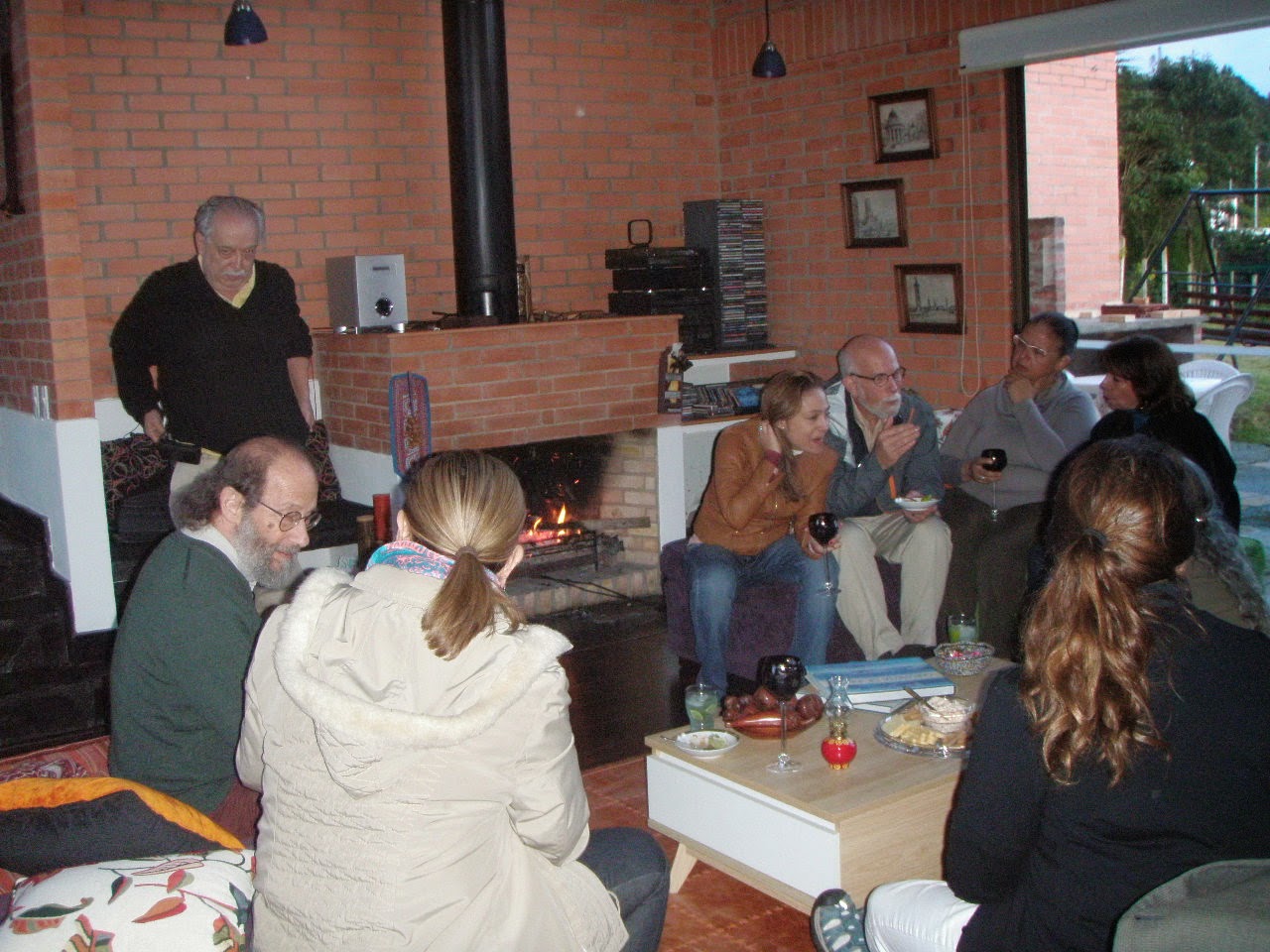
Some of our guests around the fireplace....

I know that Vickie, one of our colleagues has a beautiful voice and sings and dances exceptionally from the rumors I have been hearing for the last three days. I try to see if she may be triggered to sing for us. She starts singing a beautiful Colombian song, which verifies what a beautiful and strong voice she indeed has. The first one is followed with a song from Puerto Rico, a protest song that apparently is sung by the separatist Puerto Ricans. From all the political discussions we have been having with this group during the last three days regarding the difficulties of Colombia, I am aware that these people are progressive, liberal individuals that want the best for all the people not only a minority in their country and in other countries.

Colombia is the country in South America where there is the most variety of fruits: I bought fruits from every stand to try their full spectrum...

This brings memories from my past when we also were demanding the government to provide for the poor and create a more a military and society rather than serving the interests of the rich and a very small minority. Unexpectedly, I start singing a song from my past activist days to this group of wonderful people and explain to them the historical significance of this particular song. I can see what a different level of connection we have arrived at with just two songs. It is the voices, the listening, the tunes, but most importantly the content, which brings a totally different level of communication among people who were bonded only at a professional level up to this moment.

Let the singing begin...

But now, at this moment, we are connected and we have arrived and understanding all one another and a much higher level. The discussions, sharing of memories, singing, exploring some of our past and present over the Internet on cell phones, iPads, bring multiple layers of color and understanding to this communication that has already started. I can sense the younger colleagues are slightly stunned with this aspect of their more senior colleagues that they might be seeing for the first time. It is lovely to see that they are as pleased with what unfolds before their eyes just as we are.

Miguel continues cooking and here is how you crack up a coconut...

Finally, Miguel brings out his exceptional dishes, one made with beef, the other with pork, and the last with chicken all unique stew with a variety of ingredients that I had never tried before. The rice that Catalina had made along with the rice that Miguel made with coco milk as the base, the steamed yucca, and wonderfully prepared sweet plantain are additional dishes that jazz up our dinner table. We all flock around the dinner table and serve ourselves to go back to around the fireplace to savor all the layers of flavor that were brought to this table from Columbia, India, turkey, and America. This global power of friendship and humane connection is going to be, I hope, what will save the world and stop the wars and violence.

Final touches to the menu require intense conversation around the stove...

Thursday, August 14, 2014

COLOMBIA AUGUST 2014 -1- GOLD WAS EVERYTHING ONCE UPON A TIME...


8/1/2014

Finally I am in Bogota. The respectful indigenous looking middle aged man, carrying my name on a piece of paper he is holding up guides me toward the door. I am very disappointed that other than introducing myself, asking him his name and declaring “Encatada”, I can’t either understand, thus, or converse with him in any meaningful way. Luckily, English speaking sweet Natalia comes to our help. Both he and I are relieved! Soon enough, zipping through modern highways, we are downtown at the hotel reserved for the instructors. It has a European urban feel to it, clean, comfortable, the staff amazingly friendly, although with little English. Unless, you plan to stay at one of the historic hotels in the La Candaleria region in Bogota, Bicentenarrio is a very good place to stay, which I will explain why later….


Traditionally dressed youth in front of Museo del Oro

I am excited to discover Bogota all day by myself until meeting my hostess Dr. Cuadros, who is organizing a course at her hospital on child maltreatment and its prevention followed with an international conference in town next week. My first destination is El Museo del Oro, the Gold Museum, which apparently is the jewel of Colombian culture. First, I need to withdraw cash from my bank account. It turns out to be quite a task. The ATM at a Colombian bank doesn't even accept my card. Locals tell me to try the Citibank. Even there, ATMs are monolingual: Only the "English speaking" ATM accepts my card! In my pursuit of cash, I discovered where the Gold Museum is located and I now am proud owner of COP $300,000 (this $ sign before each charge I commit to paying in my future credit card use will make me feel very uncomfortable, since on credit card receipts it does not state COP. I just trust people and hope that I won't have to pay these horrendous numbers in USD!

Most heavily clad a gentleman with gold!
I am finally in the Gold Museum. It is indeed impressive. It shows mostly the history of the rich and the rulers of the communities that lived over a stretch of land covering modern day Colombia, and parts of Ecuador, Venezuela, Panama, and Brazil. The huge amounts of silver, copper, but most specifically gold they invested into the accessories the rich wore to show their power over those that they ruled is unimaginable without seeing it with your very own eyes. Each chieftain wore a golden forehead piece, under which a nose piece connected to a facial mask that extended with two large ear rings. In fact the ear rings specifically were made to be very heavy they were eventually able to fit in circular gold plates in the holes created with the weight of the ear rings themselves. Further, they had wide wrist and ankle bracelets as well as a wide belt below a chest plate, mostly circular, in the shape of the sun or a duplicate of the facial mask depending on the tribe and culture.


Gold, gold, gold....
What is more, they were buried with their golden ornaments, in many cases their facial masks put over the face of the dead, mask over mask. There were spears, clay containers of various sizes, other smaller pieces of jewelry made of gold or other metals, blankets, and other items that might have been used by the common people, too, but after all, most items were all about the rulers and the rich, which led their communities and took the surplus the people produced under their own possession to exert power over the same: Any difference between what was happening thousands of years ago and now? Still, who makes the history, who sets the agenda for societal, political discourse, are the rich and those that have, are they not? In return, they claim the surplus of the societal production and create the monstrosity of living spaces for themselves, lock themselves into gated communities of recreation, invest their surplus into jets, and boats and blood diamonds although they keep telling us people that they are investing into our economies to make us rich as well, which rarely happens... Despite all this debate in my mind, I still must say, it is true that the Gold Museum is a very unique, one of a kind place one needs to see upon landing in Bogota. There is no doubt about that.

Shoe-shiners in one of the plazas in Candeleria
After leaving the Gold Museum, I started strolling through La Candeleria with no goal other than moving toward the east to reach the La Cathedral Primera. I started observing what people meant by stating there were many universities in La Candeleria. They were so right. I came across the first one around the Plaza de Rosario. The plaza was lined with cafes and packed with young people, either the students or visitors or both. A French woman guides me toward The Cathedral. That's when I see that interessting restaurant window: It displays an iron tippie cage against which pieces of meat have been loaded. The flames from the fire within the pyramid is cooking meat slowly but clearly, deliciously. I hop in: Wonderfully juicy, delicious meat platter with patacon (fried green plantain, overrated), fried bananas, delicous.

Colombian style meat grilling: delicious

Once I find my way to the 7th Avenue, I come across something that turns out to be a very interesting Colombian way of processing the past: Two indigenous intellectuals had started an initiative, inviting people to bring in newspaper clips related to the violent episodes in Columbian history and write a paragraph related to that clip. They have extended clotheslines from one tree to the other along a full block alongside the 7th Avenue. I will discover later on that 7th Avenue is a place for the people to do as they please; it is almost a claimed-by-the-people place. 

Street vendor cooking sausage: Didn't dare trying...

These newspaper clips are clipped to the line for passersby to read and remember the violence of the past to prevent it from happening again. I am excited and feel very close to the two gentlemen sitting on a bench responding to the questions of some readers like myself. They tell me the purpose of this initiative is to keep the memory of the past alive. I am also impressed with the number of people stopping by and reading the clips of all ages and walks of life. Again, I wish I had had better command of Spanish to get to all the details of this action. 
Cathedral Primada in the heart of Candeleria on Plaza de Bolivar

After shaking hands and giving each other our best wishes in Spanish, English, and Spanglish as they call it here, I move on toward the Cathedral Primada, which was built in early 1500s. There are two sections to the cathedral, one section is a more prominent building architecturally and the other has a more humble facade. The interior of the latter is also much more humble than the churches I saw in Europe, however, there is such a calming air in it. I must say, I find a kind of peace in every church I walk into and have to remind myself not to forget about what kind of atrocities were conducted through especially the old old church of Christianity, which is really not unique to any one religion, every organized religion has incidents and at times prolonged periods of atrocities, such as inquisition, such as crusades, such as what fundamentalist islam is doing all over the world now, such as Israel's expansive aggressivity in the "holy lands", on and on and on...

Lama in Plaza de Bolivar
But, I would like to put all that aside for some time and meditate when I have found such peace in a big urban setting. I walk to the very front and sit on one of the benches, close my eyes and focus on my breath and observe all the thoughts, emotions, plans, ideas pass by making mental notes of them and letting them go. I practice bringing a visual smile into my mind, which I learned recently from listening to the audiobook titled “Radical Acceptance” by Tara Brach.


One of the delicacies of Colombia: Granadilla fruit

Try it, when you feel tense, just think of a smile in your mind and notice the tension you are in. Once you settle into the warmth and relaxation of that smile, notice what it does to your eyes, especially the outer angles, feel your muscles around your eyes relax, than bring the smile to your mouth and sense the relaxation of your facial muscles, then feel it in your throat, in your chest, in your belly, in your arms, in your legs... I did that all, and when I reached my toes, my tired body, walking for hours now was so relaxed and was so much at peace, I almost wanted to lie down right there and take a nap.

Colors of Colombia are very similar to Guatemala's...

Of course I wouldn't do that out of respect to those around me at least. Instead, I stood up heading outside to go to Museo Botero. On the way out, I saw an invitation to all believers (perhaps church members) to campaign for the evangelization of Colombia. Something turned inside of me, I noticed it, made a mental note of it, but did not allow what I just saw ruin my meditation: I walked out. Oh, fresh air felt good....


Boteros: Satirical of the church, it looks like doesn't it... But all of his figures are like this...

Botero museum is part of a complex that is funded by one of major Colombian banks and it is free to visit! What a treat... Botero is one of the most famous Colombian painters and sculptors. But not only those, he is also a philosopher and a political activist. He made Abu Gharib famous by painting the pictures regarding the tortures that took place there and created a media sensation all over the world with that series. Not only that, he documented with his art all the violence that took place in Colombia, witnessing and testifying to all the pain his countrymen suffered from for centuries and recent decades. Botero calls himself most Colombian of all Colombians despite living in Colombia for only one month a year. I find it interesting but curious as well.

It was lovely to see young Colombians learning about their "uncle" Botero...

Yes, he raises his voice very loud for all that matters to become the voice of his coutnrymen. He has donated a huge amount of his art that creates the basis of living art in many places in Bogota including the Botero museum. But is that enough I wonder. I am not asking the question critically. I am asking because I am a Turkish American living in America and feel as dedicated to my country of origin if not as an originally-Turkish woman, but as a world citizen as Botero perhaps feels he is to Colombia. But I do not live in Turkey, I do not suffer from the pains that those who live there do on a daily basis. They are the ones, who fight against the daily oppression of the fundamentalists ruling the country for the last decade or longer, they are the ones who will have to fight the major fights to be fought when it comes to it. That is why, I wonder if one can leave a land and still feel more of that land than those who stay… I, perhaps need to read more about Botero and learn more about him...

Self portrait: Botero

The museum is stunning: Some of the most striking work of this now-80 year-old master (so they call him in Colombia) is on display. His style is now known as "Boterismo": He depicts people and live or inanimate figures in large, exaggerated volumes (he himself calls his people “fat”). His fame started building a year before I was born in 1958. Although, later on I will discover, his early style was quite different than his most recent signature style. When I bring this observation up my friend Dr. Cuadros will make a firm statement: He was a master even then! If you would like to enjoy his art and the very strong voice that he emits through his art, take a look at a few of his work at: https://www.google.com/search?q=fernando+botero+paintings&rls=com.microsoft:en-us:IE-SearchBox&source=lnms&tbm=isch&sa=X&ei=JIDqU9rZMZGBygSlsIGIDQ&ved=0CAgQ_AUoAQ&biw=853&bih=645

In the evening, my hostess introduces me to a number of colleagues, who have arrived in town from Spain, USA, and other parts of Colombia. We head toward Monserrat sanctuary, the hill top right behind Bogota. A church for pilgrims of 1600s was built modeling after a counterpart in Barcelona, Spain. The hilltop is now known as Monserrat. Bogota was shimmering down below as we visited teh premises of the church with no opportunity to get into the French restaurant adjacent, that had to wait until the next visit.

Bogota shimmering down below from Monserrat

Monday, August 11, 2014

SPAIN JUNE 2014 -8- GOOD BYE TO ANDALUCIA, WOULD DEFINITELY LOVE TO RETURN!

6/20/2014

Our last day in Seville and Spain. We both would like to see Alcazar Palace, which has a very similar history with the Cathedral. The Triana concept is seen everywhere here as well. The Moor king built this palace in 1200s as well with multiple courtyards donned with a variety of plants, ponds, fountains and recreational touches. It is indeed a blend of dwellings of various significance: Some were dedicated to the court or ambassadors to show off the grandeur of the king and his kingdom, some to the king and his family, some to his servants, and some purely to nature from the courtyards to the acres of gardens embracing the old town from the southeast all the way to northeast.


Tile bench from Alcazar

The tiles, the wall plasters with unimaginable intricacies, the courtyards and gardens from the Mamalouk reign, the ceilings, windows, and the paintings from Christian and baroque era have converted the complex to as diverse a place as the town itself with its visitors, inhabitants, and architecture. It is too bad that Jewish history has been truncated from all this richness in the 1500s' unfortunate inquisition just as the Greek history has been from Anatolia. I recall the movie titled "The ghosts of Goya" that I watched just before my trip to Spain regarding the inquisition and French Revolution era: a historical fiction, it was spectacular, highly recommended.


Lilly pond in the king's courtyard at Alcazar

Once the palace and the gardens are covered, I go upstairs to see the ceramic exhibition. It is indeed worth a visit. Starts with simple tiles with, blue, golden, brown, green and white colors. Gradually gets more intricate and delicate including strips of ceramic, bands of tiles, square tiles, ceramic bowls and pitchers of all kinds and sizes... By the way, in all Andalusia, but specifically in Seville, most balconies' undersurface is tile covered, that is, whenever you look up, instead of dirty balcony bottoms, you see beautiful tiles. Make sure you look up when you walk around in Seville if not in all of Andalusia taking care not to fall in a hole.... Shopping time! I don't like to shop extensively in places I visit, however, I do like to take home something that will remind me forever of my visit there, usually something to use. I find wonderful blend of fruit and herbal teas for my friends and family. I buy small ceramic items from olive (zaytuni) bowls to small salt and pepper shakers, spoon rests, and finally abanicos (elegant Spanish fans). My special gift to myself is a blue silk fan with wooden frame (abanicos de Seda), which will be very handy when we watch Shakespeare in the park this summer in Iowa City. I finally find stud earrings with emerald for Zeynep, I know she will be happy since she lost in the robbery of a few days ago similar earrings I had bought for her, which she had liked quite a bit.


The gothic ceilings are reflected upon the waters in the Bano de Marilla de Padia at Alcazar

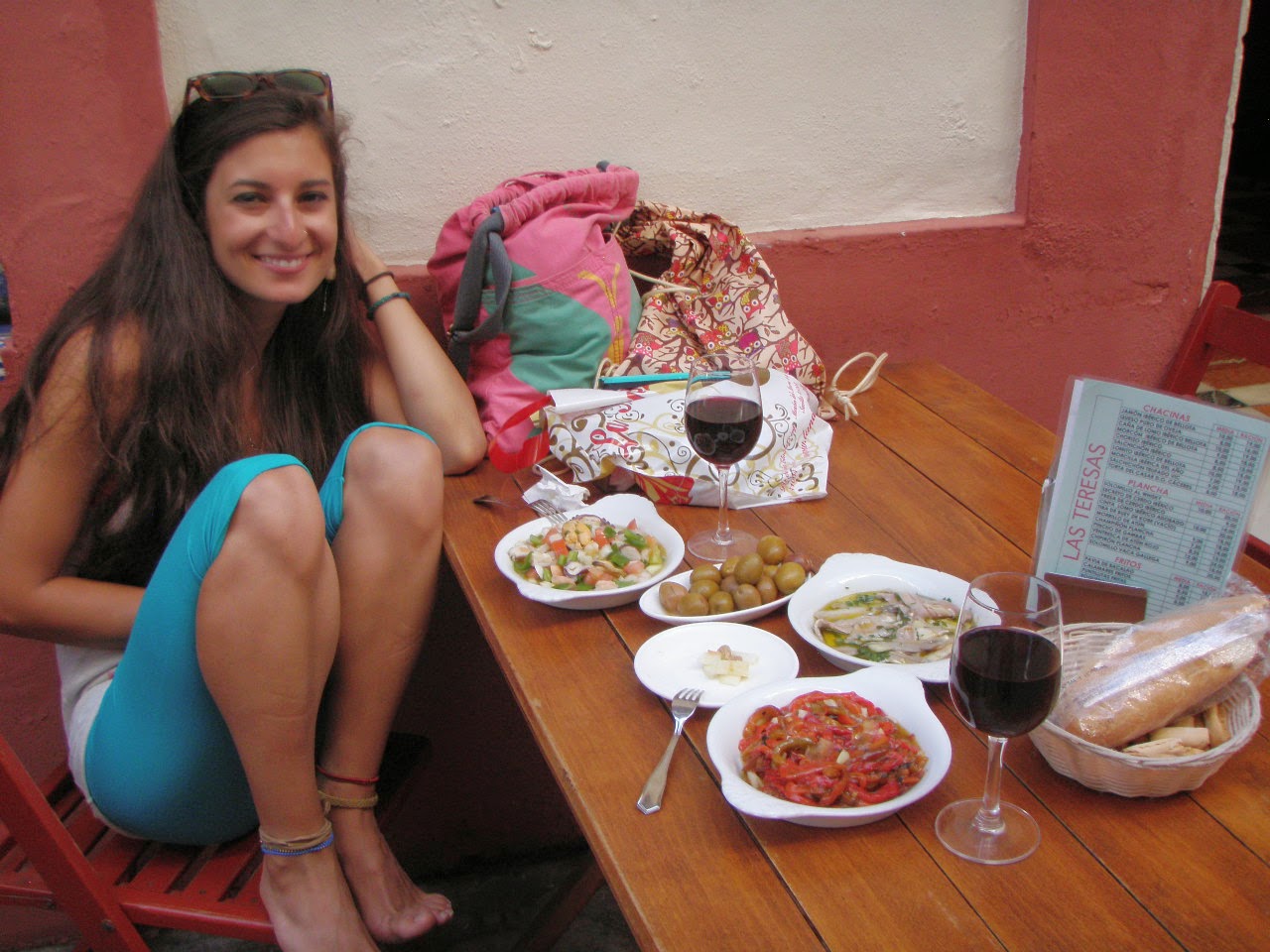
Finally, Zeynep and I have an early dinner at the Cafe de Terresas close to our hotel in the historic district with the best octopus and mussel salad, roasted red pepper salad, and anchovies. Now it is time to go back to the hotel to catch the 9 pm flamenco show now that we couldn't come across an improvisational one. It pays off well. Although the singer's voice is nowhere near our friend Martha, whom we were so fortunate to listen to the other day, the tunes and melodies are touching enough. The dancer, especially the female one is astounding. All in all, this contribution of Roma culture to mankind is one thing we all need to appreciate in such a rich amalgam... We go to bed with extraordinary audiovisual tastes of what we have experienced tonight. Falling asleep is difficult, we had a spectacular week in Andalucia. Although we are both all for going back home, it still requires some energy to detach from a culture so similar to where we come from and let go of it in one breath....  


Our last dinner at Las Terresa consisting of delicious tapas


SPAIN JUNE 2014 -7- WONDERS OF SEVILLE

6/19/2014

Time to head up to Seville after spending four days on Costa del Sol. Zeynep, my daughter has spent 2 days there already in addition to one day in Tarifa and 3 days in Cadiz the week before my arrival. We decide to take the mountain roads, in our pursuit for Seville. In the end, we will be able to say "highly recommended".  The first town again is Ronda, which we already explored during our first visit. We had spotted a restaurant that belonged to a hotel built into the cliff of the gorge to the north of the New Bridge during our first visit, which we had not had enough time to explore. Phenomenal an experience, we will share with each other later. It is too late for breakfast and too early for lunch. All we get is a baguette, olive oil and freshly squeezed orange juice. It will do perfectly. All I care about is the grandeur of the canyon right below us, the expanse of the meadows with their liberating influence on us... Another refreshing experience after the robbery, from which we are still trying to recover...


It is impossible to capture the entire height of the canyon in Ronda

Once we are done with our simple "brunch"  we head north. We pass through Algondales, another pueblo blanca and find a back road to Zahara, which we had wanted to visit during our first trip to the pueblos blancas but had not had enough time. As we meander through the hills on a snake like narrow road that is taking us to Zahara, we see now and then again that it is situated on top of a cliff like an eagle, a white one at that. Its reflection cast over her beautiful namesake lake.


Zahara, last pueblo blanca of our trip from a distance

Once we arrive on the last curve of the road climbing up the hill toward town, we decide to stay there and enjoy the lake, which covers our view panaromically all the way from southwest to northeast. It has an emerald color, pristine, lying ahead of us with no visible ripples, enjoying the soft, caressing touch of the sun through the clouds in the overcast sky. We assess all the towns we visited up on the Mountains of Andalusia: I like Grazalerma the best due to its size, a tiny village with less then a dozen shops and cafes with great charm, where we picked lavender flowers, albeit, they were stolen with our luggage, too. Zahara seems to be a touristic town of moderate size, but worth a visit to experience this beautiful lake vista at least. Ronda is the place with lots of history as well as natural beauty, but deserves a full day to do justice to both.


Lake Zahara stretching below us like an emerald beauty

Having gotten enough of pueblos blancas we are now ready to head to Seville. The drive is pleasant. We arrive in town around 3:30, very good timing and for a change my data roaming is working and GPS is on. The GPS lady is guiding us toward the parking place. However, not only the old town is a maze, but whatever parking there is around and in it is all roadside parking and I already know from my travel book that is not a safe option. Especially, after the luggage robbery, we can't afford to get the rental car stolen! However, by the time, we realize that we probably need to find a closed ramp to park the car safely, we are already in the heart of the old town where data roaming has been cut off and the more we try the more we get sucked into the streets ever growing narrower, some barely 5-6 feet wide.


First glimpse of the Cathedral in Seville

We are miserable in a funny way as if we are in the devine comedy! Finally locals coming across us multiple times in our futile effort to get out when apparently all we do is to circle the same streets, figure out that unless they help us, we will never be able to get out of old town! Zeynep's Spanish comes to help again and with directions from locals, we manage to get out from this claustrophobia and find our way to the cathedral, where there are police officers: A nice policeman tells us, there is no way to find a parking ramp unless we go by the river. Well, that's what we will do then, we don't have any luggage anyway!  Such a liberating experience, for the last two days we have traveled each of us owning only two dresses and 2 pieces of underwear and bras. Each night one set was washed and dried throughout the night and day until the next day when the other set was washed. It worked out just fine! We both bought the smallest backpack we could for our minimal possessions and we are not afraid of a walk of a mile to the hotel.


Alcazar marrying Moorish staco with elegant tile work

We follow the police officer's guidance and in five minutes the car is safely tucked away. In two days we will discover that in fact there is no reason to have a car in Seville unless one plans to drive out of town for other purposes during the stay in town. The parking for two days cost E35, add to this the rental cost, taxi to and from the airport to old town, would have been quite a reasonable option. The old town in Seville reminds me even more of the old town in Antalya, Turkey. Narrow, convoluted streets, breathing just a bit via the tiny plazas (200-300 square feet or so) scattered into the entire old town wherever three to five streets intersect. These tiny plazas are lined with small shops selling abanicos (fans), white dresses, shawls, cards, ceramic goods, olive oil, spices, and teas, among lots of other things. Zeynep finds a store where the gentleman sells hand painted silk abanicos, one of which I would like to take home from Seville. I choose a blue one, my favorite color. We choose additional abanicos for gift as well as ceramic gifts. All the gifts I had bought in Grazalerma unfortunately were stolen, thus, we need this second set of gifts. Let's hope they will make it to the USA!


The grandeur of the main entrance at the Cathedral in Seville

We go to the cathedral before returning to the heart of old town to enjoy the evening delicacies and intricacies. Triana concept thrives here, too. The cathedral was built in 1200s by the Moors as a mosque. Those features still survive in the round domes and smooth curves of the architecture. In 1400s it was taken over by Christians, who added, columns, stained glass with legends from the bible, and finally baroque touch with impressive and colossal wooden carved figures and huge panels... I look at Agia Sophia, which was converted to a mosque in 1500s after the conquest of Istanbul by Ottomans more compassionately now. With a better understanding of layered cultures in one architectural structure. Agia Sophia in Istanbul is also a museum now, in fact exclusively a museum with no islamic religious services, which is contrary to many cathedrals converted from mosques to churches in Europe... 


I can't get over the beauty and creativeness of the use of tiles in this country

When we get hungry, we start looking for a restaurant in this maze. As we are passing along one of the streets very close to our hotel, we notice a man playing guitar and a woman singing flamenco style at one of the tables. We look at each other, no question, this is where we will situate ourselves for some time if not to have dinner at least to have some tapas to savor this what seems to be a totally spontaneous show... The woman has black hair put in a bun in the back, wears traditional flamenco attire for a singer, I will learn later that singers' attire is more subdued compared to dancers in flamenco culture, understandably so. She has a very powerful voice, guttural, with a very wide range, very impressive. The guitarist is almost amazed with her voice and singing. We wonder if they are a couple. Give some time, we will learn it all...


Tiles on display at Alcazar

They are Martha and Richard, yes, married for 25 years. They have been performing for as long. She originally from Colombia, he from Scotland, they met in Canada, where they currently live. They travel the world to perform the way they do tonight. Although, their arranged travels are professional tours, tonight is voluntary, they just liked the place and sat down and started playing and singing. How lucky we are. This spectacular miniconcert reminds me of the Irish pubs that I had visited in Doolin in Western Ireland one time, where, locals and regionals would just stop by for a Guinness or two and all of a sudden, there would be a band, totally spontaneously formed, playing and singing all night long.


One of the narrow streets in the maze that got us circling in the old town...

Zeynep exchanges contact information with Robert and Martha to see if we can get an entity to invite them to Iowa City, who knows, perhaps some day... We seek a place where we may see an improvisational flamenco show to top what we already observed. Alas, none to be found. We resolve, one spontaneous gem a night is more than enough and decide we will see a flamenco show at our hotel the next day. By the time we are done with our full dinner, it is 11:30, already. We smile at ourselves, how easy it is to melt into the fragrant and syrupy juices of life in such interesting and exciting a place considering I would rarely have dinner past 8 pm in Iowa City...

SPAIN JUNE 2014 -6- NEVER TAKE ANYTHING FOR GRANTED: MARBELLA EMBRACES US AFTER ROBBERY

6/18/2014

After the grand robbery of yesterday at a highway oasis, which took away all our belongings except for what was on our persons (luckily that included our passports, money, credit cards and electronics) we canceled our plans to go to Granada and Cordoba. Our energy was so drained and both of us, my daughter and I were so exhausted through the processes of legal claims and the unnecessary shopping we had to go through all day long, we decided there must have been something to learn in all of this. Doesn't Buda say "Don't cling onto anything...". We let it go, it wasn't meant to be. However, it was still disconcerting to learn that such highway robberies were common place in Spain and they were most notorious regarding the outcome. The stolen items were almost never recovered in such robberies: We had figured that one out already since my hat, which was on the car seat next to my luggage was stolen along with the three pieces of luggage:

The sunset we returned to in Marbella after the robbery

That changed the meaning of the robbery altogether to either the robbers had a place to use my hat (to please a lover or girlfriend) or they had a market to sell it. If it is the latter, they would do the same to all the goods in our luggage, except for my diary. I so wish, someone in the group will not help himself/herself and realize how special an item that was for the owner but would serve nobody on their team with no market value. I know it is ridiculous to wish or hope that they may feel for me and send it to my address, which is on the luggage, but I do anyway asking myself will the universe feel the intense desire I have, just about that one piece and put some feelings into the hearts that stole our things? Or should I just resolve with the fact that memories are ours and nobody can steal them just like my friend tells me and I already feel deep in my heart? More learning to do... "Do not cling to anything, knowing to let go is the most important virtue especially when what is at hand is/was pleasurable..."


Sunsets are irresistable in Andalucia...

We decided to return to our hotel in Marbella mid-afternoon yesterday: Puerta de Aduares, owned by a family. Our hostess Doris, a woman from Morocco and her son call the police lost and found office and leave their contact information and learn one more time that highway incidents are hopeless regarding recovery. We are one more time thankful that they are so helpful just as we felt for the lady who had helped me with translation at the police station and the young woman, who had provided Zeynep with sample contact lenses that she had lost in the robbery:

After an exhausting day, we found joy at Bora Bora one more time....

Good people and good deeds always override bad and ominous ones. it all depends on how one looks at things.  We may choose to look at things in negative light and make ourselves miserable by looking at everything skeptically, negatively, and bitterly or choose to recognize that what happened is but one negative experience without persevering. I recall what I had read in one of Pemma Chodren's writings: Pain is inevitable in life, but suffering is optional. In processing all that happened that morning, Zeynep and I, for a while go back and forth for a few hours looking at the circumstances leading up to the robbery. However, by the evening, we are back to our laughing spirits especially after the optician experience. We both understand there is something in all this to learn from: My "greed" to see everything there is to see in one trip, my lack of paying attention to my instinct regarding sensing something unsafe around us, Zeynep, dismissing my instinct regarding safety, and however brief getting lost in this virtual world of internet that absorbs us more and more each year...

Tiles are everywhere in Andalucia, elegantly climbing up multiple stories along staircases....

We are back in Marbella making a 180 degrees turn in our direction both physically and metaphorically. We still need some relaxation time and we will spend that time by going to the beach today and the next couple of days. We will become beach bums all day today. It feels good. We indeed spend our day in San Pedro, the little not so touristy town between Marbella and Ronda. It turns out to be a fantastic day.  Light breeze under the overcast sky protect us from sunburn along with the umbrella the restaurant has on the beach. We first have a lovely breakfast at a hotel's beach cafe then move to this restaurant called Macaao Beach Cafe, clearly with a theme from North Africa. Most servers are of African origin, too.

Elegance of carnation out of white washed metal can: Extraordinary out of simplicity...

In the afternoon, an interesting encounter occurs: I am walking along the beach allowing the Mediterranean play with my feet. With each thrust of the sea my feet sink into the pebbly sand. With each retreat, my feet are again grounded in the sand that has let go of the juice of the sea... It is a lovely sensation that brings many sweet memories from the Aegean, along which I grew up. As I turn around to go back to our "homestead", I see a young man fishing on the beach and pulling something relatively heavy out of the sea with his fishing pole.  As he pulls the  line out of the water I am terribly excited: My it is a "cupura" as we call it in Turkey!

Sense of freedom in the distances beyond chicken wire fence...

I know they call it dorado in Spain! He is excited and he has all the right to be since this is at least a 2 pounder, pretty big for cupura, it could very easily, feed three people. We start chatting, then I see he has another fish in his bucket, a bigger one, a 3 pounder, he calls it Sarcoz or something like that, a fish that I don't know. His name is Emanuel. I ask emanuel whether he fishes for his family (he has a wedding band on his finger) or to sell. He says "depende" giving me the green light "if you'd like, I can sell it to you". He is asking for E20 for either fish. I get excited more but we can't cook it at the hotel, too much fuss! Can he cook it for us? He can, but, at his "casa", no way, we can't go to the house of a stranger, had we had a man with us, perhaps, but not two women, by ourselves.


I ask two restaurants whether they would cook the fish for us, unfortunately, they won't. Understandable, they already have fish in their fridges, why would they do that? It is time to let go of this hope and potential excitement. I catch myself still debating "Shall I go to Bora Bora (the restaurant we ate at twice already) and ask them as well?" Too much trouble my inner voice says and I let it go and I am at peace with it. I wave at Emanuel, who is looking at my direction and tell him with my hand gesture "It is off, sorry", he gets it. In a few minutes, as he walks by us to go to his car, we smile at each other. I bet it would have been a lovely experience to get to know his family, but unfortunately, we all experience enough negativity in this world, we learn not to trust strangers especially in a foreign land... My inner voice tells me one more time just as Zeynep would tell me "Clinging to things can be as harmful as resisting pain." I let it go in peace...

Paraphernalia from Bora Bora, our favorite restaurant on Costa del Sol

When we go to Bora Bora for our last dinner at Costa del Sol, we wave at Shofik right away. His face is all a smile, he recognizes us and seems like he is as happy to see us as we are to see him. He seats us at our number seven again as it has become our table at Bora Bora! He brings the outdoors heater as close to us as he can, too, knowing how cold we were the other night, although we don't need it as badly tonight, sweet. Shofik is clearly more friendly tonight. He tells us he has been living in Spain for the last ten years and is from Bangladesh originally. We also introduce ourselves to him. He figures out from our names we come from a Muslim country. He actually has been to Turkey, too. He tells us he has a young child. We order two tapas and a main dish as has become our usual in Andalusia. Another pleasant night on Marbella beach. We are happy to close our Costa del Sol adventure at Bora Bora somewhat having developed a belonging to this place.

Beach at sunset in front of Bora Bora restaurant