Monday, August 13, 2018

LIMA - PERU 2018 - 1 - GETTING USED TO LIMA, SOME CULTURE SHOCK...

My second visit to Peru: Last May, I had just flown through Lima to Cusco for a marvelous 6 day trip in the Andeans with Machu Picchu being the unforgettable destination. I knew I had to come back to Peru for at least a few days to dedicate to Lima. I hope I can come back to Machu Picchu with friends, whom I know will enjoy the challenge and beauty before it gets closed to visitors, as rumors have it... Little do I know what another unforgettable trip this will be making me fall in love with Peru, more so Lima.

From unforgettable Machu Picchu in 2017

I am staying at an AirB&B apartment, the location of which I will appreciate much better as the days go on. It is on the 20th floor of a middle class neighborhood apartment building, which is inhabited mostly by young professionals, looking at the people that I will need to share the elevators with over the next five days I will spend in Lima. I will also learn soon that just as in Bogota, in Lima also, the temperature is pretty much stable around 60-70s. As a result, it neither justifies heating or cooling in the homes! But it is also very humid even in this arid part of Pacific Ocean. Hence, I will have to wear all that I brought in five-six layers to keep warm and on day 2 eventually, my hostess will provide me with a dawn comforter and a space heater to be comfortable in the house!
 
Looking at Lima from the highest point of Barranco, the southernmost part of Lima proper, it is mostly hazy like this...

As soon as I enter the apartment, I check the view after discovering that I am on the top floor of this high rise! The living room looks to the south, thus, all the way to Miraflores is before me in bright city lights. The kitchen balcony is to the north, thus, the lights in that direction must point to the city center. It is interesting, in my travel book, there is no old town description, because, apparently, before the government recognized the touristic importance of the “old town” concept, capitalism had already risen its high rises through all veins of the city suffocating most of the old colonial architecture let alone old old Wari structures. I am still looking forward to going to The Plaza where the Cathedral will be along with other worth-to-visit structures.
 
Looking at the Government Palace from the Cathedral at The Plaza

Bad news about the apartment is there is no hot water. I start my expedition through the hosue and discover that there is a mini water tank above the sink in the kitchen balcony, which has been turned into the laundry. The tank seems to barely hold 5-6 gallons of water. I notice a red handle on the pipe extending between the sink faucet and the tank, which is perpendicular to the pipe. I turn it to parallel the pipe assuming that is when it will allow water to go into the tank, which should allow water from the tank to arrive at the shower head. I know this type of old electric water heaters from Turkey. I check the switch, its handle is down displaying the green above the handle. That must be on. Yet something is wrong, since, although now there is water in the shower, it is cold! I try to have a positive attitude, cold water refreshes the body…
 
THE Cathedral in the Plaza de Arma

Cold shower, relatively cold and damp apartment, and relatively light bed covers are not conducive to good sleep, I discover. I put on socks, a clean pair of tights under my sleep wear and finally drift into sleep. Of course the first thing I do when I wake up is to text my hostess, she is not necessarily quick to respond. At least I learn that the electric switch has to be pushed up to show red, not very intuitive, but I do as I am told. However, half an hour later, there is still no hot water. After a second cold shower, I realize I have to be a bit more demanding. It helps, the next day, I have a space heater, a down comforter, and I learn that it takes hours to heat the water in the tank. After a good hot shower on the third night and sleeping like a baby under warm comforter, I can be much more thankful for all, my hostess has done for me!

First time scene in any big city I have visited: City workers are washing the fences of a park with detergents!

Despite the cold shower of the previous night, I wake up energized and enthusiastically curious on my first morning in Lima. I know that the city center is in walkable distance from where I am. Avenida Arequipa is a north-south bound throughway, I will discover in the coming days carrying working class people to and from the city center, from where they disperse to their neighborhoods after having worked in the touristic businesses of Miraflores… The park with Magic Waterworks borders Arequipa. To my surprise, a team of city workers are washing the green metal fence with detergent at the early hours of the day. I wish I had had good enough command of Spanish to be able to talk to them to understand why that is…
My server Carol at Mango Café happily poses for me in front of the delicious fruits some of which goes into my delicious juga de fruta for my breakfast overture...

I walk eastward before entering the park. It is beautifully trimmed, the locked up part must be where the magic waterworks must be. When I get out of the park, I see a café named Mango Café and stop to have breakfast. A huge glass of fruit juice is my first breakfast in Lima since none of the sandwiches appeals to me. Nothing could be better than the “juga de frutas” that I am already in love with in both Colombia and Peru…

Peru and Lima specifically make well use of gastronomy tourism

As I walk up on Avenida Arequipa, I come across a fenced in area, clearly being prepared for some festive activity, which turns out to be a gastronomia fair. There is a gentleman standing before the gate that is locked, trying to get the attention of men, who appear to be guards. He informs me that the fair will be starting in about half an hour and people will fill the fair ground soon and music will be playing all day long. His name is Elver and I will learn later that he happens to be one of the servers/cooks at one of the booths inside.


I will soon have a delicious slice of this pork belly in a sandwich already grilling in semi-vertical grills

However, the guards will not allow us get in, they want us to walk around the block to get in. Then comes in the force of nature a woman, probably my age, although her hair is as black as it gets. The woman’s fiery argument with the guard melts away his resistance and soon the gate is being unlocked and in a minute all three of us are in! By now I have understood, Elver and the woman are workers at this fair, but Elver is kind enough to invite me in as if I am a worker, too!
Colonial remnant architectural structures like this are scattered all around Lima: most used for public services...

All the vendors are just setting shop, but one of them is earlier than the rest.  This gives me the chance to get a brunch sandwich, which is called chicharron consisting of fried pork belly or fried pork rinds, no wonder it was so “delicioso”. I savor the roasted sweet potato that comes along with it. First time in my life I am eating pork and sweet potato for breakfast!  I will learn in the days to come that they make chicharron out of any meat and poultry…
One of the most impressive pieces from MALI

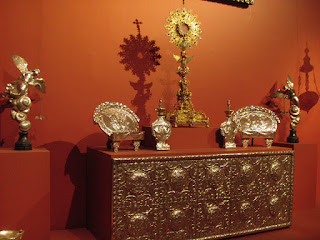
Before I leave the park, I come across the Museo de Arte de Lima (MALI), art museum. One of the museums I was planning to visit. It is a pleasant surprise that this weekend is independence-day celebrations weekend for Peru and state run museums are free! In addition to numerous pieces laying out the Inca and Colonial history, there are pices, celebrating the diversity in Peru from urban life to rural, from European ancestry to indigenous cultures. They have dedicated an entire section for the silver heritage of the Andeans, specifically.  Interesting piece of information I learned at this museum is that, for the Incas, gold and silver were equally precious metals. Hence, the Plata del Los Andes exhibition is a rival to the Gold Museum I had seen in Bogota.As I leave the museum and walk toward the exit of the park, I come across what looks like multiple bulletin boards put up side by side. They are full of announcements related to art classes for various age groups anywhere from elementary school ages all the way to adults. Que Bueno!

From the Plata de Los Andes exhibition at MALI
 
I gradually walk my way up to the city center, the closer I get the more I come across surprising, hidden samples of Colonial architecture rising humbly but confidently among the high rises almost resting peacefully in their shade. At some point, I come across a bus station very similar to that I had seen in Bogota just a few days ago. The Metropolitano bus system and Tren Electrico are more akin to a subway system above the ground, which works very effectively in Bogota, and here, too, it seems. Although, all travel books will tell you the rest of the big buses, midi-buses, and mini-buses make up a chaotic public transportation system that foreign visitors cannot fathom, my experience will prove otherwise, stay tuned.
 
The words across the side of this bus indicate its route is between Chorillos and San German, and it travels on Avenidas Arequipa and Bolivar. It is very easy to conquer the bus system in Lima...

Finally, there comes a point, car traffic is blocked around the blocks leading to The Plaza Mayor or Plaza de Armas, which is reported to be the birthplace of the city of Lima. It is not as warm as that of its twin in Cusco, which I visited last year, but surrounded by the Government Palace, Cathedral of Lima, Archbishop's Palace of Lima, the Municipal Palace, and the Palace of the Union, it has both significant grandeur and some charm to it.


Limenos checking what art classes may be available for them in front of MALI

Since it is almost 2 pm and Peruvians usually take a long mid-day break, I find the Cathedral doors closed. In front of the cathedral is a local, who is trying to sell a tour to me to other parts of the city center including a tower. My apartment, very close to downtown and on the 20th floor of a high rise gives me more than what I need, and I decide exploring the city center on foot in and around the Plaza is a better way of spending my time until 3 pm, when the cathedral will open. As I visit several colonial houses, most of which are now housing a variety of museums, I inch my way toward Chinatown to find Wa Lok for lunch.
 
One of the Colonial structures from The Plaza: The brown balcony covers are very similar to the covered bay windows of the Ottoman era, which were used for women to look out without being seen by outsiders!

One of the characteristics of Peruvian cuisine is Chinese influence, or rather Peruvian influence on Chinese cuisine that has created what is called Chifa. Chifa is a fusion of Peruvian and Chinese cuisines, brought to Peru by East Asian immigrants from late 19th to early 20th centuries. These Chinese immigrants that arrived in Peru in 1849 initially worked in coastal sugar plantations and mines and rail road constructions. They integrated South American ingredients such as pineapple and aji amarillo, a paste made from Peruvian yellow chili peppers to their Chinese dishes and volla, chifa was born, which can be found all over the city.
 
From Convento de Santo Domingo de Lima

Wa Lok is a huge restaurant with an army of servers running all around like worker bees. I order dumplings and… They are delicious and the sauces are to die for. When I return, not only the cathedral is open, but there is a mass that has just started. I walk to the front quietly and take a seat to observe the believers. Although, I am not religious a person, I always enjoy observing people in their humble submission to a higher power. If only that power could make their life conditions better, too. Who knows, maybe it changes their reality to such an extent, what seems to be suffering to me is not so much so for a believer; who knows where the truth is…

My light lunch dish at Wa Lok in Chinatown, delicious dumplings and sauces with Peruvian ingredients
The rest of the afternoon, I visit the modern art museum, Inca museum, Afro-Peruvean museum, Museum of Arica War, which apparently is very important in Peru's history, Convent of Santiago where the bones of many dignitary from Inca era was buried and are on display, where I also learn about the details of all ethnicities that one may encounter in Peru, Santa Maria Monastery as well as colonial homes open to visitation such as Casa O'Higgins and Casa Osambela. When it starts getting dark, I find a café just south of the Plaza, where I have my first pisco sour, which is Peruvian national drink, very similar to margarita in taste, along with yucca rolls to close my gastronomic exploration for the day. Ceviche is tomorrow. At the end of the day, my fitbit says I walked 12 miles, my back, knees and feet verify that it is true! I deserve a good rest and sleep.

Pisco Sour, Peruvian national drink and yucca rolls, the latter pretty filling, taste is mediocre..

I close my day by listening to Tara Brach’s talk on "Present Heart: The Universal Expression of Love". She talks about how even the roughest person we encounter has a gold heart deep within. The only reason, their soft core is hidden so deep is because of the amount of pain they have experienced in life. They have built that crust protect that soft core from further pain and suffering. I question myself, how many times I missed seeing that soft core, or even if I had, because of the need to protect my own soft core, how many times I might not have given them a smile, a hug, a word of trust and kindness that they might have desperately needed...

As a gregarious Mediterranean woman, I am learning from wiser friends and Rumi not to trust words that much...

I am thankful to Tara, who reminds me of Rumi's  “Your task is not to seek for love, but merely to seek and find all the barriers within yourself that you have built against it.” As Tara invites us to meditation to look deep within and "Ask yourself, 'what is it, what are the habitual ways of thinking that blocks me from feeling deep love for those that are important for me?' Are you afraid, are you defensive, do you have a need to control others, without judgment, just recognize what the barrier is between you and love..." As I have felt freed so many times from all the above, in the last several years, her words hit in me a central cord, tears are rolling down my face, cleansing-ly...

How ethnic mixing has been occurring in South America

Bones of dignitary at the Convent of Santa Domingo
 
Chinatown
 
Casa Osambela
 
Casa Osambela


Saturday, August 4, 2018

COLOMBIA 2018 - 4 - COLOMBIA THE LAND OF SMART AND HUMANE PEOPLE

Today is the second day of the conference organized by AFECTO, the major child abuse prevention NGO in Colombia. This conference has been going on for over two decades at the end of July every year. At the conference I meet beautiful new people in addition to those that I already know.

Some of the opening panel members from the conference

Ron Slaby, who is a well-rounded researcher from Harvard University also works on violence prevention, specifically in the school districts all over the USA. One of the school districts in their project is Maquoketa, Iowa! He has a daughter, who is a SW and specializes on trauma informed care! His wife and he also are very active politically to help America take Trump’s robbers clan off the backs of American people. They, as a whole family are people after my own heart. When I disclose this to him, he smiles gracefully and tells me he agrees that we have lots in common.

Ronald Slaby lecturing on bullying and its effects

CJ Mody is a prosecutor from San Diego, who is extremely competent on how child abuse cases should be prosecuted. At our first breakfast at the hotel, he tells me he comes from Zoroastrian background. His family immigrated to the US from India, however, their roots are from Iran, where Zoroastrians were a relatively big group, and still is there. However, since Zoroastrians are mandated to marry other Zoroastrians, their number is dwindling down just like in CJ’s family. He is married to a Hungarian woman and their daughter cannot be a Zoroastrian even if she wanted to.
 
CJ Mody during his lecture on how to prosecute perpetrators of child abuse 

I do a bit of internet search after I come back home. It becomes visible in human recorded history in 5th century BC. It was the state religion of Iran territory before Islam took root and dominance there for about a millennium. Islam suppressed it from 7th century AC and currently there are about 190,000 Zoroastrians, most living in India and in Iran. Zoroastrians preach “Good Thoughts, Good Words, Good Deeds”; they preach “There is only one path and that is the path of Truth” and “Do the right thing because it is the right thing to do, and then all beneficial rewards will come to you also”. Very consistent with Buddhist philosophy! Interestingly enough, Buddhism also entered the center stage of human history around 5th century BC. I wonder if Christ had ever heard about Buddhist philosophy as he was coming of age.

Walter Lambert during the pizza party at our host Miguel Barrios' house with Miguel and Catalina's older sons 

Walter Lambert is a Child abuse pediatrician in his 60s, whose family is originally from Cuba.  He has all the characteristics of a Latino man, long hair, long beard, a devout Christian and dedicated to prevention of child abuse both in Miami where he practices and in Colombia, to which country he has been coming for decades to do training on child abuse. His fluency in Spanish certainly makes him an exceptional resource for AFECTO.
Loyd in the center of the panel leaning over most likely organizing something for the next activity!
 
Loyd, Walter’s cousin is also of Cuban descent and as warm a personality as Walter. Both of them have more Latino, boiling blood than American, for sure. Both in their way of taking initiative to solve problems, their generosity, their warmth, and making sure everybody is included in all activities. I become aware of where we will have dinner and what time we are meeting where to be shuttled, from either one of them. On my last day in Bogota, during lunch break, a group of Colombian colleagues and our Cuban cousins decide to go to a restaurant named “Madre” (mother) near the emerald district. They invite me enthusiastically and I go. I order a delicious salad, but I decide “Next time I come to Bogota, I am having one of those brick oven baked authentic pizzas”.

Madre, an authentic brick oven pizza place in old town in Bogota 

Frank and Jean are two peace warriors working on an educational program in numerous school districts in America to teach our children peaceful conflict resolution methods without pointing fingers at anyone, even domestic violence perpetrators. They collaborate with Ron in obtaining the tools to teach school districts to us. They teach at the conference, how they just help everybody understand how victims feel when they are treated violently. They give examples of how even students with violent tendencies learn from this technique and develop an understanding toward the consequences of violent behaviors that lead to change without blaming. That is also a Buddhist conflict resolution method: “Change can happen only after compassionate acceptance of what is…”
 
This is how I approach change nowadays rather than forcing it...
 
Carlos, a Colombian pediatrician from Cali; Alvaroz, an emeritus pediatrician from Medellin, Vicki, who took the banner from Alvaroz from Medellin are other warm, caring, competent colleagues, who do their best to change the trajectory of the child protection field in Colombia. The farewell dinner is at a restaurant owned and run by a friend of Isabel’s. It is a lovely old home full of all kinds of nick nacks. We are served a soup called sancocho made with yuca, plantain, and chicken seasoned with lots of cilantro and other herbs and spices. It becomes my second most favorite soup in Colmbia, the other being ajiaco, which is a potato chicken soup, as delicious as this one.
The group at Madre with Vicki who always has the biggest smile and Jean and Frank at the top of the table along with Walter and other colleagues
 
On the way to the restaurant I tell Alvaro, who is with me in the taxi that I could easily move to Colombia. I ask him which city would be the best. Of course his choice for me is Medellin, first of all it is easier to live in Medellin with its 3M population considering Bogota’s 8M. It is also warmer than Bogota. Walter votes for Bogota. Lyod rejects my idea of having a car in Colombia when taxis are so cheap. Alvaroz announces my “plan” to all Colombians during the dinner. I announce back to make a decision, first I need to visit each major city in the country. That is a plan…

Alvaroz to the left in the front and Julios, Isabel's husband, another engine of AFECTO, to the right at one of our collective dinners 

I feel at home with these people with their kindness, their hospitality, their generosity, and their friendship. As Isa and I discuss plans on how to bring child abuse management skills to the front line providers, I am excited to come back to this country. I know that they will do well, with such level of passion in doing good work, nobody can fail… On my way to Lima tomorrow, I will meet a young man on the plane. Mauricio, a law student in his last year is on his way to Argentina to work on a human-rights related project on a 5-month scholarship.

A colorful street from old town in Bogota

Despite coming from a family of engineers, after studying engineering following his father’s and brother’s footsteps he left the field, went to law school, and now is on the way to dedicating his life to human rights field. He will, one more time trigger hope in my heart and I leave him with the thoughts that the future belongs to the young generation. Men of Mauricio’s caliber will move the wheel of history forward to a better future for all including us, aging generation.  As I leave Bogota, I leave more of me behind with those Colombian friends and down-to-earth colleagues that I connected with. We all hope our collaboration will continue and I hope next time I return to Colambia, I will be able to see its Amazonian region... And Isabel is on board with that plan! Hasta luego, companiaros!!!
As I stroll through the streets of old town, I come across a small shop making only guitars from scratch!!
                          Street art in Bogota is a pleasant surprise around any corner

                              An old town square bringing together mostly young visitors

                       Beatifully preserved example of a house with Spanish/Moorish architecture

Wednesday, August 1, 2018

COLOMBIA 2018 - 2 - KIND FRIENDS IN BOGOTA ON MY FIRST DAY

AFECTO is a relentless NGO fighting against child abuse and organizing annual conferences in Colombia to improve professional and public awareness for decades

I arrived in Bogota last night close to midnight. Jairos a dear friend, one of the staff at AFECTO, the child abuse prevention organization in Bogota, with whom I can communicate only in Spanish is waiting for me. But he has situated himself so close to the exit, had he not unsurely call my name, I could have easily missed him! He must have planned to make sure he would be able to see me the moment I stepped out of the exit door, what a kind heart and such hospitality... He is already on the phone with Isabel, my hostess, the director of AFECTO and a renowned psychiatrist in Colombia, letting her know I have arrived. I am so happy to see him, I am already giving him a big hug, Turkish style... My Spanish is a bit rusty not having used it for almost a year, so very little intelligible conversation in the car. I don’t understand most of what he says, I am unable to form my sentences…

Jairo, a purely gentle man and gentleman among AFECTO staff

Very frustrating, but it will get better, I know, and it does. On the way back to the airport in 4-5 days, Jairo, Fernando, another AFECTO staff and I will have a phenomenal conversation with some great laughs, of course with some use of my little Spanish travel book.  After going to bed in the wee hours of the morning, I wake up around 9:00 this morning. Good thing, the breakfast at the hotel is until 10:30 on Sundays. I bump into my now dear friend Walter Lambert, a child abuse pediatrician like I, who is a Cuban American by descent, born in the US. He and I had taken a long walk at one of the major urban parks in Bogota a few years back and had had unforgettable conversations. He delivers me the plan for our Sunday: Fernando from AFECTO will drive us and perhaps other speakers from the conference to Miguel Barrios’ house in La Calera which is a suburb of Bogota up on the mountains to the north.

Fernando in pink and Miguel our host carrying pizza ingredients to the patio 

Miguel and his lovely wife Catalina have also become my close friends in Bogota in the last several years. Miguel is also a pediatrician, who is an attending at Meseri Cordia Hospital in Bogota affiliated with the National University. On the side, he not only runs the child abuse program at the same hospital, but also moonlights for a neonatal intensive care unit at another hospital. He writes books, publishes papers, and engages international partners like I on his research projects. There is no getting away from many projects Miguel always has going, which I am honored to be a part of. Catalina manages her big family of four boys including Miguel as I joke lovingly as well as a day care center that is on their property that they rent out. She might be a personal secretary to Miguel’s academic projects, too!
 
Dear Miguel, the most gracious host and always a loving, caring friend

Both are as loving and caring as one may get in Colombia or on earth. On the way to their house, I am thoroughly enjoying the mountain roads meandering to the higher elevations. What is interesting is that, there are hundreds of bikers and some runners on the road, going uphill along with a heavy traffic of cars. I know, from my previous visits that Sundays are outdoors time for Bogota residents. The city even closes off some of the across-town highways to dedicate to bikers, runners and joggers on Sundays.

Catalina and her youngest son Solomon sitting on the steps in their elegant home  

However, I didn’t know that most of its population also went out of town in all directions over the weekends, biking, hiking, or running with their families. Fernando tells us that at this north exit for Bogota, they climb all the way up to what is called El Patio that is The Patio since this is the crest of the first range of mountains to the north of Bogota. Thus, El Patio becomes a meeting spot for families just like certain towns during our Iowa RagBrai gets flooded with bikers at the end of each day of biking.

El Patio flooded with bikers for food and beverages, a typical Sunday family picnic for people living in Bogota! 

The area is full of shops, cafes, restaurants, and street vendors, who are all equipped with all the needs of their fellow residents, who climbed up to El Patio to have their lunch in groups of friends or with their families. It is akin to a festival that we often have throughout the summer in Iowa City. Except that this happens in Bogota every single Sunday! On the way back, late afternoon, we will see that they had had their picnics and gone back home, most likely refreshed and happy!
 
Catalina chatting with Walter as she is firing the brick oven for our pizza party

When we finally get to La Calera, we just cannot figure out how to find his house. Eventually, Miguel comes down in his car and leads us to his place, which is a resort place throughout the year. It is at least on an acre, a brick home very elegantly decorated, I will be pleasantly surprised that they had brought four kilim pillows and a very fine lamp from their recent trip to Istanbul, Turkey. They have a day care center built in front of their house on the lower terrace, which is being rented out to a team that runs it. They do have a patio on the west side of the property with an outdoors brick oven! Catalina is working on starting a big fire in the oven, when they announce that our lunch menu is going to be brick oven pizza. I am all for it since I know what exceptional chefs both Miguel and Catalina are.
 
The view of La Calera, where Miguel and Catalina live from the hillside

Miguel has already made the dough from scratch, prepared all the toppings in bowls. The oven needs to get very hot first and Catalina is already attending to it. In the meantime, Walter and I are curious if we could climb up the hill behind their home. Miguel is in, Catalina chooses to stay in to tend to the oven. I am comforted only after I learn that Catalina doesn’t care much about outdoors activities anyway. I have a blast moving away from the neighborhood as we gradually climb up the paved road then leaving the road altogether and climbing up the hill. With every dozen feet of elevation, the valley opens up before our eyes like a book. Such privilege to be living surrounded with such beauty day in day out…

Spider plants growing on tree bark on our expedition to the hillside 

After about an hour of energizing hiking, we decide to go back feeling, we will now deserve our delicious-to-become pizza. Miguel and I roll out our pizza, first by using a rolling pin, then and mostly with our finger tips. They need to be baked in the oven for a bit before putting on the toppings, maybe that is what I have been doing wrong all along. My pizza crust never turns out the way Miguel’s will. Live and learn! Walter, being a vegan, needs a pizza with no cheese on it, I need one with only olive oil as the base. All three boys have individual orders, too. Good thing, we have enough dough and toppings to make everybody happy. In the end, here is the verdict: This is the best pizza of all times for me. Miguel my friend, if you move to the USA, your pizza shop will make a lot of money!
One of the pizzas Miguel made for the family
 
Miguel drives us back to the hotel late afternoon since I have to take a nap before the evening dinner Isabel and Julio, her husband have arranged for all the speakers. Apparently, since most restaurants are closed on Sunday, we have to travel a long long distance to get to a French restaurant. I am still so full with Miguel’s delicious pizza, I can only eat a light soup, which is delicious. First day in Bogota is one of a reunion with old friends and getting introduced to those who will become new friends in the next few days.
Miguel and Walter, both child abuse pediatricians, one from Bogota, the other from Miami

In the mean time, I am gathering information on how to get to the Salt Cathedral in Zipaquira. Isabel of course insists that I take a tour that the hotel may arrange for me. She is one that is all about safety and wouldn’t’ even hear about any shade of adventure. Before going to bed, I gather some information from the night receptionist that there is indeed a way to get to Zipaquira by public transportation, but the details are not very clear. Yet, even this bit of information gives me hope that I can get off the beaten path and get on a bus with mainstream people, get to know some of them hopefully, and learn Colombia and its people a bit better from within… I am content as I go to bed and dissolve in the arms of a delicious sleep.

Miguel and I making the pizza crusts to feed a team of 7 in La Calera
Miguel and Catalina's family except for Solomon, who is still sleeping with Walter Lambert

Beautiful lamp Miguel and Catalina purchased in Istanbul during their recent trip to Turkey

                         And the pillows, woven in kilim style again from Turkey at Miguel


COLOMBIA 2018 - 3 - TWO "ABLA"S ON THE WAY TO SALT CATHEDRAL IN ZIPAQUIRA VIA PUBLIC TRANSPORTATION

Before I go to the breakfast lounge at the hotel, I stop at the reception desk to obtain more information on how to get to Zipaquira to visit the Salt Cathedral near Bogota. Lucky day for me, since a bright young woman at the desk, understands what I need. She doesn’t push for the organized tour or taxi, instead quickly understands that I want to connect with her real people. She gives me step by step information on how to get there by public transportation.

First impressive church from Zipaquira where Salt Cathedral draws scores of visitors 

Once, I have all the information I need, I can peacefully have another wonderful breakfast with two eggs, sunny side up “huevos de blanco”, savory bread, fruit, and fruit juice. Fruits and fruit juices in Bogota are to die for and I savor as much of them as possible. I recall, when my Colombian friends including Isabelle and Miguel had come to Iowa City for a conference I had organized, especially the young physicians in the group were horrified with the price of a small fresh squeezed orange juice at the hotel. In Bogota, fresh squeezed juga de fruta is not only all over the place but also cheaper than dirt!
 
Fruit juice carts are all over Bogota a bag of it may be as low as $1

The opening ceremony is delightful. Isabel brought together all key players of the country, who either do significant work on child abuse, or who must be doing so and are hoped to be encouraged to take more actions by attending this panel! Good plan, I can read Isabel’s mind sometimes… Some of the governmental representatives certainly give a brief spiel about all the good things they are doing by listing a series of numbers. Whom I appreciate the most is the president of the pediatric association, who tells the audience “Yes, we are doing good things for children in Colombia, but not enough! Children are still dying because of child abuse…” and starts telling us cases that have recently died in Colombia due to abuse. That is true leadership…

Half of the table at which the opening ceremony panelists were sitting, the woman in white jacket is the force of nature, Isabel 

What is most impressive about the opening ceremony is that the art component consists of a mini chamber music concert with a pianist and a tenor singing arias…There is a reason why I am in love with Colombia. I haven’t seen any conference that I have attended in my 30 plus years of academic career that started with classical music as the keynote art piece. That is Colombia for you. If you like intellectual endeavors, arts, and culture, come to Bogota! At some point, I tell Isabel about my plan for Zipaquira. She orders me “Don’t talk to anybody on the buses”, I don’t know why… She probably thinks, because I don’t know the subtle cultural ques in the country yet, I might miss warning signs of danger. She has a warm and caring heart, too. I promise to her, I won’t…
 
Transmilenio bus system and their designated stations and roads

The first step of my travel starts right across from the BH Bicentenarium Hotel, where there is a Transmilenio bus stop. I will take the bus B74, which will take me to and from Portal de Nord (North Bus Terminal).  In order to do that I will have to buy a 3000 COP worth a card, load 5000 COP on it for a round trip. Then I will catch a Flota Zipa Bus to Zipaquira, which will cost me 5400 COP one way. Then I will take a mini bus to the cathedral in Zipaquira. Instead I will choose to walk the steep 1 mile distance, which will open up my lungs to the crisp air of this lovely town.
 
As I start climbing up the steps of the Salt Cathedral Park, the city is already down below

Transmilenio is a phenomenal innovation, which in fact is an over-the-ground subway system with a dedicated lane on all roads for these buses. The following week, I will see a similar system, albeit much more sparse routes than I will see in Bogota. The only slowing factor is the intersection stop lights. Otherwise, the traffic doesn’t affect the speed of travel. My Colombian friends will tell me, the city had to tear up all the roads to remake them to accommodate the Transmilenio system. I applaud their innovation and am glad to hear that other countries have started modeling after this system in Bogota. However, one must pay attention to what stop they got on the bus for a return trip. I will fail to do so and not knowing the number of the bus stop I got on, I will orient myself to my surroundings by looking at when Montserrat appears in my view, since the hill that carries it is right across the hotel.  Little do I know that from majority of Bogota Montserrat is visible! After getting off the bus, I will walk over a dozen blocks, still not coming to a familiar site, I will end up taking a taxi back to the hotel to barely catch my group before going to dinner. All in all, I will be 25 blocks off in my estimation.
 
One of the buses that one may take to Zipaquira, they are not bad at all..

When I get to Portal de Nord, I am trying to figure out where to catch the bus to Zipaquira. Young men and women, especially those with glasses are the best to ask. In case I can’t make myself understood in my broken Spanish, they are the most likely people, who might speak English at least as much as my Spanish. I approach a young woman and tell her “Quire ir a Zipaquira”, simple statement: “I want to go to Zipaquira”. She doesn’t even speak first just points to the end of the platform. I am not sure if she understood me. I tell her about my salt cathedral plan. She then tells me something that I interpret as she is also going to Zipaquira.  
 
One of town squares on the way to Salt Cathedral with a Spanish feel 

Great, I start following her within the crowd and yes indeed a green Flota Zipa Bus approaches the platform and we all get on it. We are to pay the 5400 COP on the bus, no ticket is required at this point. The young woman asks me to sit by her, I am happy to do so. Thus, we start chatting. Her name is Angie and she lives in Zipaquira studying environmental engineering at a university half way between Bogota and Zipaquira. She was in Bogota this morning, taking the 4th level English test in order to complete 5 levels of English classes in order to graduate from college. After today’s written exam, tomorrow she will take the spoken test.

The walls of the entrance tunnel at the Salt Cathedral is covered with this salt accumulation 

We make a plan, I want to practice Spanish and she wants to practice English. I speak to her in Spanish and she responds to me in English, then we correct each other’s mistakes, win win! She tells me when I ask, she has two younger brothers just like I. I explain to her the concept of “abla” in Turkish. It signifies that a sister is older than the other siblings. Our able status connects us in a different way, I feel and I can tell from the sparks in her eyes, she does, too. She gets off the bus one stop before mine, but only after showing me where I will turn toward the cathedral park, figuring out I can walk that distance.  Salt Cathedral is embedded in a salt mine, which produces significant amount of salt that is consumed in Colombia. Walter, my Cuban American colleague told me yesterday that in fact as far as the history knew it, the miners of the old would create religious statues within the mountain here and there as their artistic expression. Recently in this millennium, the government decided to create a true cathedral as a touristic attraction. Thus, the park that now surrounds the entire hill is very nicely landscaped. From the bottom of the hill, there is a white line that leads the visitors all the way to the ticket booth across hundreds of steps.
 
Along the lengthy tunnel leading to the cathedral there are several of these crosses with a variety of relationship with the floor, the ceiling, and the surrounding walls representing Christ's falls and resurrection in the process of crucifixion
 
The entrance fee is 55,000 COP, which includes either an audio or in person guide. I choose the audio guide to complete my tour at my own pace. If one wants hands to be free, they tell the visitors at the auido counter to use their own headset! Otherwise, one would have to carry the audio device like a phone adjacent to the ear for 1.5-2 hours, which is what I will have to do. There are 21 points of interest in the mountain along the tunnels and within the cathedral itself and audio has to be dropped off at the 22nd and last station. The entrance is impressive with cauliflower shaped surface on the tunnel walls as a result of the seeping water and deposited salt.

The major cathedral hall made very impressive with lighting and choral music

As I am led deeper into the mountain, there are numerous crosses embedded into the walls of the mountain in one way or another representing multiple phases of Christ’s crucifixion. Since I am not a theologian, I found that part a bit boring. However, upon arrival in the Cathedral, everything is transformed. Constant choral music playing engulfs every visitor. The lights surrounding specifically the Cross at the altar act like a time machine, all of a sudden, I am beyond this world. I can now understand why one of my friends Mark, who travels a lot was telling me I had to see the Salt Cathedral. On the ground is a sculpture of Adam and God, my audio tells me this sculpture represents the four elements: Earth, water, fire and air, from Ancient Greek Culture. Adam’s knee is broken in reference to man’s imperfection. God in fact is represented only with a large hand and arm touching Adam. Beautiful art piece for sure. Time to meditate, there could be no better place than this to do exactly that. I find a relatively quiet corner, where I can hear the choral music, sense the light breeze, and close my eyes to see everything with the eye of my heart and mind.
 
Adam and God's connection on a sculpture on the floor of the main Cathedral Hall
 
In my loving kindness meditation, first I “pray” for myself compassionately to be free of infliction, conflict, fear, frustration, judgment, sadness, othering, and anger, among other negative feelings and experiences. I wish to be at peace and at ease, to be well and happy, to be held with loving kindness in loving presence, and to find love and joy in life. Then I turn my compassion to a loved one, to an acquaintance, to a neutral person, to a person that might have hurt me, to a person that I see as adversary, and finally to all beings on earth. I “pray” in the same manner and hope all that touched my life and those that I never met are free of difficulties that may apply to their lives and find all the positive in life that we all hope to.

 
My dear friend Jeannie and I are meditating daily on two different parts of Americas this week, she in Canada I in Colombia

As Pema Chodron teaches, in doing so, I am trying to “take a leap that involves a commitment to ourselves, to all fellow human beings, and to earth itself – making a commitment to let go of old grudges, to not avoid people and situations and emotions that make us feel uneasy, to not cling to our fears, our closedmindedness, our hard heartedness, our hesitations.” Pema also recommends, “Now is the time to develop trust in our basic goodness…a time to develop confidence in our ability to drop our old ways of staying stuck…” Work in progress, but I trust myself and the good in all beings on earth… On my way back to Bogota, this meditative spirit will continue with fond memories of Angie, wishing her best of luck in her exam tomorrow.
May I never forget the fact that all human beings have inherent goodness, and only by touching that very essence, we can help everybody be the best that they can, perhaps better than they hope to...

Good people of Americas and Europe will teach tomorrow to some 700 young Colombian colleagues on how to improve child protection systems in Colombia... Tomorrow I will write about them.