Tuesday, October 31, 2017

TURKEY FALL 2017 - 2 - THE SCARLET OF ISTANBUL AND MEDITATING AT THE AIRPORT


I watched a movie on the plane from Chicago to Istanbul, Istanbul Kirmizisi: My translation is “The Istanbul Scarlet” however online translation is “Red Istanbul”, I respectfully disagree. A very powerful movie that blends together all walks of life in Turkish society into an intermixed series of personal histories heavily shaped by generational traumas that unfold very gradually through the movie in moments that are the least expected.
The cast of The scarlet of Istanbul
Orhan who has lived in London for years without visiting Turkey agrees to help Deniz -a famous director- and Orhan’s friend from his youth to edit his first book. Deniz, the son of a very old and wealthy Istanbulite family has been living in a mansion with his mother. His mother has been struggling with cash shortage and the fading grandeur of their mansion and status in high society. Orhan finds himself in the middle of Deniz's complicated relationships, mysterious friends and strange family members, which leads to a relapse of his alcoholism. Then starts unfolding his own trauma…
True scarlet of Istanbul for those who haven't seen it first hand
I couldn’t help but notice time and time again how the appearances rarely tell the full story of a person’s life and what their life is about… A queen-like set of attitudes and elegance may be hiding deep suffering and poverty. A man a little better looking than a beggar on the street might have come from the same mansion as the high society’s “princess? Addiction as the mirror of unresolved trauma… How Turkish culture encourages avoidance rather than bravely processing and resolving trauma… Isn’t it the same in many cultures in fact?
Ah, how childhood trauma is behind everything that we do that forces us to adopt behaviors to push aside the problem of the moment without resolution of the root cause… Haven’t I seen many patients, acquaintances and even family members, who couldn’t examine their lives that led to their premature death, just like in the movie… As the film unfolds, it becomes almost a textbook on trauma, maladaptive behaviors to numb the pain of depression, and prematurely short-cut lives... I wonder if the script writer had studied adverse childhood experiences that I focus on lately in my teaching and research. I definitely would watch it one more time.
Istanbul behind the veil of its familiar fog
As I head toward baggage claim, I am paying a renewed attention to people of many ethnicities that walk past by me; I am more curious than before about what their story may be. What type of adversity they had dealt with in the past, what type of resiliency brought them to this very spot in their lives… Are they happy in this very moment, are they suffering of some impermanent, sometimes misperceived problem in their minds? I feel that this openness opens my heart to more loving kindness and space.
Routine crowd with a variety of cultures evident at Istanbul Ataturk Airport
I could never imagine in the past that simply a new way of looking at life based on wise knowledge could change our thoughts and emotions so drastically in a relatively short period of time. And the name of this new way is mindfulness, and its tool, meditation. I am thankful to Jon Kabut Zihn, whose mindfulness work first convinced me to the importance and feasibility of this paradigm shift, to Pema Chodron, Thich Nhat Hanh, Dalai Lama, and many others, who have been teaching millions on earth the tools of meditation so that more and more of us could lead mindful lives. If one would like to fight against being judgmental, discrimination, hatred, anger, anxiety, even sadness, this paradigm shift and its tools are highly recommended…
If only we could maintain the mindfulness and awareness we cultivate before the beautiful horizons watching the elegant dive of a seagull when we are challenged with emotionally charged situations in daily life...
As I am typing these lines, I am startled with a woman screaming from the security check point with an accusatory tone in her screeching voice. As she continues screaming and blaming, a second voice starts escalating in an angry authoritarian tone, most likely a security officer. I am glad to see that I automatically start taking deep breaths that prevent me from getting carried away with judgments of my own, which were pretty frequent in the past “What do you expect? These angry Turks! I hate this screaming and screeching! on and on and on…”
I wish some wise publishing house had translated Thich Nhat Hanh's books including this one to Turkish...
This time I am calm and curious without any emotions attached to it, although I can’t help but think fleetingly “Welcome to Turkey…”. Still some element of judgment there… As soon as I think this thought, the next one is “This is not Turkey, this is two individuals who are both ‘trauma triggered’.” At the same time I am thinking of countless young homeless people screaming exactly the same way on “Reality” shows on TV channels in the US! This helps me be curious about both individuals: “What triggered this woman? Could the officer have done or said something differently that triggered the other one? Could she have approached the triggered person in a trauma informed and trauma sensitive manner to prevent the escalation? Could the triggered woman have acted differently had she been able to understand her trauma, had she been meditating?”… on and on and on... I will never find out the answers to any of the questions… All I can do is feel loving kindness for both of them and hope they may be free of enmity, anxiety, fear, and anger and find peace and happiness in their lives…
I wonder if these fiery sunsets make Turkish people as fiery as they are, as we are... I just wish we could keep the fire within limited to our writing, our dancing, our singing, and loving with loving speech and actions...

Friday, October 20, 2017

TURKEY FALL 2017 - 1 - SWAYING BETWEEN TWO CONTINENTS

My second visit to Turkey four months apart in 2017. Turkey has always been something of a push and pull for me at least for the last 20 years. When I left Turkey in 1998, with the hopes that I could establish a more free, more peaceful, less hectic life in the US for both myself and my daughter, I was more on the push wave. Although my financial future was well secured in Turkey as long as I was willing to work 60-65 hours a week, to which I was becoming more and more averted, the path to my academic aspirations had seemed to be a dead end.

Cooking together, one of the cultural traditions in Turkish culture
I was a very future oriented person then, putting my ever-present anxiety to good use; a propeller to build a future… I have to give credit to myself, how could I not be? …having grown up in a developing country, where nothing is secure, where most if not all aspirations may clash with a wall of corruption any time, where ‘whom you know’ (mostly corrupt) override any and every skill set and competency and where future is always a concern in one’s mind with some hopes but mostly surrounded with a halo of fear...
Gezi resistance of 2015 in Istanbul when the government tried to destroy a centrally located park
Add to this, the shame culture Islam pumps over especially women, there is almost no opportunity to stay in the moment, joy almost blinks its eye for a moment during a sunset walk, or a hike in the deep forests, or in the waters of the Aegean along with peaceful strokes as if stolen from long narratives of struggle with life. No wonder, when I had read this quote in a book “Life is a long telegram. The relatively fewer dots are the blissful moments scattered in between numerous lines that represent the struggles life presents. Treasure those blissful moments.”, it had resonated perfectly with my then-experiences.
20 years ago, a gay rights march would be unthinkable
It took me a mere couple of months in the US to start feeling the pull to what I had left behind. Relatively sterile and homogenous environment at the Ohio State University, my port of entry to professional life in the US opened my eyes to some of the beauties of the Turkish culture that did not exist in Columbus, Ohio. I recall my discussion with my daughter, then 13, “There are good and not-so-good in both the US and Turkey. If we can preserve what is good in Turkish culture and add to it what is good here, that will make us the best people we can be.” She was in, and all too naturally, we preserved our mother tongue Turkish, a must to remain connected to the culture.
Best cartoon I have seen on Tayyip Erdogan's approach to ISIS-Kurdish fight
Over time, having spent more of her life in the US than in Turkey, she became a woman full of compassion, curiosity, freedom, exploratory enthusiasm, fearlessness that she acquired, some, from American culture, some from Turkish and some from both.  She is probably the person that I would have liked to become had I had all the resources she has had. American culture, rather the section of it we chose to connect transformed my life as much as hers. I discovered I was not a true democrat as soon as I arrived in the US. Discussions about gay rights as part of human rights had not been part of my activism at all! Even in my medical training, homosexuality was taught to be a pathology! I had to wear my humility hat and relearn homosexuality as part of human panorama.
Saturday mothers who claim their loved ones "disappeared" while in state custody due to political arrests
I learned about secular volunteer work. I found myself as free as a bird in relating to other people in a framework of non-judgmental, flexible, respectful connectivity.  The suffocating “everybody has to be in your business because everybody knows your business better than you” attitude in Turkey dissolved into my past, only emerging in small doses during visits, which I learned to manage over time, with compassion but sensible boundaries. Both my daughter and I are not American, nor Turkish, but at the same time both Turkish and American. Add to this, my Greek heritage and her probably Central Asian heritage on her father’s side, we don’t know where we belong anymore, but we feel at home wherever we go, all around the world for that matter.
Talk about conspiracies in which multiple states are intermingled
This reminds me of what Pema Chodron, writes about groundlessness: “Groundlessness makes most people uncomfortable, unknown generates anxiety, and we try to avoid it at all costs. Life is a river, if we try to swim to either shore to grab onto something, we will lose the opportunity of enjoying the river. Staying in the middle of the flow is groundlessness. To meet all challenges and beauties of life with the same calm and peace, we should make ourselves comfortable in the groundlessness of each moment.” Once upon a time, I could never ever consider this, engulfed with anxiety that we call goal-orientation, aspiration in developed countries I was in need of controlling every single moment, day, month, year of my life. It took me over 50 years of learning to understand what she means: embracing in peace and with calm the groundlessness life presents to us day in day out. Although, it isn’t easy to do this when unworthy, incompetent presidents control the lives of millions to serve their best interest, try, I do my best… With this paradigm shift, to my surprise, I am thoroughly enjoying what is happening as life happens to me in this “life is a work-in progress” attitude...
Pema Chodron is one of the wisest and most compassionate philosophers I have been reading lately
As I am typing these lines, something happens on the place that draws my attention to cultural clashes and biases that are all around us. The incident involves a middle-eastern couple sitting in front of me. The lady’s traditional attire, topped with a conservative head scarf and the gentleman’s dark features coupled with their accent made it clear they were not born in the US. As the stewardess is going through her last minute checks, she tells them to put under the seat in front of him the backpack that he apparently is holding on his lap. She is about to pass by my seat when I ask her whether my bag is OK (I had put a seat belt around my bag!!). She politely says it is unacceptable, and I move it to where it belongs, under the seat.
One of Pema's wisest quotes
When she returns, she is very upset with the couple in front of me, since they had moved their bag onto the seat across the aisle that is empty! As she tells them what she already had instructed earlier, the lady reaches out across the aisle and tries to buckle the seat belt over the bag! The stewardess now looks like she is about to kill someone. Having lost her hope in the customers’ capacity to abide by the rules, she tries to move the bag to under the seat, unfortunately, it is too voluminous to fit there!! The couple is almost paralyzed, they are murmuring something not quite audible, the lady is trying to do something about it with minimal success. The gentleman sitting on the window seat, who would be expected to resolve such problems in Middle Eastern culture is just not doing anything that makes me think ‘this is weird, I wonder what is going on with this family?’
Are we this afraid of the truth!?
The stewardess is fighting with the bag to push it under the seat without much success.  In the end, she manages to have the bag get stuck between the two seats, and walks down the aisle, clearly fuming and frustrated.  To tell the truth, I am slightly frustrated, too: I wonder if the couple was simply being sneaky in putting their bag on that seat, rather than under it; I wonder what their motive might be in not obeying the rules of the flight… Luckily, I also catch myself thinking “who knows what you don’t know about the justification of their attitude, Resmiye, let’s not be judgmental.” At the same time, I am feeling for the stewardess, but am also wondering whether she could have approached the problem in a more peaceful way. Did she have a bias against this couple the moment she recognized they were “other” in her mind when she didn’t even feel the need to check my seating because I look more like of the dominant ethnic group in the US?
That is me versus the below picture of a Middle eastern couple: Appearances leading to biased treatment?
As we get ready to deplane, I notice that a younger woman from behind approaches the seat of my neighbors, who clearly seem to be her parents. As I pass by them, my physician eyes notice that there is some neurologic abnormality with the gentleman. He is of the age, he might have had a stroke. No wonder he was sitting by the window, the lady as his protector on the aisle seat. He most likely was not able to stand up and find a place for their big backpack. She on the other hand is either not strong enough to do the task or as a woman of her own culture didn’t feel comfortable being the center of attention of all the passengers at the time the bag became a problem. I feel grateful that my inner voice had cautioned me against sharing the stewardess’ frustration in full. There was indeed something I didn’t know and recognize, which I could appreciate now. How many incidents do we encounter when we form an opinion that may be totally baseless and wrong? How often we miss the opportunity to “find the space between an experience and a response”  to pause in order to make a just, fair, and kind decision to act… If only we could always manage this…

The couple in front of me pretty much looked like this sweet couple

Tuesday, August 29, 2017

MACHU PICCHU PERU 2017 - 11 - CONTEMPLATIONS ON HISTORY

Inka emperor ruling Qusqo across centuries: Plaza de Arma

After four days of hiking and 6 days of living in Qusqo and its mesmerizing vicinity, here I am sitting at a window table at the Limo restaurant. I made a contract with the waiter: I will spend my afternoon here working on my blog and have dinner before 6 pm and leave by 7 pm since they have reservations for the window tables, one of which I am delightedly occupying, from 7 pm on. Deal, I order my first anise tea, which has replaced my usual mint tea here in Colombia and Peru. "What does this trip to MP leave me with" is what I’d like to think about this afternoon. Exposure to yet another culture with its many layers: Its generous, hard-working, humble, shy but proud, definitely appreciative mountain people; its smart and witty entrepreneur indigenous youth, who find their way into tourism and opportunities to get the best out of their language skills, their wild and striking landscape and their relationships with tourists; its modest but courageous indigenous women, who find opportunities to help their families with their handcraft either on the streets or in many small shops; its adorable children, mostly inappropriately clad, but still gifting me with a big smile when I give them merely a piece of chocolate, or fruit and more, much more…

It looks like marketplaces are dominated by women in Peru

I don’t even think of all the history, yet, the grandeur of a past empire, the Spanish conquest and everything in between: Whenever I travel, what makes my travel worthwhile is who I meet, who I connect with, how they interact with one another and us strangers, and how they live their humble lives, which happen to be so similar to ours in many surprising ways… My mind veers toward our guide sharing with me the last evening of our tour his difficulties with his wife-to-become at times when he is torn between her and the demands of his job and not knowing how to drop his manly, patriarchal mask that holds him back from a genuine communication, apology at times. 


A peasant playing his local instrument as we hike
by him at the north end of our first campsite on Quarry Trail. 

Don’t we all, all over the world, struggle with this same pride versus open communication? Don't we all fear vulnerability and avoid opportunities that may bring understanding into our relationships if only we could risk being vulnerable at times? When we submit to “my way or highway” attitude, which we all do at one time or another, and some of us, all the time, how our relationships become shaky even with our most loved ones… I open my book by Thich Nhat Hahn on anger: He writes "Spirituality is a practice that brings relief, communication and transformation. When an intimate relationship contains spirituality and emotional connection, physical intimacy is so much more meaningful". How I wish, mindfulness and meditation practices had been taught in schools...

Our crew lined up with their horses behind us as we leave the first village

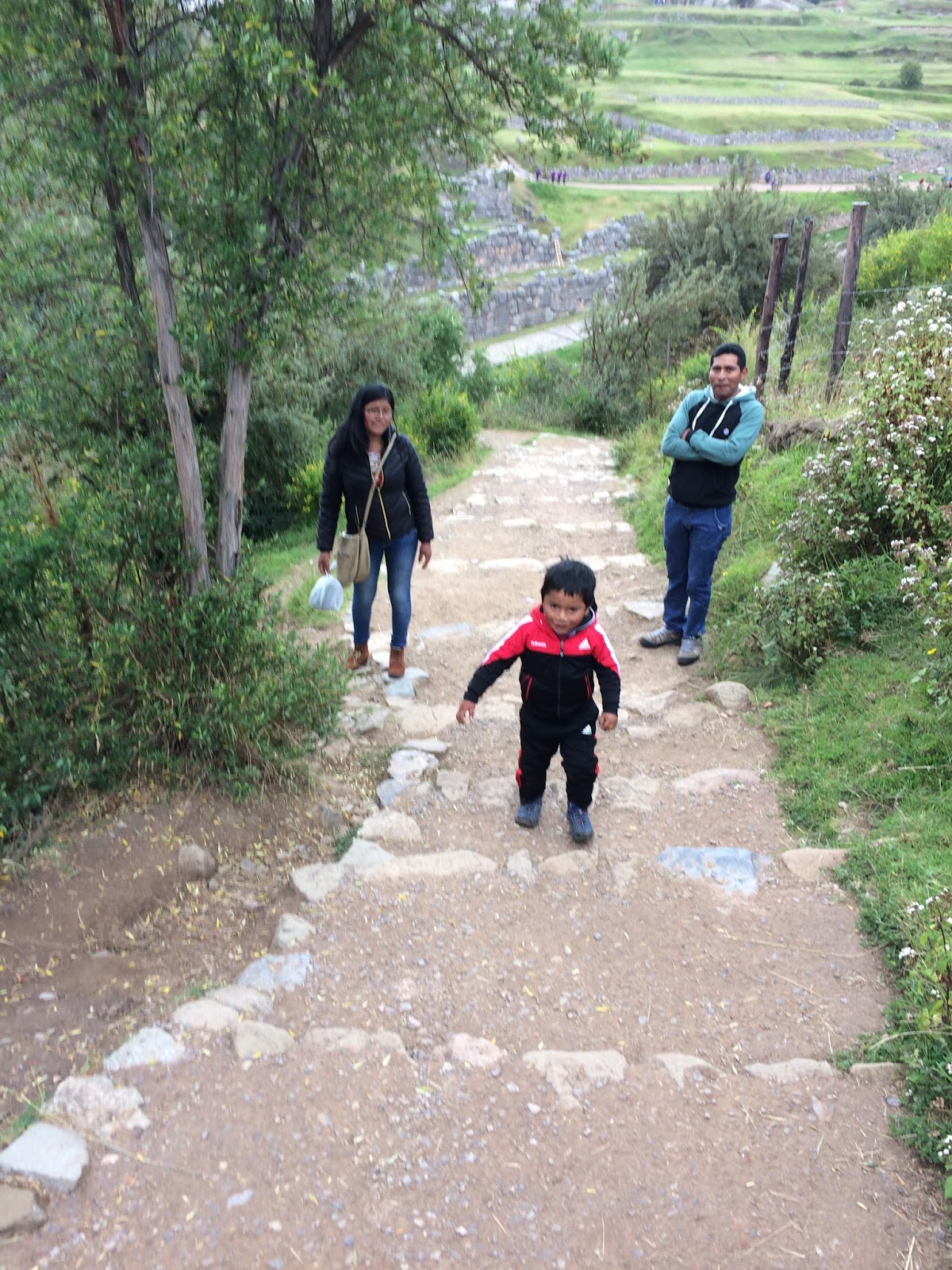
I recall my last moments of exploration in Qusqo: I was left with several bars of chocolate from our hiking. Knowing, how happy kids become with even a square inch of a chocolate, I am looking for kids to give them away. I see kids in school uniforms climbing up Sachsayhuman, some with their parent(s). Apparently, locals are allowed to use Sachsayhuman as a short-cut between lower Qusqo and upper neighborhoods, nice. I see two kids, and hand out to them two bars. I will never forget the spark in their eyes and the enormity of the smile that turns their face to one big sunshine instantaneously!

The steep slope to Sachsayhuman Inka Fortress, close to Qusqo

The father walking along with them is also one big smile, in his  appreciation more than excitement. We exchange loving kindness right on the spot. How little we need to be happy and content and grateful… One of the boys start running up the road announcing to his mother selling her handcrafts up the hill with another child. I can’t help but holler after the runner “Share it with your brother” since they are already almost by the mother at this time…

For the last two bars I have left, I will have to look for kids to give to downtown. I see a mother with her sons, I ask her permission to give her sons bars of chocolate. She gracefully and somewhat shyly says yes. Who knows, maybe my white hair is imposing trust and respect in these parts of the world, although my hiker attire not so much at times. The boys’ faces light up with disbelief as if to say “Wow, how did I turn out to be so lucky today? Who is this mamako (respectable elderly woman in Quechua culture)?”

A waterfall on our way up to our first campsite on Quarry Trail

I wonder if they ever wonder “Why is she giving this to me?”, it doesn’t look like it. Kids or adults in cultures like this, grow up with and understand “people do good things for no reason at times, it is a gift to accept.” I don't know if I could do this in the US, I worry it would meet questioning eyes "Why does she do that? Is there something harmful in it?" Are we losing contact with one another as we become more "civilized", especially as we move into exclusive digital era? This is what traveling does to one, open all channels of observation and critical thinking... That is why when I hear about somebody in the US, who hasn't traveled outside 100 miles of their hometown, I feel sad for them. Not having encountered people of different cultures, distant geographies is one of the reasons how Trump got elected in the USA. Ignorance coupled with malevolent politicians' brain-washing, fear mongering campaigns is breeding ground for the electability of the likes of Trump, Tayyip Erdogan, and all other fanatics across the world.   

One of the proud Andean summits

As my afternoon wears off, I start recalling layers of history I encountered here in this Urubamba Valley from pre-Inka, to Inka, to colonial occupation and their surviving cultures and remains. It is still a lingering question for me that every nation and individual have to strive to find answers to: How do we come to peace with our past? I see that Peruvian society is also looking for answers to this very question with its human rights movement recognizing the need to finally revive and allow to flourish whatever remaining components of the Inka culture there are. However, will they continue doing it in a business-first mind-set by commercializing whatever is Inka or will they invest true cultural efforts into understanding Inka culture in its full scope and pass on the truth to future generations.

A cave on Quarry Trail with remains from Inka time, reportedly...

In my understanding, Inka culture was a combination and product of its predecessors that came to be through wars, invasions, and blood shed. It was a culture based on class, even our tour guide eventually admits to the fact that noble upper class surrounded by the religious entities of the time ruled a middle class and the working class, the latter of which was building the palaces, the temples, the walls, and the cities of the Incas. Where we depart from an agreement is that our tour guides claim, in this class-based society, all class relationships, and the submission of the working class to the ruling class, even human sacrifice were voluntary since they believed their upper class was the representatives of God on earth, thus, denying the existence of slavery in Inca time.
A dance show in Qusqo

Our guides’ position is that Inca society was a communal one and when all due was paid, meaning working in the masonry for a few years, the society lifted all its people with adequate housing, food, and communal protection. What I know from history tells me the opposite: In every society based on class economic relationships, there is always class struggle and conflict: Our contemporary art scene, literature, film, mythology is full of such stories Spartacus, Jesus, Moses, Apocalypto, Borderland... These people also lived in cultures when the rest of the society believed in the dogmas the ruling class pumped on them, but sooner or later, those opposing or questioning the status quo created a leader that rebelled against the rules of the ruling class.

Our entire Intrepid group of hikers in Agua Caliente after our first shower following a three day hike and camping

Especially when it comes to human sacrifice, I tend to believe Apocalypto and Mel Gibson as well as Smithsonian documentary on virgins of the sun rather than our tour guides, whose job was most likely to create all embracing sympathy toward Incas as the victims of the Spaniard conquistadors: These protagonists in these movies are the visionaries of their societies that, even in their death and sacrifice led the future generations to rebellion and revolution. I wonder if the Incas’ weakening society that led to wars among their partners had something to do with the rulers not being able to rule the ruled as usual toward the end of their reign, which made it all too easy for the Spaniards to give them the big blow after several years of fighting. (http://www.smithsonianmag.com/videos/category/history/virgins-of-the-sun-and-the-incan-human-sacri/

An alley in Qusqo 

Spaniards were not humane at all, either, perhaps, much more harsh than the Incas in the new order they brought upon South America: Feudal system replaced the slavery based system. This was accomplished not so much with peace of course but with the blood-shed generated by cannons, weapons, and torture, all in the name of God! They destroyed everything Inca, they could put their hands on and/or if they were able to move it elsewhere. They enslaved Incas to serve their God, exploited the riches of the land, and converted the Incas to Christianity. As they infused their Inquisition culture to the depths of the fabric of Inca society, Incas played kind of a trick on the Spaniards: They absorbed Christianity into their own culture, but in a way that they preserved many of their Inca religious traditions, thus, they created an Inca Christianity! Just like Turks inserted many shamanistic elements into Islam as more and more of Anatolia was converted...

Qusqo through a window at Santa Catalina Monastery

Finally, in the last several decades, the human rights movements all over the world started recognizing the importance of understanding and acknowledging how first peoples have been oppressed, exploited and at times destroyed to extinction, by the explorer western civilizations be it in South America, Central America, North America, Pacific, and other places. The descendants of Incas joined in with all other first peoples demanding recognition, respect, and acknowledgement of their first ownership of their lands.
In all this, where is the balance that glorifies only the truth? To acknowledge what was good in the past and what was not so good to build on the strengths of the past? I don’t believe accepting the today-unacceptable practices of the past empires would hurt us in any way. In fact, I believe it would increase our respectability: I would like all Turks accept the fact that Armenian genocide did take place.

Locals and tourists intermingling at Plaza de Arma in Qusqo

I would like the British Empire to acknowledge that World War 1 was their attempt to exploit the riches of the middle east and their artificial division of the Arab world actually seeded the middle east with the ongoing warfare that inundates tens of millions of people all around the world even today... I would like the US accept the fact that racism is killing many African Americans on US soil either by police bullets or in prisons with industrial-prison complex’s inhumane profit-oriented entrepreneurship. Is it possible that the Peruvians also approach their Inka and Spanish history with such honesty and openness?

San Pedro Market in Qusqo

Wouldn’t it be good if all nations could embrace the richness in the products of the clashes and integration between the subcultures they have oppressed or cherished? Wouldn’t it expand the richness of our contemporary societies if we could melt all our cultural components into a humane, progressive, and egalitarian pot? Is this a possibility in Peru, Colombia, Bolivia, New Zealand, Hawaii, and in all other places where the West clashed with, destroyed, and rose on top of the embers and ashes of indigenous people’s cultures? This is the question I am ready to leave with the Limo restaurant, Plaza de Arma, Qusqo, Peru, and Colombia, on my way back home, the USA. Food for thought for all of us.
              
Urubamba River and Valley from the air as I leave Qusqo

Sunday, August 27, 2017

MACHU PICCHU PERU 2017 - 10 - CUSCO AFTER BREATHING ANDEAN AIR FOR A WEEK


One of my shots from the Sacred Plaza in Machu Picchu

After a phenomenal day at Machu Picchu following a three day hike up and over the Andeans to get to it, we arrived in Qusqo late in the evening. Today is my last day in Qusqo. It was great to take one more long shower last night and at least rinse my clothes that were soaked with Andean mud. I am grateful that I had a radiator in the room: Everything I washed was dry in one hour to be tucked into my luggage waiting to be thoroughly washed back home. I thoroughly enjoy a bunch of banana pancakes again this morning, other than the corn soup, the best food I have discovered in Peru!

I could eat only 3-4 of these, they are rich, but much much tastier than regular pancakes we find/make in the US.

My goal today is to visit Sachasayhuman, an Inca fortress within vicinity of Qusqo. Sweet Maria again guides me to how I can walk up to Sachasayhuman with disbelief in her eyes that I am set not to take a taxi there: I read in my book that it is couple of miles from downtown that is close to me... The people I ask for directions from Plaza de Arma, just to be sure I am walking in the right direction are also loaded with the same disbelief:

The beginning section of the about mile long slope to Sachasayhuman

First they make sure I know that it is a very steep hill that I have to climb, "I know that" I say smilingly. I have to assure them all one by one. I know it is this white hair that makes them all recommend me to take a taxi! Anyway, I head up the … I see a store sign that announces Inca grains as their product. Interesting, tucked in this corner with an unusual product. They are indeed selling all kinds of grains from quinoa to chia to many other grains I hear of for the first time. What is most interesting is that they also sell some Alpaca hand-made apparel. The hat I have been looking for, for my daughter is right there, with the right colors, right texture and the right price! Once that is paid for and secured, I happily push on to the top of the hill, where the entrance is. I discover that getting to the entrance is just half of the climb! But there is a beautiful payoff: Every 10-15 m of elevation gain, Qusqo that reveals itself to me becomes larger, more expansive, more provocative almost…

One of the shots revealing Qusqo down below

Then comes the Sachasayhuman slowly revealing itself, its walls, its core, its secrets. But before fully exploring this place, I follow the Mestizo family with a lovely daughter up the trail to the right of the lower walls just because the loving interaction I observed intrigues me. It turns out that they are heading toward Christo Blanco! As a result, without planning I pay my respects to a huge, some 50 feet high statue of Christ, that is as big as a three story apartment building…

A local family and their lovely daughter climbing up along with me to visit the Christo Blanco "protecting" Qusqo for centuries

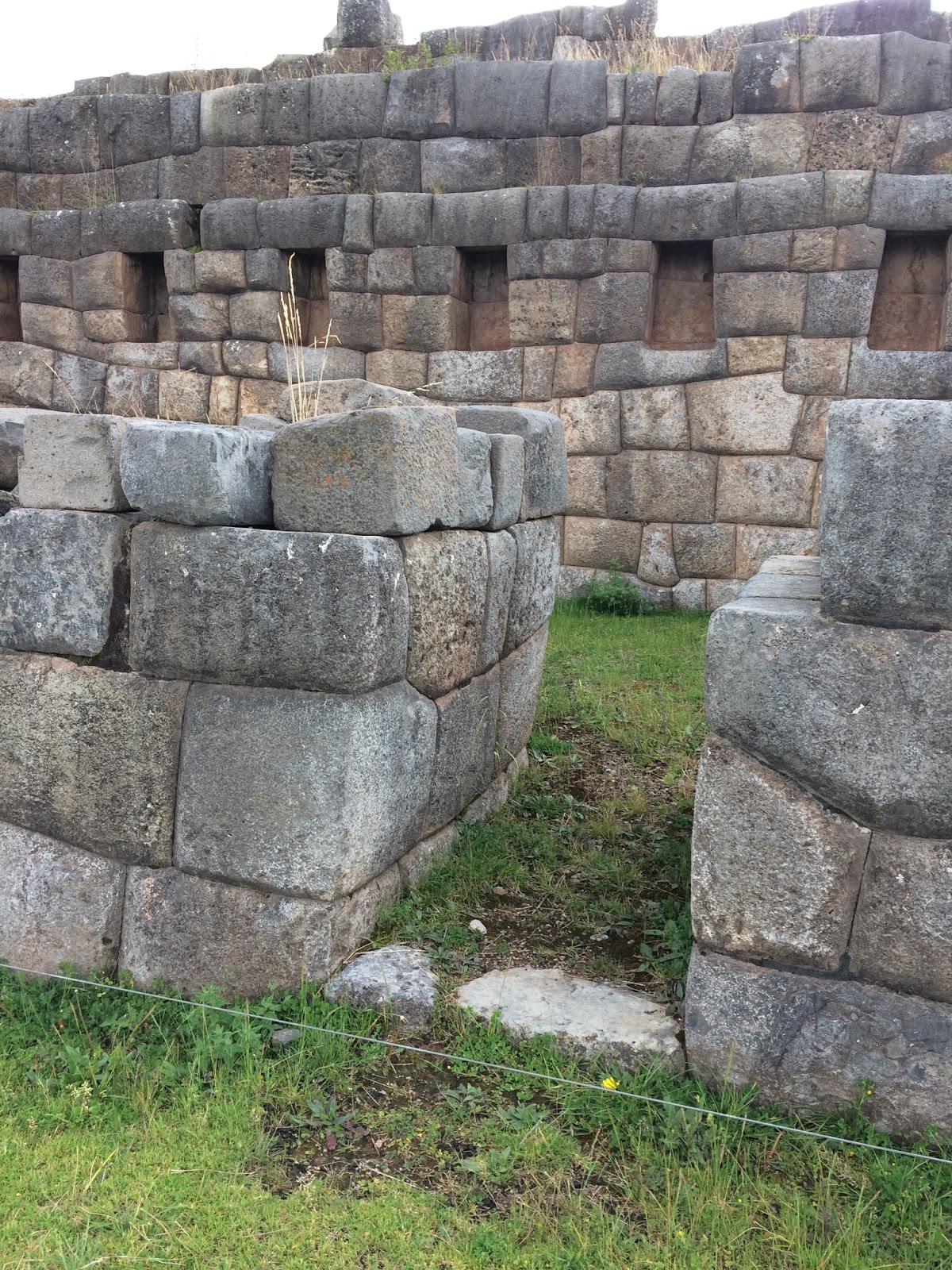
I head back to Sachasayhuman to complete my tour. As I learn Inka Pachacutec started it in mid-15th century, but it took 100 years to complete it. It is very easy to understand why looking at the walls of the fortress made up of stones several hundred tons each, especially those at the bottom row of each wall. I find out that these massive limestones were carried to this place from as far as 32 km away! Historians estimate that the fortress housed some 10,000 men. My travel book states only ¼ of the original structure has been unearthed. In addition to excavated and partially restored walls, clearly there are ruins under the undulating terrain. According to legend, entire Sachasayhuman represents the head of the puma and the zigzagging walls its teeth! I sure would like to see it from up above…

Huge Christo Blanco above Qusqo in awkward contrast with the modern lighting that brings him to life at night

I discover that at the top of the fortress, there is another entrance to which taxis bring people left and right. That’s where the townspeople were trying to send me then. Culture in Qusqo has evolved around MP and Inca heritage in such a way that everybody makes a living out of some aspect of this huge touristic enterprise. Guided tours are one major business in town. Whoever strikes a spontaneous conversation with you, you may expect that they will make an offer to guide on this or that tour. Women and men dress in the glamorous Inka attire and wit for tourists to take pictures of them or better yet to ask them to take pictures together. Women wonder around a plate full of jewelry, men carry their paintings or drawings to sell. Some of them are chased by the guards in city center. Each company has multiple packages of tours anywhere from the tour of Cuzco, to Sacred Valley, to MP and more…


The walls of Sachasayhuman at the lower entrance

I am so glad that I came to this place instead of going to the chocolate factory. I can see how Spaniards would have found it very convenient to use the stones from this fortress in building some of their buildings. After my tour of the walls and remainder ruins, I climb over the central bedrock that is partly covered by earth and overgrown grass and occasional bushes. It is clear that there are inca buildings waiting to be excavated (or not) underneath. I sit on the Inca stone that seems to sit on the highest point of the mini hill. After enjoying the caress of the breeze on my face and arms, I close my eyes: The object of my meditation is the Inca residents of this neighborhood at a time of battle.
 
Layers of walls all from Inca times...                                                                                Their rulers wanted to stay in power, their subjects wanted to live free: I suspect they would have preferred to be free of all oppression. Did they understand their rulers’ need for grandeur as such or as our chief guide told us time and time again, did they devoutly believe that their rulers were in fact gods that made the wind below, sun rise, moon set, rain nourish their crops and many more things they needed to survive? Did they care about being under the rule of their Inca and their nobility versus Spaniards, or did it change very little in their lives? I try to envision their daily routine in their “happy” times, I can see the shy smile of Andreas on the face of a man, the innocent chuckle on the face of an Inca woman carrying her baby on her back in a textile wrap, embracing her bosom. They climb up the steep slopes of Qusqo toward Shacshayuman as the breeze sings a sweet song in my ears unlike the whipping whistle of its kindred up on the mountains. I send them compassionate thoughts across centuries before I open my eyes to the sunshine.                                                                                 

An indigenous woman carrying her infant child on her back wrapped with her hand-made (most likely) textile
 
The central portion of the walls in Shacshayuman is in a zigzag form, the protrusions representing the teeth of the sacred puma


Wednesday, August 23, 2017

MACHU PICCHU PERU 2017 - 9 - FALLING IN LOVE WITH MACHU PICCHU FROM THE SUN GATE


Our group of seven with our chief guide saying our goodbye to Machu Picchu

Five delicious hours at Machu Picchu guided by our Intrepid guide from 6:30 am to 11:30 am. Once our tour guide left us to our own devices with our return bus and train tickets in our pockets to take us back to Ollantaytambe, I found myself with 4 hours at hand to kill in this beautiful land. My first instinct is to find my way back to the entrance without having to exit the fortress so that I could go to the sun gate, no chance! Once you have entered the one way path of the dictated labyrinth, Peruvian guards catch you at every turn you try to take to go back! After couple of futile attempts to benevolently beat the guards, I let it go...

Our guide and I just before he takes off to get back to his girlfriend in Cusco

I have to exit and get into crowd at the outside entrance, now swollen up to ten times what it was at 6:30 am, get in line, and get back in… This mentality is seen only in developing countries like Turkey. I don't know what the purpose of this may be, tire people out so that they leave sooner than they would like to, just to keep the crowd flowing in one direction, or to have more visitor numbers with double entry per person, for whatever reason. Who knows., I hope there is a good reason for it. I have made up my mind that I won’t allow anything to upset me at this crowded, yet, still peaceful place. I follow the crowd and exit.

The trail to Sungate, which is also the path bringing the Inka Trail hikers into Machu Picchu

I get back in line, not that bad actually, I realize that some of the huge crowd outside is made up of those that are done with their visit in Machu Picchu, waiting for a bus to take them back to Agua Caliente. In five minutes I am back in, climbing over the 2 ft high Inca steps one more time. I stop when I have to catch my breath, chat with other visitors until I come to the turn toward the sun gate. Two gentlemen from our larger Intrepid group are doing the same route, but they are fast, they don’t stop to take pictures or just watch what we have left behind turning our backs to Machu Picchu… I have lots of time, I don’t want to rush. I spend time taking in all of the beauty around me, the Machu Picchu that is getting smaller and smaller with every switchback, the mountains that are getting higher and higher around us, the wild flowers of all colors, the llamas grazing on the terraces, the fog forcing the mountain tops to play hide and seek with the sun, the river flowing gregariously down in the valley...

Urubamba River in its namesake valley down below from the sungate

A group of young men anywhere from 17 to early 20s pass by me with friendly greetings; this is youth. I let them pass, too. The higher I get, the cloudier it gets, at some point I feel like I am in the cloud, and I am. It is not raining, but I feel wet and put on my raincoat. I recall my visits to the Taurus Mountains in southern Turkey. Even in the summer, how wet and chilling they would make me feel, just like here. The plateaus of the Kacgar Mountains in Northern Turkey surrounded with harsh peaks. Mountain landscape is so similar all over the world: Beautiful, harsh, protective but dangerous at the same time, warm and cold simultaneously, rich and unforgiving... First destination is the sun gate. I stop one more time and look back. I am trying to figure out which part of Machu Picchu is the Father Sun Temple, which would align with the sungate in the old days during summer and winter solstices.  I wish I had brought my binoculars, unfortunately I didn't. I just try to have a "de ja vu" sensation from the Inka times...

Machu Picchu behind me before I reach the cloud/fog covering the vicinity of the sungate

I will learn later on from fellow hikers that did the actual Inka trail that they walked all the way to Machu Picchu and entered the fortress from this very sun gate. I look down to the valley one more time. Sometimes the fog draws a veil over Machu Picchu and the mountains behind it. Sometimes it condenses into a cloud that settles over the valley just like our experience at the 4450 m summit on Quarry Trail, or when I had climbed up the Ilgaz Mountain summit in Western Black Sea Mountains in Turkey. It is so much fun to watch this playful spectacle of the nature.

Fog turning into a cloud settling over the river and valley as I climb up higher

I continue climbing up further from the sungate towards additional ruins on top of the next hill. There is a small building with four walls and window spaces all around with no roof top. A native, man, most likely a Quechua, dressed in the same attire as the guards down below, sitting on one of the "window" sills, straddling the Inca wall. He looks at us as if he has transcended centuries. Apparently, the sungate and its associated structures need extra protection! I will learn better soon there may be a different reason behind this.

At the peak of the sungate trail, the mist and drizzling rain forces out our raincoats

Visitors are walking around almost aimlessly, all of us enveloped by the cloud, which is drizzling itself onto us, onto the lovely llamas that have traveled up alongside us, the trail, the terraces of old, Machu Picchu in the distance, and the Urubamba Valley. Everything is under and behind a gray veil now, which has a different somber beauty... I want to get to the very top of the ruins and look at all this beauty from up above. To the right of the "building" is a set of stairs that lead to two landings 15-20 feet higher than the "room" we are in. I climb up the stairs to my left. There are some 20 of them. I notice that the group of young men that passed me on the trail is up on the ledge of the top of the stairs to my left. Sweet, perhaps I may catch up with them and see what this group is about. All I know at this point is that they are a bunch of boys from different parts of the US. I reach the top step and as I do, I hear somebody snorting something followed with coughing and sneezing. I look up to see one of them turn away from me. What is going on here...

The most photogenic of a dozen llamas we saw on the trail
 
My peripheral vision catches a pipe being passed around and a couple other young men are smoking something that is not a cigarette. Although I am on the same platform with them, nobody seems to notice a stranger or "that old lady" with whom they chatted gregariously on the trail. I wonder if they were already high on the trail, was it why some of them were more self confident than the situation called for on the trail? Hmmm, this group is not really "here" at this point, who knows what they are seeing right now, how they are perceiving the beauty around and below us... Perhaps they are seeing things that I don't, who knows. I decide to leave them alone in their 'lost'-ness or perhaps discovery of experiences that I will never do, wishing them to be safe just as I always do with my daughter when she travels.

From the top of sungate trail, Machu Picchu once again

I stop and take one more long look at MP, stretching behind the veil of the mist and drizzling rain, calm, quiet, and peaceful. I wonder if it enjoys being stumped on by this many of us every day of the year. The terraces connect MP to the peripheral structures of it down below, still buried under vegetation and earth. My gaze naturally drifts down to the valley and Urumbaya river, who knows with what might it is flowing in the depth of the valley that I can’t hear at this elevation. I start heading down, savoring every additional moment of this divine, pristine, magical vista. I understand how and why Incas developed all their legends, this land is so conducive to creativity, imagination, and story telling…
Wymapicchu Mountain and Machu Picchu from the sun gate