Saturday, September 20, 2014

COLOMBIA AUGUST 2014 -7- PLAYING WITH WORKING CLASS PEOPLE OF SOUTH AMERICA


8/8/14

My last day in Cartagena and Colombia. Isa, our conference chairperson, gradually becoming a dear friend and Robin my American colleague from the conference we attended in Bogota have decided to stay at the hotel I am staying at. That will make things much easier. We will definitely have dinner together, which will give me an opportunity to not only chat about how things went since my departure from Bogota, but also I will be able to take over the possession of the jewelry I left in Bogota in my hotel room that I vacated! Isa makes a joke and tells me, you want to leave your jewelry with us it looks like. True, what she doesn't know is that there are several metaphors in that statement as well.

What a group of jewel of people I spent time in Bogota 

I consider my heart the core jewel of my existence (most likely like everybody else) since I wish the best for all creatures on earth and try to do good in the world as much as possible for especially those that need it. I know that I will leave part of my heart behind with the gracious, elegant, warm people of Colombia. Secondly, my daughter is also a central jewel of my life. Having traveled to Colombia in the past and fallen in love with it, who knows, she may choose to settle down in Colombia... And, there may be a metaphorical connection there in my attempting to leave my jewelry in Bogota.

Cafe Sanalejo in Bogota, a  must visit place 

Since, I am essentially free till the evening, I would like to repeat some of what I did yesterday if I can. I go downstairs. Dear Andres, our gracious receptionist is already in when it is barely 7:45. I tell him about my plan. He tells me enthusiastically, he knows of a tour he could call. Sure enough, they do have room for me and Andres makes the reservation. They will give me door-to-door service and lunch is included.  And the tour is going to the Baru island, which I had been curious about. All is well, although since the price is one third of the price to Maja Gua Hotel, I am a bit skeptical about the service, but "what the heck, I will see a different type of tour service at a lower level of quality."  I take it.

Where The People board the boats in Cartagena 

A young African man arrives in a taxi cab to pick me up. We are heading to where all the boats were docked yesterday that had raised my curiosity about what they were up to when we were headed to a secluded, private looking dock to catch the elegant yacht that took us to Maja Gua yesterday. I smile to myself with a silent murmur "Isn't everything relative in life?" Only after seeing the boat and dock of today, I discover that the boat of yesterday in fact was an elegant yacht and the dock was a quiet, private dock!

A team of natives accompanying our boat for a while 

Our boat today will be Nautico and we are shown to the rows of white plastic chairs lined up on the pier to wait for our boat. I chat up a Mexican young couple, who turn out to be running a restaurant of their own in Guadalajara, and they are on vacation in Colombia now. After half an hour of waiting, Nautico arrives and all 42 seats are occupied, maximum allowed per the ordinance put up on the wall of the boat. The way we are cramped up in the boat reminds me of the "chicken bus" concept of Guatemala. Sitting next to me is an "African-indiginous" mixture of an adolescent beauty, a zambo. She tells me she lives in London with her parents. She has this adolescent insecurity and her answers are brief. I leave her be.

One of the fortresses watching the entrance of the Cartagena Bay

Later on, when her mother volunteers to chat, she tells me her husband is a chef in London and she stays home with her four children. We go through the same routine of discussing the meaning of the fortresses at the entrance of the bay before heading toward the Rosario Island National Park. I will learn in the evening from Isa that in fact, there was a chain between the two fortresses and they would raise it when a ship approached and not allow the hostile ships even enter the bay.

Almost exclusively Latin Americans filling the Baru beach 

When we arrive in Baru, some people are offered to stay here to enjoy the beach, which is crowded to the nth degree. The Mexican couple among other people get off here. Since I did snorkeling yesterday, I would like to do something different today. Besides, I would like to leave my snorkeling experience at the climax it reached yesterday. The snorkeling they offer doesn't seem to be very inviting anyway. I choose to stay with the group heading to the aquarium. As we rush out of this cove, I see evidence that I made the right decision by not volunteering for snorkeling here. There are 5 heads per square yard of water 100 yards off the shore with pretty much no guidance as I can see it.

Young female caregiver playing withe the dolphins in the aquarium 

Aquarium on the other hand, is an interesting place, at least a place worth visiting once. Along with the enclosed mini acquariums, in which smaller sea animals are displayed, there is an outdoors display area. This section of the aquarium is sectioned from the ocean itself with metal chicken wire fencing. In each section, sea creatures live in their more or less natural environment, although a bit crowded one might say. One section is dedicated to dolphins, another to big brown fish, yet another to sea turtles, on and on. Well trained caretakers put on a show for us in each section during their feeding process. It is quite a spectacle to observe the crowd move from the fencing of one section to the other not to miss the show. I join in.

Another caregiver putting on a show with getting teh fish beg him for food 

When we are done, I feel I desperately need some juice, coconut juice comes to my help. It feels really good, refreshing, rejuvenating as we wait for our boat Nautico to come pick us up. I look around, nobody familiar. I ask somebody about whereabouts of Nautico, he shows me a boat approaching. Come to see, the boat that has arrived has nothing to do with Nautico, and now the guy I asked for help is gone. I ask somebody else. The same process repeats itself, which makes me a bit anxious, especially given the fact that I don't see anybody from my group on or around the pier.

The crowd around the aquarium shows 

Fortunately, I spot the Colombian couple, a young architect and a civil engineer, with whom I will stay for the rest of the day, and I learn from them this is how it works. The time set for our meeting 12:20 apparently is just suggestive with some +/-, and how large that variation may be is open to imagination. We are in the Caribbean and I am not in a rush for anything anyway. As long as I know Nautico will come pick us up at some point, I am at peace. I sit down and enjoy my coconut juice until finally Nautico collects its snorkelers and comes to pick us up with 35 minutes of delay, which is not considered a delay around these waters...

Sections of aquarium fenced in from the ocean 

I have learned my lesson, this time I sit in the back of the boat: These boats are like jets. They probably do 80-90 miles an hour on the water, causing the water to become almost a non-yielding solid surface. Since they also try to cover the shortest distance, they don't mind riding perpendicular to the waves. As a result, it is not rare for the front end of the boat rise up to the sky and land on the surface of the ocean from several feet! You can imagine the impact of such on somebody who may have a lower back pain, which I do since yesterday's excursion. In the back I expect the "slams" to be felt much less. And... It turns out to be very true.

Fruit juice is the most abundant item via street vendors

When we get to Baru island, we are rushed through the crowd from behind the shade-tents into a make-shift restaurant. The servers are not as friendly as yesterday, but people who leave the area with a plate seem to be happy. The plates are loaded with a whole fish, I am sure it is morollo, this will be my third morollo in subsequent three meals, for the first time in my life! And the best morollo of all three, too, since it must be so fresh; with this crowd, all the fish must have arrived this morning.
I am now not only with the couple from Medellin, but also a young man from Chile, vacationing in Colombia. Sabrina, the architect and I enter a discussion on the political circumstances in Colombia. The men, who don't speak much English start their own conversation in Spanish. I show them how Turks eat whole fish with head and all, they are interested, Sabrina is a bit disgusted with the eyes and the brain, but is good sport;  that makes me chuckle... We are having our lunch under a straw canopy providing the deepest shade to the tables laid out for the needs of these humble boat tours.

Indigenous women parading in Bogota Festival

Today, I am definitely meeting a different crowd of Colombia and South America. Except for me, everybody on our boat is either Colombian or from somewhere in Central to South America. Age average is much lower and these younger people are either students or young professionals. Middle aged people on the other hand, are from the blue color section of their society. Yesterday, we, a combination of Europeans, North Americans and upper class Latinos had a private beach all to ourselves. Today, I am sharing my day with the real people, mainstream people of a cross section of Latin America.
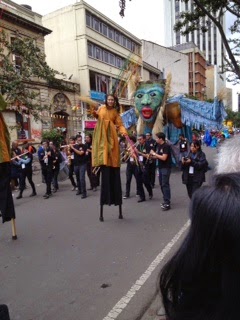
More from Bogota Festival

After lunch, Sabrina and her husband Rudolpho ask me whether I would like to share an umbrella with them, "Claro!", but I would like to pay because I am their senior. We chuckle, they agree, but Sabrina tells me we will pay before we leave. When we are ready to leave though, I discover that it was just a trick, Rudolpho has already paid for the umbrella. They smile at me and Sabrina tells me "you are a guest"! How Turkish, knowing this common element of our cultures, I smile back accepting their hospitality with gratefulness. When we get under our shade, I tell Rudolpho and Sabrina to go swim as I look after our stuff. They are pleasantly surprised. At this age, I feel motherly instincts toward protecting all young people, who are in my daughter's age range now. I hope my daughter, who will soon embark on a 1 year-long travel across the world may come across good people to give her a hand and good guidance should she need it. After all, I have a sense that all good deeds on earth are interconnected and hopefully my daughter and I will remain connected through our good deeds be it when we are half a world apart geographically.

Meat Market in Bogota

Back to being in the shade... I take out my book titled "A Few Small Moments" by Carol Scott-Connor, a surgeon who rose to the department head position at the University of Iowa Hospitals, a rarity for a female to become a surgeon, especially during their time, even rarer to become a surgery department head. As soon as I read the blurb on the back cover, instantaneously I ask myself "At what cost, I wonder". As I read through this book, Kim Ephgrave, a dear friend, albeit brief, who died due to terminal lung cancer after three years of very gracious battle with it, keeps popping into my mind.

And... The holy fish world...

It warms my heart that Carol mentions her as one of her guides in her work in her preface. As soon as I return home, I will contact Carol and meet with her to share with her how much I enjoyed her book and her honesty in it. So many things I read here resonate with what I heard from Kim throughout her experiences as a female surgeon in a manly world of surgery. I am so surprised though, that as many things resonate with my own experiences... Expectations of perfectionism, first and foremost from my own self, but then from my secretaries, from medical students... I wonder if I make their life as difficult as Alexis in the book, does her counterparts'. As I move on, though, I feel a sign of relief since I have never done anything to make a staff feel humiliated or angry to the extent of filing complaints... Still, food for thought in this life of mine, which I have identified as work in progress till last breath...

Vegetables are also abundant in the market

It is not possible to keep a train of thought, though, since every minute or so, an indigenous man or woman stops by and tries to sell something, beads, fruit, baked goods, fried coco, massage, water, you name it... I almost feel like there are as many salespeople on foot as clients trying to enjoy the beach! I now understand what Theresa meant by "Public beaches are not very pleasant, they are extremely crowded and every minute somebody is trying to sell something to you". I get it, but I also notice the similarity between what I observe today with most of the beaches in Turkey.

One of many delicious dishes in Colombia

All in all, when all is said and done, my day on Baru island was not that bad at all. I was in fact able to get a glimpse to a different section of Cartagenian society, which enriched my life and understanding of Colombia. All is good. On our way back to Cartagena, the boat unexpectedly approaches a ready-to-fall-into-the-bay type of a pier in front of a village or shall I say "suburban"  shanty town east of Cartagena. In the meantime our "tour guide" another zambo, who proved to have a very good sense of humor from the amount of laughter he brought out of my fellow Latino boaters is shaking hands and bidding farewell with all of us.

Another delicious and vegetarian dish
"A bit early?" is my thought, but not quite, since by the time he is done we are at the pier and off he jumps onto the pier with his graceful backpack on his back and another of his villagers jumps on the boat. That's where our handsome tour guide lives, in this neighborhood that looks like a very poor one, in which the only thing that is sparkling is the church painted in the brightest blue and yellow. I wish him and his villagers well. I know there is a world outside of the touristy vivaciousness of the old town and showiness and luxury of the towers and hotels of the new town in Cartagena....

Where our host jumps off the boat

I believe each country or location that we visit is an iceberg. What we tourists are allowed or choose to see is the tip of the iceberg. If we have contacts from within we may reach couple-of-feet-below-the-surface section of the society. Only if we live in a society long enough, at least 6-12 months, will we be able to dive toward the deeper depths, perhaps never to get to the bottom of the iceberg for a variety of reasons... Locals may not want us to see the bowels of their society, we may not feel safe to explore those depths or have the desire to do so. After all, what proportion of our own society do we know well enough that we may say, I have reached the bottom of the iceberg ?

Gabriel Garcia Marquez' home in old town Cartagena

All in all, Colombia gave me very good glimpses of her society from intellectual professionals, to intellectuals interested in politics of their own land as well as distant lands, to working class, to small business owners, to a variety of ethnicities... I am grateful for all the exposures and appreciate the grace, dedication, and warmness of her people, whether they came from the poor working class or blue color or from upper class intellectuals... Colombians opened my eyes to a different way of existence in Latin America. Looking forward to repeat visits to discover more of it in the near future....

Colombia is a country that one must visit...


COLOMBIA AUGUST 2014 -6- ENJOYING THE BEAUTIES OF THE CARIBBEAN: ITS PEOPLE, ITS WATERS, ITS ISLANDS AND MORE...

8/7/2014

Another phenomenal day in Colombia, perhaps the best, which I will repeat tomorrow. My dear colleague Erika arranged this tour for me so that I could go to the Rosario Islands, a national park, across from Cartagena. I am highly excited about the whole trip since I will snorkel to see coral reefs for the first time in my life. I am sharp on time in front of the office for Hotel San Pedro de Maja Gua. The bus that will pick up a dozen people from this place, which is very close to my hotel is already in front of the office. Sharp at 8:30, we take off and our driver delivers us to the far end of the Cartagena dock, where a small but will-turn-out-to-be mighty boat welcomes all of us. Due to my returning lower back pain, I had put my beach shawl behind my back, no doubt I left it on the bus, but, hey, I don't worry any more, Colombian people surely will save it for me at the end of the day. I am content.

Private dock for rosario islands
Our captain is as crazy as the drivers of Colombia! The boat is cutting through the water and occasionally is airborne after which it falls onto the water, which turns into a solid floor with a harsh slam; certainly not good for my back, but I survive, all is good. I am occasionally looking at my Spanish book and come to a burning question that the book doesn't make clear. The young man I am sitting next to looks very Latino. I ask him if he is Colombian or not in Spanish. Nope, he is English. Well end of my study, we start chatting.

Paul from England, world traveler
His name is Paul, working for an company selling alcoholic beverages, which he tells me emerged with the merger among Guinness and multiple other British and Irish companies. Most recently, he was living in Shanghai, but couldn't take the air pollution anymore and asked for a position back home. Before starting his new job, though, he took 6 weeks off for a South America tour, which he had not visited before just like me. He has already visited Argentina, Chile and Peru.
Cartagena defense waals and infamous clock tower

After Colombia, he still will have couple weeks left, he is debating whether he should visit Guatemala, Bolivia, or Nicaragua. He quickly eliminates Nicaragua due to the unrest there, his bet is between Bolivia and Guatemala then. I give all my best about Guatemala, which I had visited two years ago with my daughter. He is interested. Cutting through the bay toward the islands unfolds many evidences of how Spaniards established a strong defense system to protect Cartagena:

One of the two fortresses at the entrance of Cartagena Bay

Watching Spaniards steal all the gold the indigenous people had accumulated, a variety of pirates in addition to organized national navies attacked Cartagena to get a share of the gold. Thus, the first measure to protect themselves against such attacks was the very long wall system they built within and around the town. When that was not enough, they built the castle behind the city where the walls ended. At some point, they understood, it was too costly to allow hostile ships to come to their shore even if they were able to push them back:

During one of quiet moments of the boat
They then built two fortresses at the narrow entrance of the huge bay in front of Cartagena, some 10 miles out from the city shoreline. Thus, whoever attempted to enter the bay with malicious plans found themselves under cross fire from the fortresses. We slow down near the fortresses and our pleasant guide/captain fills us in, I assume with all this in Spanish, of course. Once the touristic mission regarding the fortresses is done, the boat takes off with such speed, I feel like the tip of the boat is facing the sky not toward the islands any more. Everything in Colombia feels so much like back home in Turkey. I quietly chuckle to myself: "OK, we get it, you know lots of tricks Captain..."

Cartagena skyline through the handrails of the boat
The entire boat trip from Cartagena to the island is actually close to an hour. Good thing, it is so hot, despite the wind our speed is creating, it doesn't feel cold at all. I recall, back in Turkey, how we would bring sweatpants and jackets to such boat trips since the temperature on the boat would drop by 20-30 degrees Fahrenheit compared to what it was on the beach. Well, we are in the tropics, it clearly makes a difference.

Our captain cooling off his belly on the pier!

I start chatting with a young woman, whose chatty daughter all of a sudden falls asleep leaning against her mother with a bag against her mouth. Apparently, she has sea sickness, and poor thing she has all the reason to have sea sickness with our speed. Her name is Emma, her mother's Catalina, who is an architect in Medellin. I am learning more and more that the coastal line is the major vacation site for all Colombians just like Turkish people flocking to the western and southern coasts of Turkey for vacation. As a result, all passengers on the boat are Colombian or other Latinos except for a young British couple, Paul, and I as foreign visitors. Finally we get to our little secluded island. The hotel team meets us with refreshing fruit juices, it really hits the spot. Then comes the information session on what activities are available to us.

Hotel San Pedro de Maja Gua is hidden on this wooded island

For our day trip, we can do snorkeling, scuba diving, kayaking, hiking and biking in addition to a visit to the aquarium. I recall Erika telling me visiting the aquarium. However, I already know that this island is known for its coral reefs, which made it a national park. I am most interested in that. The group that decides to go for coral reefs consist of the British family, Paul and I in addition to a few Colombian fellow tourists.
We get back on a boat, a smaller one this time, and head to a location a mile west of the hotel and anchor about 200 yards from the coast.

Hotel San Pedro de Maja Gua under the canapoy of tropical trees

Our guide is Nestor Junior, he goes by Junior, but I get his real name out of him with benevolent interrogation since he is as indigenous as one gets. He has a rope tied to one of his ankles tied also to a floating device held by a gentleman, I am not sure if he is assigned to hold it or he holds onto it because he doesn't know how to swim. At any rate, I figure out very quickly that if I stay close to Nestor by holding onto the rope near him, I will get to see lovely scenes underwater.

Tropical trees are phenomenal
Initially, I am not very impressed with what I see under the water, I council myself for patience, and as always, it pays off beautifully both literally and metaphorically. As we move toward the coast the scenery dramatically changes. Rocky terrain appears with some rocks rising almost to the surface. However, I am again disappointed to see that the rocks are bare. "Stay in the moment and with Nestor, Resmiye" and "Volla!" As we move further closer to the coast, all of a sudden I start seeing what I've expected all along. Rocky terrain underwater now is all covered with corals: Nestor waves his hand at them and they come to life with their gentle movements. The open mouths of the corals all of a sudden close and the dark yellow color of the rock turns into a pale yellow color as if they fallen asleep.

My fellow day tripper Paul and I at our lunch table

And the fish? Schools of a variety of fish dancing among the rocks is a totally different scene to savor: The mainstream black colored fish of all sizes is abundant filling the background. Then we start seeing in the depths a pretty large emerald colored fish, almost transparent. Nestor calls it "Lula verde". Initially we spot a rare lula verde, but deep in one of the many canyons in the reefs, we see a big school of lula verde swimming very elegantly. Nestor kicks off the rope and dives down.

Multiple small islands off the coast of Rosario island

He positions himself just behind the school of fish and starts swimming dancingly along with it and they do the same. I never saw a man and a school of fish dance this elegantly before my eyes before. My heart goes to all of them at the bottom of the water. How can we nurture this kind of friendship between men and animal kingdom so that man-created destruction of the world stops; our children and grandchildren deserve a better, more peaceful mother earth...

Interesting coastal erosion prevention method
I am not using snorkel during this expedition, thus, i have to take breaths outside the water. Although Nestor has his snorkel on, in the depths of the Carribean, all he can do is to continue his endless exhalation. During the time he spent under the water, I took at least three breaths and when he comes out to the surface, there is no sign that he has spent couple of minutes without taking any breaths. Next, he shows the way to us into a deep underwater canyon. I am still puzzled with some rocks being bare and some covered with live underwater habitat; there is something not natural here, almost like fire-stricken acres in national parks that I have seen over the years. I will soon learn that it was almost an identical process:

Locals' colorful art products for sale as we leave the island

When I ask Ricardo at the end of our expedition, he clarifies that indeed the barren rocks is not a natural phenomenon: Before tourism exploded in these waters, the natives on the island had gotten into fishing with dynamite use some ten years ago, which practice almost killed the reefs and the fish population. However, once tourism industry discovered, coral reefs could bring more income to natives than simple fishing, they stopped this very harmful practice and corals started flourishing again. I hope the income from snorkeling for the reefs we and many other tourists generate for the natives we have encountered today and those we have not will incentivize them all for the decades to come to keep their reefs, our reefs alive.

School of silver fish off internet: What I had seen was mush more spectacular
In one of the canyons, I have a de ja vouz feeling: Underneath us is a school of tiny silver fish, almost invisible. But in fact, when paid attention, it feels like there is a million of them. They form a huge  oval ball just like the ones that I had seen couple years ago in Gocek, Turkey by an island just like this. The oval school of fish in which, each individual fish is very intimately tucked side by side with its fellow school mates apparently gives the predators the impression of a very big fish, thus, protects the silver fish from becoming very easy preys. Basic instinct for survival has a wisdom of its own, doesn't it? To watch this semitransparent body of fish, with its shimmering, with its minuscule movements, with reach but so far away is meditation.

Not all of Cartagena is pretty there are shanty parts where working class people live...
My entire experience underwater is in fact a full hour of meditation. There is no distraction but the fish, the reefs, the moving bodies of our group members, all in harmony with one another. We are all in the moment, what a relaxation it is to become one with our natural surrounding. Becoming one with the ocean, with the fish, with the vegetable and animal habitat under us, and with our fellow men from who knows how many nationalities. Why can't the entire world do the same? Why can't we stop fighting one another, why can't we see that imposing one religious belief on others is not good for humanity? Why can't we stop dropping bombs on this group or that? Why can't everybody on earth allow everybody else be the way they choose to be without harming any other living creature? Another lula verde catches my attention and brings me back to the beautiful moment that I do not want let go of.

What saw during my visual meditaton under a tropical tree

Yet, like every special wonder, this also has to come to an end. As people gather around the boat, I take a swim circling the boat twice. It feels soooo good. When we get back to the boat, I discover that the British family had actually scuba-dived so that their adolescent son could get his credit that he needed for his scuba diving course. I love to see in families such devotion to their children and their needs and such wisdom to integrate such tasks into fun family time. Nestor now is used to me calling him Nestor instead of Junior? I hope I can convey to him without words that it is OK to be Nestor in this white man's world. Being Nestor is becoming enough, in fact more becoming to him, at least in my eyes. Do I see a different kind of connection with me in his eyes as well? Or is it wishful thinking?

Cartagena castle
When we get back to the shore, our food is ready! I had ordered a whole morollo fish, native to these waters, I definitely will look for it in Latino food stores in Iowa City. Paul has ordered a filet, we both enjoy our fish, I along with my mixed fruit juice and Paul with his beer. Paul is a world traveler, his sisters are both teachers, but one has changed careers after working as a nurse for a while just like their mother. We have a lovely chat about the books we have read, a movie that he has watched. I am glad we started an accidental conversation. Paul makes my day much more interesting than it would have been.

Cartagena at dusk from the castle

In a little bit, I walk to the east side of the beach away from the few customers on the sands. I find a tree up on a wall above this rocky part of the beach. I sit on the natural rock wall  and meditate listening to the sounds of the sea, now trickling into the spaces among the rocks of the shore, now thrusting herself onto the wall, the sounds of the birds chirping, singing, cooing in all kinds of melodies, the sounds of the rocks squealing and crackling and the sounds of the trees whispering, sighing, and rustling with no man made artificial sounds. After this audio meditation, I open my eyes and start my visual meditation, this experience of just being over the reefs, on this island, away from even the smallest crowd nearby in and of itself is meditation.

Uniterrupted Cartagena at dusk from the castle 

When we get back to town, I head toward the castle, the Castille de Felipo V. You have to walk through some quite rough neighborhoods to get to it, but that is part of the game. I know, Cartagena has the richest of the rich and the poorest of the poor living if not together, side by side to say the least. Homelessness is not rare, both in Cartagena and Bogota. But at the same time, on the eastern end of town are huge high rises, some hotels but some residential buildings for the middle class and upper class. Poor neighborhoods on the other hand are crowded with shacks that mostly are run down. Making mental notes of all these observations, I climb up toward the castle. What is ironical is that, right across from the castle is one of the major malls of the city. The tourists are heading toward the castle when Carthaginians are busy in and out of the mall!

Old and new side by side

I am right on time to visit the castle. Dusk is fast approaching and the vistas from up above the town's skyline are spectacular. As I read some place, this castle is so similar to that in San Juan and perhaps to others in South and Central America. I feel like I am in San Juan one more time.  The castle's thick, I mean thick walls, huge towers, hidden passages and galleys are off-putting in a sense, but as interesting, displaying the culture of a certain time frame; colonialism at its height.

Old and new through one another
I enjoy the sun coming down gradually creating the mystic scenery of pre-dusk. I volunteer to take a photo against the ocean and old town of a Latino couple, which they clearly appreciate, now they do have at least one photo of both of them in a loving embrace. I watch a young man taking multiple photos of an extraordinary Latina beauty in a very striking attire that displays all her slightly provocative attractiveness on top of one of the inner walls of the castle. He is so enjoying to be documenting her in her, again slightly provocative poses, and she is enjoying to be posing for him to such an extent, I just smile at them and leave them be, that is clearly what they need at this moment of intense connection.

Flag up on the castle against Cartagena skyline

Finally, I decide to head toward the city walls for the sunset. I am not the only one who has made that plan. There is a huge crowd over the walls and everybody is crowding the west side of the walls to watch the sunset. I discover that this is the thing to do when in Cartagena since it seems like most of the city's population, young and old is up on the walls. Another opportunity to meditate. My heart is light, it is full of light, surprisingly, despite (or perhaps because of) the fact that my daughter announced to take time off medical school at least for a year to travel. I hope my heart is emitting some of its light to others around me, who are doing the same to me....
Sunset in Cartagena from the city walls

Sunday, September 7, 2014

COLOMBIA AUGUST 2014 -5- THOUGHT PROVOKING DAY FROM MODERN ART TO INQUISITION IN CARTAGENA

8/6/2014

What a day it was proving Colombian elegance and gratitude over one after the other event. I woke up early in Bogota and headed toward Cartagena for the rest of my stay in Colombia. My colleague Erika met me at the airport in Cartagena with such hospitality; she took me to the hotel she chose herself by an earlier visit to make sure I would have a comfortable room to stay in for three days.  Hotel Mocambo is indeed a lovely boutique hotel with comfortable and clean rooms, as long as you are OK climbing up the relatively steep staircase. The receptionist Andres is very welcoming, not solely out of professional courtesy, but more so out of pure generous heart, I can tell. Although it is too early to check in, he takes in my luggage into a secure room and Erika and I take off.

Colorful beach restaurant in Cartagena

Erika takes me to a beach restaurant, a neighborhood one with no fuss or showy-ness, just as i had asked her to introduce me to; want to see how locals dine... We order a ceviche and an "arroz con camaron" (rice with shrimp) dish, but it turns out the fried rice has snail, octopus and perhaps scallops in it in addition to shrimp, both dishes are delicioso, one more time. I am yet to eat anything not exceptionally delicious in Colombia. Well... Perhaps with the exception of fried green plantains (patacon), I don't think they have much flavor unless they are garnished with something very flavorful. Today, a sour cream-like milk product is served with Erika's request, apparently unique to Bolivar region (department as they call it in Colombia). We garnish our fried plantain slices with this, and it does taste much much better, indeed.

Colorful homes in Old town Cartagena just like in Guatemala

Erika has to work at the hospital starting at 1 pm, and we rush out of the restaurant so that she is not late, she chuckles at the cashier's comment when Erika tells her she is in a rush: The indigenous attractive woman in her 30s or so murmurs "Lady, take it easy". She explains to me this is the life style on the coast, people take it easy, enjoy life, and don't push themselves too much! She tells me about the "Chacachos" and "Coastanios" nicknames the coastal people and Bogotanians have given each other respectively, with a slight judgmental, critical connotation of course. She believes coastal people find people of Bogota too rigid, too rushed and boring. In return, people from Bogota find coastal people too laid back to the extent of laziness, taking life too lightly as I understand it. I can't say I have encountered either group enough to generate an opinion of my own, I am just conveying to the reader what I was told...

Courtyard of Claustro de Santo Domingo, oldest church in South America, built in 1551

Once I send Erika to work, I visit the Iglesia de Santo Domingo church on my way to the hotel. It is peaceful as I always find religious temples to be as architectural structures, especially when there is no religious activity going on. After a brief meditation at the church, I arrive at the hotel; my room has already been cleaned, air conditioning and a lovely tune on TV turned on: I like my space-to-become for the next three days very much.  Andres is very sweet to carry my luggage to the third floor up the steep stairs. He is young and doesn't seem to mind. I start unpacking to a certain extent. When I unpack my carryon, which would have all my necessities for the last three days as well as everything that I cannot and should not lose, I notice that my jewelry bags are not in it. Just as I turn to my main luggage, it downs on me that I forgot to take the two little bags out of the safe at my hotel in Bogota. A surge of anxiety flows through my entire body.

Plaza de Bolivar, one of many squares in Old Town 

I recall  my reading of "Radical acceptance" that I was listening to on my audiobook as recently as this morning. "We have to live in our bodies and be aware of the sensations we feel rather than avoiding them". I stop for a moment, notice how tense I have gotten with the realization of the missing jewelry, not that they amount to much monetarily, but they are all gifts and mean a lot to me: I start taking deep breaths to calm down a bit before I can take notes of my sensations. The tension and fear I feel is not really about the material value of what I left behind, which might be lost, it is more about the sentimental value since I have at least 3-4 pieces that were (Oh my, I am already into the "they are gone" mood!) gifts from special people in my life.

Land of many colors shoudl have been Cartagena's name...  

Breathing helps quite a bit; I recall again one of our yoga teachers reciting "You can't imagine what marvels three deep, mindful breaths can accomplish for you at times of distress...", so true, I am much calmer now and able to move from "What if... (they are gone forever)" mood to "What is... (I don't know that they are lost, yet)" mood. This has become such a powerful tool lately for me to deal with any kind of tension-provoking event. I discovered after learning about this tool via reading, meditation and mindfulness classes I have been taking, that my mind mostly lives in the future, worrying about what can go wrong in the future, or wishing the good things of the future to happen right away! Both are equally not helpful to be content and fulfilled, not at all helpful toward being mindful....

Sometimes white prevails, even the purity of white is accentuated with color... 

I go back to "What is?". The answer is that, most likely nobody has entered my hotel room in Bogota, yet, since it is barely 1:30 pm, and the housekeeping never came to my room before 4 pm. It is true today may be different, if the room has been assigned to a new guest, it might be cleaned as early as 1 pm. I decide, the best thing to do is to call the hotel. However, before that I send an e-mail message to my colleagues, who are still staying at the same hotel, one of whom will be coming to Cartagena in two days, to retrieve them and bring along to Cartagena. However, I also know that they are all at the conference all day long and won't be able to attend to this issue until later in the evening. Calling the hotel is the best way to go. Andres is again extremely helpful. He finds Bicentenario's phone number online:


Color returns with all its might! 

After Andres' call and couple of trips to my ex-room at Bicentenario by Carlos Jimenez, his face is before my eyes, one of the most polite and helpful staff that I recall, finally finds my two little bags of jewelry that I had put into a black bag to stick into my carryon before going to bed the night before. He promises he will save them in a secure place until my friend Robin picks them up to bring to me. The good in the world has come together again and no harm is done, furthermore, I am full of positive energy and all the tension is gone to such an extent, after expressing Andres my thankfulness profusely, I change into a very light attire to tolerate the heat of the tropics and take off into the old town. 


Fisherman in Old Town graciously allows me to take a picture of him...

Cartagena was the trade capitol in South America of the Spanish Empire, as a result of which, it became a very rich town very early on with Spaniards luting all the gold of the native tribes of the land. However, other nations wanted to have their share of the pie of gold and Cartagena was attacked by not only these national fleets but also by pirates. The solution was to build a very thick and long wall all around the city. Before I start my tour near the infamous clock tower, I want to buy some fruit: I have already seen numerous vendors pushing carts loaded with a variety of tropical fruits. Especially after discussing with Erika the variety of fruits in this region, I am more well versed on them.

Not a rarity to find this image in Old Town Cartagena

So far, I have tried granadilla, guavanava, lulo=dragon fruit, star fruit=carambolo, tomate de arbol, mamancillo= a strawberry like fruit, mango, passion fruit in Bogota. Let's see what Cartagena will offer. Erica tells me about guanabana (a fruit with 9 white, juicy, sweet sections under its skin), cocada=fried coconut, which unfortunately I won't be able to have throughout my stay, somehow it seems like something to have in a kitchen the safety of which I should be confident of.

Or this... I eventually surrendered and tried all kinds of fruits that I did not peel and cut!

Except for mango and passion fruit, I didn't know any of the rest before coming to Colombia. What a treasure to learn with all senses, no wonder old Turks memorialized "who wonders more than who reads". It is surprising to see how much more pricy they are down in Cartagena than in Bogota, though, perhaps due to the touristic nature of old town. What can you do? I pay COP $3,000 for a glass of cut up mango, and COP $5,000 for a glass of guavanava juice. They are both delicious. No wonder, Colombians have a hard time surviving in America, where there is none of the juices and fruits they have access to here. Erika tells me they were stunned to have to pay $8 for a glass of freshly squeezed orange juice in the USA, which is dirt cheap here!

Modern Art Museum in Cartagena

I visit their Modern Art Museum, Inquisition Museum, Cathedral de Santa Pedro Claver among other churches. Modern Art Museum strikes me with a number of paintings by Benny Schuster that display women, whose prominently pictured skirts are very colorfully painted to display a multitude of items that the painter clearly makes a statement with. What strikes me the most though, in the museum is a tree drawn sideways on a wall, the roots of which, extending into the perpendicular wall turn into a network of electronic devices and their extension cords.

This is what the roots and living core of each organism is gradually turning into on earth with the ever digitization of our daily lives...

That's it! I find myself murmuring: The answer to the question "where are we going with the ever increasing digitalization of our daily lives, of our relationships, and communication?" that I have been asking myself for some time now is right there on the wall: The tree has already fallen on its side representing what I fear may happen to mankind; we may fall down on one side or another if we lose the source of our liveliness, our roots or communication channels to digitalization. What better way of expressing my worry...

Inquisition Museum in Cartagena 

Inquisition museum is another very profound place, which clarifies the question Walter and the rest of the group discussed in the last several days. Dear Ed, who has a strong interest in Jewish history had shared with us how Inquisition had reached even Americas at its height and the Jews fleeing from Ottoman lands including Europe (who were by the way called Turkos in Americas). Walter didn't agree with Ed during the discussions; yet, there the evidence is, before my eyes. Two "high homes" housed the Inquisitors of Cartagena whereas multiple additional homes adjacent to this large complex housed the victims, who were tortured by the use of multiple devices and instruments, that are on display at the Inquisition Museum before execution again by the use of multiple other "ingenious" devices. They even have on display the list of questions that the alleged witches were asked and convicted by! You may go to: http://www.takethatvacation.com/slideshows/Destinations/South%20America/Colombia/Cartagena/slides/questions%20for%20witches%20Spanish%20Inquisition%2C%20Cartagena%2021.html to see some of them more legibly posted online

33 questions to interrogate suspect witches, generated by the all-knowing priests...

Furthermore, the rebellions of African and indigenous origin against the ruling class of Spanish origin also saw multiple witch trials in the context of Inquisition: I wonder one more time if this would be adequate proof to convince some nay-sayers on how organized religion has traditionally collaborated with the ruling class to rule the "ruled" better and easier by instilling fear and intimidation into those who uprise for equality and human rights? I also wonder what the good man Claver thought of the Inquisition?  He was a priest that lived adjacent to the Cathedral under relatively humble circumstances and indeed helped the slaves brought from Africa by providing food, medicine and some protection to them. However, even the paintings hung up on the walls of the Cathedral make it clear that his mission was to win as many of the slaves as possible into Christianity. I wonder what his position was when the slaves started uprising? I wonder whether he helped any of the indigenous people to freedom whether they chose Christianity or not.

Stained glass at Claver's cathedral showing him with the indegineous people

Before dinner, I come to the hotel to see if any of my colleagues responded to me via e-mail regarding the jewelry. None, I am not surprised, the conference barely ended. Now dear Isa must celebrate her and her team's success. However, I need to call her to alert her about the situation. The hotel receptionist team has changed. No difference, they are as kind and attentive to my need as Andres.


Gabriel García Márquez's home in Old Town right around from my Hotel

The lovely indigenous looking lady at the reception desk calls my friend Erika to obtain Isabel's phone number. We then call Isabel twice until we reach her, now I am at peace, Isabel knows of the situation and she will meet Robin for dinner, who will take care of the situation. All the good people of Colombia and Americas will resolve this problem for me and hopefully, next time I will be more mindful about the details of my travels... While addressing all this, I can take only one picture of a beautiful sunset, but I am sure, I will enjoy two more before I leave this land. I am at peace with that, too.

Restaurant paraphernelia at the Argentinian restaurant 

I top my day with a dinner at an Argentinian restaurant, lamb chops and two kinds of salad. Patagonia, the restaurant is a very interesting place, the walls are almost entirely covered with pictures of the celebrity that have apparently eaten here, newspaper clips regarding Patagonia's gourmet status, wine bottles, horse shoes and all kinds of other restaurant paraphernalia. And what is also interesting is that their menu is printed on a wine bottle.

Menu on a wine bottle

When the waiter comes to me with a wine bottle I tell him, I won't have wine tonight, I'd like only ice water, he has a quizzical expression on his face, leaves the bottle at the table and goes away. Now I am perplexed, why did he leave the wine bottle here when I told him I didn't want wine. I reach to the bottle, weird, it is very light as if it is empty, and it is, too! Dah, I see the inscription on the bottle that looks like a list: of course, it is the menu... I explain it with my broken English to the waitress, who serves me for the rest of the night, we both chuckle, I bet they will tell this story for some time, or I wonder if they encounter this often?

Time to go crash, I will go to the Rosario Islands National Park tomorrow...


First sunset in Cartagena