Wednesday, June 8, 2016

GREECE 2016 - 4 - PEOPLE ARE GOOD EVERYWHERE


Wow, what a week and day... The train-the-master-trainer training activities a team of Greek and American instructors held involving 20 exceptionally competent pediatricians from all over Greece a week took four 15-hour work days, mostly training, partly networking and socializing. As my colleague from the USA states every day “to keep the smile on our faces demands effort”. But our hearts are at peace, the effort paid off, it was so gratifying to see our younger colleagues to flourish into master trainers over half a week and with such dedication and commitment.

Acropolis visible from the terrace of Benaki Museum at dusk

From our busy schedule, we were able to steal one evening to visit the Benaki Museum, which was established in 1930 by Antonis Benakis. It is housed in the Benakis mansion on the street lined with other mansions housing most of the embassies in downtown Athens, Greece in the vicinity of the Parliament. The museum houses Greek works of art from the prehistorical to the modern times. Its previous Islamic art exhibition apparently is housed in a satellite museum since 2000. My colleague and I savor the items on displayed scattered the halls on three stories. The final touch is a light dinner on the terrace where the Museum Café is located, again with a view of the Acropolis. My friend believes every restaurant in town must have the view of the Acropolis!

National Archeological Museum in Greece
 
With adrenaline gone, I now face the fact that being confined into a hotel room for a week really makes one get scattered all over the place. It takes me 2 hours to put my luggage into ready-to-carry shape again. After my now-routine but delicious Greek breakfast, I decide to go to the Archaeological Museum of Athens, which I’ve known for a long time to be an exceptional place. I am planning to walk to the museum from Plaka, where my hotel is, but soon enough I discover it is too far to walk: If I do, I will lose half of my day walking to and from the museum, instead of spending that precious little time at the museum.

 
From archaic times with the influence of Egyptian art on Greek art: Kouros
 
I ask a young woman the directions to the museum, it turns out, she works for one of those hop-on-hop-off tourist buses. As she tries to convince me to buy a tour ticket from her, the man at the newsstand tells me, I can take the metro. I want to ask one more neutral person to decide if it is indeed that far. I am used to now, people looking at my white hair, making a judgment about my age and energy and telling me to take a taxi even for 0.5 km distances. However, once another person tells me I have to take either a bus or a taxi, I am convinced, I don't have enough time to walk all that distance, enjoy the museum without a rush, and make it to the hotel on time to meet my taxi driver. All of a sudden, the idea of the hop-on-hop-off tourist bus doesn't seem that off-putting.
 

The depth of the expression on faces in classical era is remarkable in some cases
 
The thought goes through my mind: “What the heck, I am tight on time, and these bus tours do give one a brief overview of a town anyway.” I can compare notes between what i read and observed so far and what they will tell me on the bus. I start looking for the lovely young Greek woman who was trying to convince me earlier to hop on one of her buses. As if she was also following me with her eyes and has read my mind, we find ourselves walking toward each other without any exchange of words. She has a beautiful face with kind eyes. It is clear she has not had any severe strikes from life as I see on the faces of some of my clients in my clinic. She has a carefree, innocent look on her face blending nicely with the warmth of her eyes. I like her, I feel, she could be one of my daughter’s friends I could get into a lovely conversation with at a party. I think, from my body language she did sense, I was also trying to give my business specifically to her. She is clearly grateful, she gives me 1 euro discount, her warm eyes smiling with gratefulness!!!
 

One of the most expressive sculptures at Archeological Museum: Aphrodite, Pan and Eros

I hop on the bus just like everybody else: Blue Line. The bus route has 15 stops that are covered in about one hour if you don't hop off. My goal is mainly to get to the Archeological Museum, which takes about 35 minutes from the Parliament Square. It still is interesting to see all the things that I have already seen and hear again the things that I knew and learn some new information. Especially sitting upstairs in open air, I enjoy the vistas much better and the touch of a lovely summer breeze is the bonus. Until the first omen of the day finds me! When the bus driver announces, we have arrived at the Museum, I gather my two little bags and head down the stairs, perhaps in a bit of rush? The narrow, sharply meandering staircase is scary as it is, all of a sudden I find myself airborne two steps before reaching the main floor and land on a twisted left ankle, which sends me flat onto the floor, twisting my right pelvis as I fall!

Hand shaking was part of Greek culture in Classical times!

Luckily, no impact on my head, but I just can’t bring myself to make any effort to move. A young man moves in front of me and extends his hands to me to hold. How grateful I am… Kindness, desire to help, good are in all of us, whatever our beliefs may be, whatever language we speak, when we see somebody hurt, we all want to help. How is it then, the same mankind creates hurting, tortures, mutilates, and kills… The easiest answer certainly is that those that naturally tend to help and those that do atrocities are not the same people. The one lifting me up certainly will not become one of the killers. The driver is also concerned. He asks me “How do you feel?”,  all I can tell is "Time will tell", both my ankle and hip hurt badly. I get off the bus and walk to the corner of the street to cross the road. I can walk with a limp, my hip hurting more than my ankle, really.


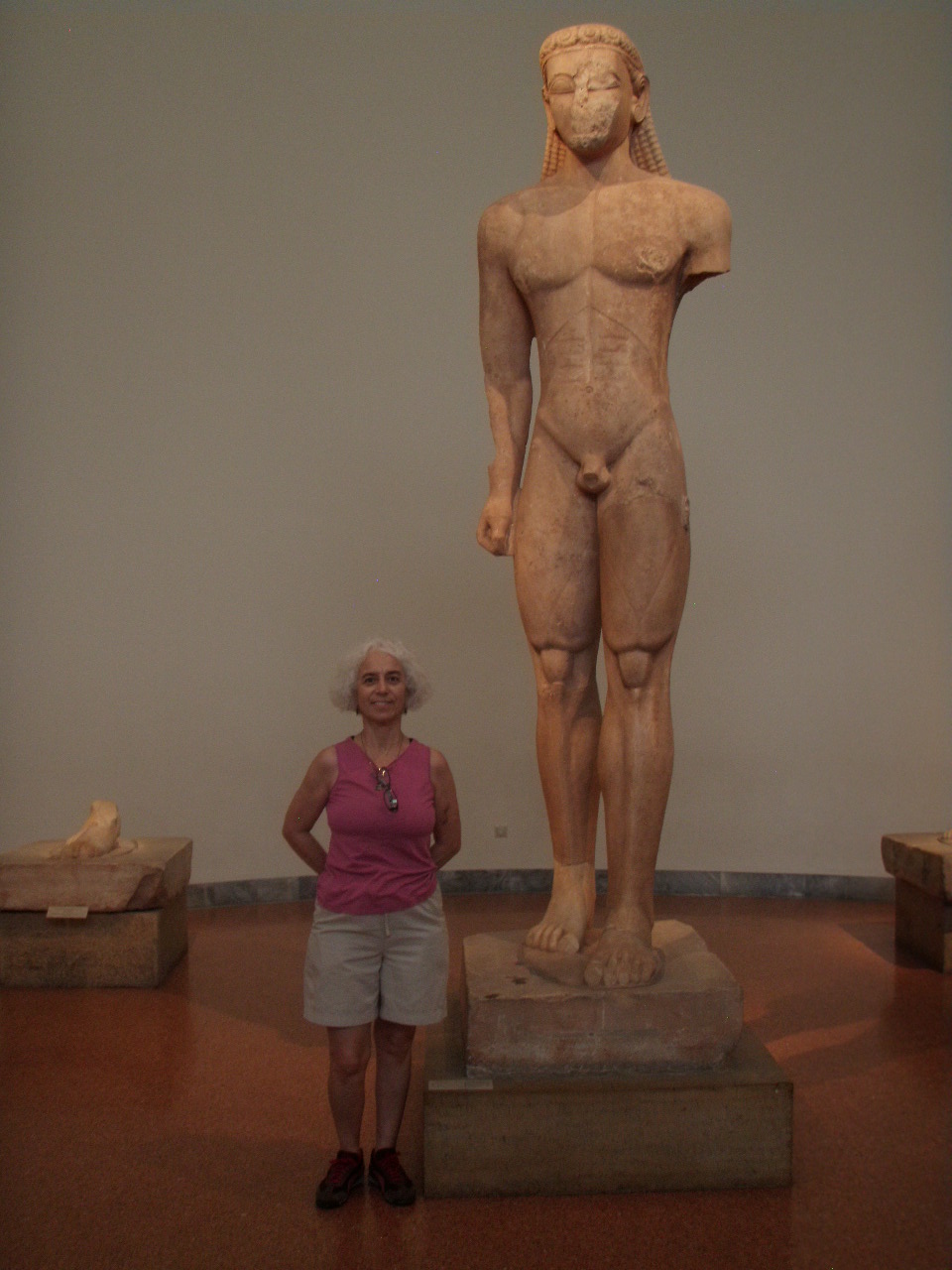
Here is the correct size of the impressive Kouros statue at the Archeological Museum

I might have felt something coming; instead of crossing the street, I stand by a post and put my arm around it. For a moment I feel like I am asleep and dreaming that I am revolving around the post in a dancing manner. Did I really flail around the post with vasovagal response due to the pain when my arm wrapped around it prevented me from falling? As I come to, I realize I might have, for a split second passed out. Feeling still somewhat dizzy, I walk the few steps to the wall by the curbside and sit on the ground. How we feel invincible with our body, until that one thing beyond our control happens and we discover, there are limits to what we can do, what we can control, and what we can change. What we cannot, we need the serenity of a clear mind and spirit to accept and the wisdom to differentiate between what is doable and what is not, which is my motto in life modeling after Reinhold Niebuhr. Finally, when I feel more stable, I walk across the street and in  short while, I am in the cool safety of the museum.

Two lions attacking a bull/cow

What an impressive museum. All artifacts chronologically ordered, from archaic times to classical, to Hellenistic, to neoclassical... How sculptures reflect the social norms, hierarchy, relationships, traditions, and artistic taste of their time. How saddening it is to recall all the stolen pieces I saw in Metropolitan Museum of New York City, British Museum in London, Museum of Greek and Roman Antiquities in Berlin among others. What would have this museum looked like had those precious pieces not been stolen?


Impressively ornate grave heads from Classical times

Or is it better that the museums of the west were willing to purchase those pieces from the intermediaries when the native governments and peoples of Greece, Turkey, Italy were not ready to protect the heritage of their own land? Being a citizen of the world, I don’t feel as resentful as I used to anymore replacing my old bitter feelings with “At least they were preserved for the entire humanity”. It is still good to learn that at least one American museum returned some stolen artifacts to the museum after a 10-year long litigation!


Monastiraki square and neighborhood

On the way back on our tour, I get off at the Monastiraki the center of which is characterized by an old mosque. To the right of the square are many “steno”s (narrow streets) with numerous shops and antique vendors. One of them has silver jewelry on display in glass covered wooden cases. The vendor turns out to be and Armenian Greek. What a combination; I tell him I am originally from Crete, born in Turkey, living in the USA, currently and extend my hand to a high five. He accepts it!. We are friends now. The bracelets I take a look at are beautiful but as pricey. No trade takes place but a few words of Turkish and Greek have been exchanged leading to a warm connection.
 

PanAthenean Stadium                                                      By the time I am back to the hotel I need a cup of Greek coffee. As I sip the last bit of my coffee, I see a young man looking at me intently. Sure enough, he turns out to be my driver, Costas. With his little bit of English and my Greek, we communicate well. Eventually, we even make a plan of him picking me up from the airport when I come back to Athens for the Fulbright reception next week. He is happy, so am I. I am leaving Athens with very warm feelings, yet, once again. I would like to use all my resources to help the wonderful physicians I met here during this past week, who would like to establish a national program to respond to child abuse and neglect more effectively. I have seen that they are capable and committed people. I trust they will accomplish this task. As I say good bye to my friend Costas, I am looking forward to my days in Crete with my friend Sofia and her very personable husband Michaeli, a pure blooded Cretan man! 


From the Great Britannia Hotel's rooftop restaurant, Acropolis is before our eyes with all its grandeur


Tuesday, June 7, 2016

GREECE 2016 - 3 - ACROPOLIS TIME

Since the exciting and also disturbing evening with the ultra-right nationalistic party supporters last night I have been trying to make sense of it. When I got back to my hotel room, it was all over Greek TV. With my baby-phase Greek, I couldn’t understand what significance this demonstration had on Greek political discourse. Apparently, the crowd that I saw was part of many groups that joined the big crowd in the Parliament Square. Later on I will learn from Golden Dawn’s blog that people from many countries in Europe joined in this demonstration. Is it Greeks from other countries supporting Golden Dawn or is it supporters of nationalistic movements from all over Europe? Not clear. The latter would be an oxymoron, but who knows didn’t the German Nazis collaborate with Italian fascists and Japanese invaders in World War 2? Yet, once I get to Crete, my friend’s son Manoli will tell me “Everything on their website is lies!” He is a trustworthy young intellectual.

 
This is the homophobic image from the Golden dawn demonstration that will stay with me from May 30, 2016 
 
Anyway, I was so exhausted last night, didn’t have the strength to follow “my” little crowd to the square, a few blocks away to see what bigger picture would have shown there. Instead, I returned to my hotel room and had an unexpected but unbelievably peaceful and uninterrupted sleep. This is a new good start since I usually have severe jet lag after each time I cross the Atlantic. I wake up refreshed and had to the courtyard breakfast. I love the breakfast layout. Olives, various types of cheeses from sweet (not too sweet), refreshing fresh cheese (in Turkish called tatli lor, in Greek mizithra) to savory including feta and harder and sharper cheeses. Various kinds of jam and marmalade in elegant, homey looking jars, fresh, crisp unsalted nuts including hazelnuts, almonds, pistachios, walnuts, all shelled, ready to mix with yogurt or mizithra and jams or honey.
 
Cheese and olives are a must for Aegean breakfast
 
I am pleasantly surprised that they have gluten free bread. Orea! It is frozen of course, but better than nothing. Although I brought a loaf of my own gluten free bread that I make every weekend in the US, I am pleased that I will have options.  I add a few slices of salmon and sprinkle them with fresh chopped dill. Last touch on my plate is chopped Greek strawberries, which are small in size and much sweeter than the large ones out of California or Mexico. I can't pass the very sweet Greek peaches. The several breakfasts I will have at Electra Palace on Plaka will prove that I can count on their taste every single morning. Mmmm, I am ecstatic with my platter complete with herbal tea.

 
Roman Agora in Athens Old Town

My colleague, who will join me this afternoon will tease me every morning with the amount of food I have for breakfast compared to his little bowl of yogurt with a few nuts! Once my tummy is happy, I have two things in my mind to occupy my day with. Find an ATM to withdraw euros to survive here, then head to a ticket booth to enjoy my day in Athens in the old town. National Bank proves to be the place to go again and I manage to withdraw cash that I need. A gentleman recommends me to start my tour at the Roman Agora and gives me pretty good directions. Partly with hand gestures and body language, but I am thrilled that I understand his "turn right"s, "go all the way straight"s, "then turn left"s in Greek! It is nice to hear that I can buy a 5-day ticket for multiple places to visit for only 30 euros.

 
Roman Agora in Athens 

Roman Agora is from 19-11 B.C., a donation of Roman emperors Julius Caesar and Augustus to Athenian people. It includes an Odeion (concert hall), a fountain, a temple for Ares, the god of war in Greek mythology, the son of Hera and Zeus.  It is not fully excavated, but the gate to the temple and the standing columns are impressive. After the invasion of Athens by the Herulae in A.D. 267 the city of Athens was restricted to the area within the Late Roman fortification wall, and the administrative and commercial center of the city was transferred from the Ancient Agora to the Roman Agora and the adjacent Library of Hadrian complex. The next stop is Hadrian's Library, who apparently during his reign contributed a lot to Athen's intellectual, architectural, and economical life.
 
Hadrian's Library
 
Hadrian's Library was built in AD 132 with a typical Roman Forum architectural style. The actual library on the eastern side of the complex was, where a few thousand rolls of papyrus "books" and official state archives were kept. Adjoining halls were used as reading rooms, and the corners served as lecture halls. Several important schools of learning and philosophy also occupied the building. Thus, the Library of Hadrian provided the people of Athens with a new, multi-purpose, public square and cultural center that contained a garden, works of art, a library, and lecture halls. The library was damaged by the Herulian invasion of 267 but repaired by Herculius in AD 407-412. The remains of the three churches built during Byzantine times are on the periphery of the complex.

 
The Agora Museum from the outside of the Archaic Agora
 
Third stop is the Archaic Agora. The Agora was the heart of ancient Athens, the focus of political, commercial, administrative and social activity, the religious and cultural center and the seat of justice. The site was occupied without interruption in all periods of the city's history. It was used as a residential and burial area as early as the Late Neolithic period (3000 B.C.). Early in the 6th century, it became a public area. The most visible structure from this best-known example of the ancient Greek agora, is the reconstruction of the Stoa of Attalos (aka Painted Stoa), which now houses the museum of ancient Agora.
 
Agora Museum from the inside of the building
 
The museum displays exhibits that are connected with the Athenian democracy and clay, bronze and glass objects, sculptures, coins and inscriptions from the 7th to the 5th century BC, as well as pottery of the Byzantine period and the Ottoman occupation. I had passed by it multiple times last time I visited Athens, in November 2015. However, it was such a work week then, I hadn't had time to visit the entire old town other than the Parthenon museum. I am glad to explore it inside and out now as I discover, the Archaic Agora is much bigger than the Roman counterpart.

 
One of many larger than life size statues leading the way to the Stoa of Zeus Eleutherios


The Panathenian Road cuts through the Agora all the way to Acropolis up on the hill right behind the Agora. As I head to the right, I see multiple larger than life size statues along a subtle, natural path leading us to the Stoa of Zeus Eleutherios (Freedom). This is the most well excavated/preserved structure on the site. I had seen it from the outside not knowing what it was in November. Now I do. Apparently, Plato mentions this place as a place to sit, relax and have conversations with friends! It is exciting to think of Plato having sat on these very steps I put foot on… I also discover that this Stoa is much bigger and impressive than what it looks like from a distance. A pleasant surprise about the entire Agora is that they identified all the native plants this place grew at the time the Agora was a bustling place in archaic times. The archeologists cleared away all the non-native plants and replaced them with the natives of 500-300 BC. Olive tree being one!  
 
Stoa of Zeus Eleutherios

Now it is time to head to Keramikus, the ancient cemetery, which was also the potters' quarter in archaic time, when the cemetery surrounded the quarter. English word "ceramic" was apparently derived from this very place and their activity. After the Persian attacks when Athenians built a new city wall for protection in 478 BC, the area changed fundamentally: All of the funerary sculptures were built into the city wall after the new wall was built and two large city gates facing north-west were erected in the Keramikus. The Sacred Way ran through the Sacred Gate, on the southern side, to Eleusis. On the northern side, the Dromos ran through the double-arched Dipylon Gate to the Platonic Academy a few miles away. I have to see what is remaining from his academy and Aristotle’s Lyceum during my next visit.

 
Native plants reigning the land of Agora for 2500 years!
 
I observe that numerous funerary sculptures are erected along the road that meanders through the site, some small, some very impressive; the latter being the statues of the rich and powerful. It is refreshing to find out that there was a time (317 BC) Athenian democracy banned by decree the construction of such lavish mausolea, following which only small columns or inscribed square marble blocks were permitted as grave stones. I learn later on that state graves were built on either side of the Dipylon Gate, for notable warriors and statesmen, including Cleisthenes, who led the establishment of democracy in Athens and Pericles, who carried Athens to its glory as well as to its final downhill demise with his greed to take over Spartans for good. As I head toward Acropolis, a hill 150 m (490 ft) above sea level, the final site to visit before I meet with my hosts for a newspaper interview later in the afternoon, I bump into a young woman, who asks me where Acropolis is.
 
 
One of the artifacts at Keramikus
 
I tell her I am heading there, she is very happy to hear that. Now I have a travel friend out of the blue! Her name is Elisa and is studying to become a paralegal as I understand with her little English and my almost non-existent French. She is pleasant, staying with the parents of a friend to where she needs to take the metro. When you have your accommodation covered, it is relatively easy to travel in Europe. Chatting about ourselves, we head up toward the entrance of Acropolis. Acropolis and its structures were impressive from afar, but didn’t imagine they would be this “glorious”. As it always happens to me before structures of this stature, I wonder again, who worked on making these structures of Acropolis possible. How many men, how many hours a day, with what provisions in the context of the new democracy in Athens? How did they manage to incorporate subtle visual elements into the Parthenon’s layout and achieve such faultless proportions and balance? And how were the Parthenon’s builders able to work at a level of precision, in some cases accurate to within a fraction of a millimeter, without the benefit of modern tools?
 
The Propylaia, entrance gate to Acropolis
 
I am awed with the fact that the ancient Athenians built the Parthenon in just eight or nine years. The Parthenon was being used for gunpowder storage during the 1687 siege of Athens by the Venetians and the Acropolis buildings were seriously damaged when the Parthenon was hit by a cannonball! After it’s gone through 2500 years of earthquakes, fires, luting, and war destruction among other things, its repair with all our tools has been into its 4th decade, and we are not anywhere near done, yet!

Akropolis is visible from almost every rooftop in Athens!

Repair of some of the largest Parthenon blocks, which exceed ten tons, by the contemporary masons may take more than three months, I learn. The ancient workers were no less painstaking; in many cases, the joints between the blocks are all but invisible, even under a magnifying glass. Once in the first half of 5
th century BC, Athenians decisively defeated the Persians and some 150 to 200 cities across the Aegean began paying Athens huge sums of what amounted to protection money, the Athenians under the leadership of Pericles, planned their new temple complex on a lavish, unprecedented scale—with the Parthenon as the centerpiece, which began around 450 b.c.
 
 
Akropolis behind me from another rooftop restaurant!
 
Apparently, the citizens of Athens had voted to fund this exceptional monument as reflected according to some scholars, by the frieze that shows a procession related to the quadrennial Great Panathenaia, or the festival “of all the Athenians”. The hill was inhabited since fourth millennium BC, but it was Pericles who coordinated the construction of the Parthenon, the Propylaia, the Erechtheion and the Temple of Athena Nike during the Golden Age of Athens (460–430 BC). First, the Propylaea, a monumental gate at the western end of the Acropolis with Doric columns was built between 437-432 BC. Along with and to the south of the Propylaea, Temple of Athena Nike was built between 421-409 BC. The elegant temple of Erechtheion was built between 421–406 BC with six Ionic columns to the east and a porch with female figures or Caryatids, to the southwest. 
Certainly, the most prominent structure, which is still being restored, is the Parthenon. After entering the Acropolis through the monumental gateway Propylaea, to the south of the entrance is the tiny Temple of Athena Nike. At the center, the Parthenon or Temple of Athena Parthenos (Athena the Virgin) rises monumentously.


East of the entrance and north of the Parthenon is the Erechtheum presiding over the archaic Agora. As we stroll through the west side, to the south of the plateau of the Acropolis on the hillside is the partially reconstructed Odeon of Herodes Atticus. As we move further down, we can also view the outdoor Theatre of Dionysus. I am glad that I can now connect the dots between all the valuable ancient artifacts of this “polis” that I saw in the Acropolis Museum last November and the actual Acropolis itself.  What if Pericles had sufficed with all his accomplishments and instead of dragging Athenians into a hopeless war with Spartans had led his people to more artistic and intellectual productivity? Could mankind have been better off? Just food for thought…I am still thinking about “why did none of the historical leaders of empires consider taking a break from wars and allowing their people breath and enjoy what they had” despite history showing them all time and time again that injustice always leads to demise of empires…

Theatre of Dionysus

Sunday, June 5, 2016

GREECE JUNE 2016 – 2 - FIRST DAY HALF ASLEEP HALF AWAKE: ULTRA-NATIONALIST DEMOSNTRATION IN ATHENS

A lovely taxi driver picks me up from the airport. His broken English and my broken Greek connect us perfectly well. I am discovering gradually that attempting to speak one’s language is a powerful connector. I wonder if this is the reason why we connect with some from the first moment on and not with others for long periods of time even when we speak the same language in dictionary sense but not deep down. I suspect falling in love has that element of speaking the same “language” or at least trying to understand one another’s love language. Can we solve the issues of the world if we start with caring about each other’s literal language first and move toward understanding their “language” of understanding and defining themselves, their culture, other’s cultures and more… Can humanity at the grass roots then hold hands together against the greed of men, who hold power all over the world through money, political offices, traditional confines and more?

Can olives be the binding "language" among the nations around the Aegean?

These thoughts will fill my mind over the next several days more and more, but at the time being, I want to absorb as much Greek language and culture as possible while I am here for three weeks. When I start asking him too difficult questions about Greek grammar, he gets confused, I feel he might be thinking, “Who is this woman, right out of the airport, with all these weird questions…” Poor guy, recognizing he doesn’t have any idea about conjugation, pronouns, subjects and objects, I decide “Leave him alone, Resmiye.” I am extremely tired anyway.

Or this shared evil eye: Can it establish friendship between Turkey and Greece once and for all?

He transfers me graciously to the hands of the hotel receptionist, who recognizes me from my previous stay in November. He is obviously in the business of tourism, but somehow I sense a genuine delight on his face even though he is not one of the very expressive receptionists that I met at this hotel. He wants to practice his English and I want to practice my crawling-phase Greek. We do well, each in our non-native language.  When I finally reach my room all I want to do is collapse into bed for a few hours. After an almost comatose sleep for 3 hours, I open my eyes somewhat disoriented. I have to get up and stay awake until late to get back to routine, in addition, I have things to take care of before tomorrow.


Metropolitan Cathedral was built in 1842-1862 and is testimony to religious leaders killed by Ottoman invaders and how Greek women were enslaved into Ottoman harems.

As I am looking for the National Bank to withdraw some Euros, I hear a beautiful chorus singing, on my way toward the Mitropoleos Cathedral in Plaka. Wow, it must be the evening mass on this beautiful Sunday. I am very excited to hear some music without understanding the lyrics, all the better: I love listening to church music; the peace, the harmony, the beauty of human voice dissolving in layers always draw me to it. As long as I don’t pick up a pamphlet and understand the lyrics: The too submissive, bigger power oriented, oppressive content destroys the peace I find in that beautiful music, meditation, if you will. As I approach to it though, I notice that it doesn’t flow smoothly: it is abruptly interrupted occasionally, then comes back as if there is a turn on-turn off mechanism involved. I will soon murmur to myself “No wonder!” when I discover it was indeed turned off electrically and turned back on when needed:


The crowd during the earlier hours of the demonstration by the right wing ultra-nationalist Golden Dawn party in Athens

I am finally on the plaza. To my surprise and dismay, the music is not coming from the cathedral, out goes my meditation excitement. This is clearly some political activity, but what kind? Looking at the number of Greek flags held by every person standing around the stage at the far end of the plaza, I wonder if this is a nationalistic demonstration. I ask the young women at a table selling books right around the heart of the crowd. They are celebrating the anniversary of Turks taking Constantinople from the Byzantines. For some reason, she makes sure I understand it is not a demonstration, but a celebration. When the women ask me where I am from, I reflexively tell them I am from “Americki”, no mention of my Turkish roots…

Archbishop Damaskinos is looking over the demonstration in front of the cathedral

I instinctively don’t feel safe to do that here, in the middle of this crowd when somebody hands me a pamphlet with the picture of the last Byzantine emperor: *** I wake up to full reality instantenously. I look at the banners, ancient Greek figures are in the middle of each banner. I am looking around to identify a “trustworthy” face to ask more. But I am keenly aware that my Turkish identity will not be welcome to this population, I need to be careful. I notice again that beautiful young woman with jet black hair with sharply trimmed bangs on her forehead outlining her beautiful enormous dark eyes. She is leaving the core crowd now and has pamphlets that she is distributing to the onlookers like myself.


As the hours go by, the plaza gets filled with demonstrators, who spill into the streets around the plaza.

One man sitting on a low standing wall rejects the flyer, I feel here is my guy. I pick up the flyer from her but stay with him and ask him politely to tell me what this is all about. He verifies for me that this is the nationalistic ultra-right Hellenistic party, demonstrating on the anniversary of the conquest of Istanbul by Ottomans. He has such an expression on his face I can clearly tell he wants to tell me “You don’t want to know this bullshit”. The disgust he feels is very clear and the same as I do. This crowd is not one, whose “language” I will ever be able to want to learn or understand. Neither will they mine or his and other Greeks’ that I had the honor of meeting all over the world. What to do then? Is there a way?...
Last Byzantine emperor's reign was what the crowd in the demonstration was hoping they could bring back!

I thank him and turn around to get a better sense of the crowd. That is when I see that large banner at the entrance of the plaza and this one is in English! Two words: STOP ISLAM. Wow, this movement has a homophobia component attached to it, too, which I am not surprised to discover. Although, I am not fond of even moderate Islam since even in its moderate form Islam clearly discriminates against women and limits women’s progress and liberation, I disdain othering Islam in political context as well. All of a sudden, I have a flashback from Donald Trump’s rallies, which has been poured down our throats in the USA for the last year. Trump works on powerless people’s need to gain power, who are in fact made into powerless individuals by the billionaire likes of Trump, go figure the oxymoron on who these people support to feel powerful. This party is working on the same social psychology principal: When I look around I see working class people all around and on the plaza, who are interested in bringing Byzantium back! Isn’t it exactly the same social psychology Recep Tayyip Erdogan’s religious party’s strategy when he works on low socioeconomic class’ need to bring back the “Ottoman glory” even at the expense of destroying Gezi Park and the natural treasures of the land of Anatolia?

Homophobia revealed by Golden Dawn ultra-nationalistic party of Greece!

I make up my mind that I will stay here this evening until this event ends and get a better understanding of what right wing and ultra-nationalism are doing in Greece. I walk back to my hotel room, pick up my lap top and camera and situate myself back at the Metropol café. As I eat my dinner, I will be a subtle spectator as I ask people innocently what is going on the plaza. I ask another woman with jet black hair what this is about since she doesn’t know I already asked the same question to several other people. Her English is poor, but she does tell me that the black T-shirts on many of the men have a text on them that means “I love my country”, which is supposedly the name of the political party organizing this event.
http://greece.greekreporter.com/2015/09/17/greeces-golden-dawn-leader-assumes-political-responsibility-for-rappers-murder/ Notice if there is any resemblance between Hitler's party and this one with their acts and symbols..

Passionate men are agitating some 200 people that are gathered on the small plaza in front of the cathedral with some 200 onlookers like me. Although I don’t understand what the agitators exactly are pouring onto the crowd, I can tell what the theme is with numerous Ellas, Ellada (different names for Greece), your children, your families, we lost, Turkia, long live Greece, in Istanbul, we are proud, why are we working, stop islam, negative comments that I can’t understand regarding the “guests” most likely referring to the Syrian migrants, etc: tying today’s problems to losing the Byzantine Empire to the imperial Ottomans. Their agitation is frequently self-interrupted with slogans that their small crowd excitedly joins in with their voices and applause.
http://www.telegraph.co.uk/news/worldnews/europe/greece/11548387/What-is-the-Golden-Dawn-trial-about.html Their slogan is: Blood, honor, golden dawn (At least they are honest about their intended blood shed)

As the speech goes on, torches appear in the hands of a quarter of the crowd. “Romantic and nostalgic”, I murmur to myself. The crowd is invited to join in some songs and marches. To my surprise, the woman at the next table with jet black hair and fiery lipstick is singing along with her friend that now joined her.  I am glad that she doesn’t understand English well now that I am typing up my observations as I eat my dinner. Finally, some additional smoke effect is created by whatever they use. Now the crowd is lit by torches and breathing industrial scale incense. Well staged, I think to myself.  This is apparently the end of the propaganda. Now they are invited to head to the downtown plaza in front of the parliament.
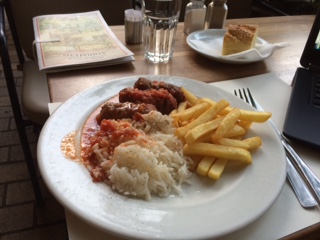
As I tried to keep myself at a safe difference from the lunatics across from the street,  devoured this low quality but gluten free dish.
As they leave, I tell the waiter I’d like to pay and ask him as well what this was about since my neighbor has already left. He is dismissive and tells me something to the effect “they are a bunch of lunatics, my ears were eaten away for three hours now”. Good this young man understands politics with more sense, I am happy to observe. As I leave, I see that the priest that came to the same café earlier for a quick dinner is standing in front of the cathedral. I decide to go into the cathedral for my belated meditation. Alas, there is construction in the church, no meditation place at this point. As I am leaving, the priest is still in front of the church.

The gentleman in the middle is the one in whose hand I had the "honor" of resting my hand a tid bit too long... Maybe he was only well meaning as a father, I want to believe.

As I greet him with “Kalispera”, he hands out his hand and first holds my hand “Hmm, interesting” can’t help wondering about clergy and sexual abuse scandals and how this plays out in Greece. I let him be and we start chatting in Greek, my hand in his while he is holding it tight. I tell him I am from Americki but that my grandparents were born in Crete.

I saw only a few hundred supporters of Golden Dawn party at the Cathedral Plaza, what about the tens of thousands Erdogan brings into the squares after all his corruption in Turkey?

I feel like my hand was in his for long enough, but he continues holding it as tightly as he started. I ask him what this meeting was about. He is the most honest, he says this party Golden Dome, is the far right small ultra-nationalistic party in Greece, and is comfortable to say that “they are nuts!” because they are yearning for the Byzantine times. By this time, I manage to get my hand out of his for a bit, but with another question, he grabs my hand again. My goodness, it is almost like “for every answer I hold your hand for as long as I provide an answer to you”. I let him, he is as old as to be my father, and besides, he is a pleasant man with more or less good politics. But a question bothers me still: These nuts are the small minority in this society, but the nuts in Turkey going after the same yearning have been the majority for at least a decade. What does that tell about where Turkey is going?

At least in Trump's rallies, there is some element of protest of him, too! In Turkey and Greece, we would be too scared to do anything like that.

As I leave the plaza, I am pleased that I am exposed to a right wing demonstration in Greece in addition to the left wing one I had witnessed last November. I must say, I didn’t like what I observed tonight, one single bit, just as I wouldn’t have had I ever found myself in an AKP (the Turkish religious party) demonstration or in a Trump rally. I will feel sad in the next several days when I have the opportunity to talk to very trustworthy Greek friends of mine that the current left-wing government that came to power with great promises is not doing well at all to satisfy its people’s needs and preferences, either. The world is indeed going through a difficult time of transformation.

http://www.sharing.org/information-centre/articles/uniting-people-world

A very lovely entry on how we need to unite around helping the world and helping all of us without any divisiveness. That is the only way to get rid of likes of Golden Dawn, AKP's Tayyip Erdogan, and Republican Party's Donald Trump.