Thursday, August 17, 2017

MACHU PICCHU PERU 2017 - 7 - GLACIERS TO OLLANTAYTAMBE TO MACHU PICCHU


Waking up to a proud Andean peak covered with glacial cap in the morning is a treat

After the most strenuous hike of my life between 3700-4450 m (12,139-14599 ft) yesterday, I slept like a baby back at 3700 m elevation from 8:30 to 5 am. As soon as we had our dinner and retreated into the warmth of our tents and sleeping bags, a peaceful but steady rain commenced. It was a lullaby not only during my end-of-day meditation that put me to yet another delicious sleep, but also throughout the night every time there was a break in my sleep cycle. As I wake up to the “agua caliente” treatment of the day, "the room service" as our guide loves to call it, our campsite is much more appealing:

Chris, our Aussie friend and our guide making plans to climb to the glacier behind Ollataytambe

The fog and clouds have cleared away after the purifying rain. I can now appreciate much better that the lovely meadow we are on looks down on Ollantaytambe and much better, yet, the mountains to its west covered with glaciers are on display before our eyes! Chief guide and Chris are already making plans for a trek to go to the distant glaciers that are cherry on top of the cake for all of us this morning. Ollantaytambe is established in the Urubamba Valley just like Qusqo. The river that traverses the valley is naturally, Urubamba River that will find us down below Machu Picchu after our train ride to Agua Caliente.

Event illiterate peasants are aware of glacial retreat all over the world except for select politicians in America!

Our guides will tell us how fast the glaciers covering the peaks of the Andeans around the Urubamba Valley are receding due to global warming. I wonder if Donald Trump ever visited Machu Picchu, or Greenland, or any of the countries that are being hugely affected by global warming. I wonder if any of his tour guides told him about global warming… How am I going to apply equanimity, loving kindness, compassion, and joy based meditation practice to this man, I still don’t know. Maybe I should go and do a childhood interview with him to understand what kind of trauma he experienced that led to his loss of empathy, led to this level of self-centeredness and afflicted him with his narcissistic personality disorder comorbid with pathological lying.

The crew and us trekkers against the Andean glacier

As I come back to the moment and look up, I can’t help but deeply appreciate the inexplicably majestic grandeur of the glaciers before our eyes. My companieros must feel the same: Whoever comes out of their tent, can hardly catch their breath in a gasp, goes back in, grabs a camera or a cell phone to memorialize this breathtaking view. No wonder…This view reminds me of Grand Teton and my campsite right across the mountain some years ago. Similar elevation, similar relationship between the campsite and the glaciers. The only difference is that here below the glaciers, there is a city stretching her arms in all directions, Ollantaytambe.

Last picture before leaving the backdrop of the beautiful glacier with our two wonderful guides

Below Grand Teton on the other hand is the elegantly wild and charming Jane Lake. How can some people not see how important and essential it is to preserve the earth with all its resources and beauty? I think of what a visionary Theodor Roosevelt was and send him my thanks across decades one more time. His litigation of the national park idea way back I believe preserved millions of acres of wonderland in the USA. Another kudos to UNESCO that does the same for the earthly heritage of the world among other places.

Ollantaytambe sprawling in the Urubamba Valley down below from our last campsite

This morning the delivery of hot water cups and plastic bowls to our tents is set for 6 am, since we have little left to get back to Ollantaytambe. I don’t know how the crew slept in the dining room tent, when we were all “semi-frozen” before going to our tents after the side zipper had broken last night. Chief’s defense against our worries for the crew is again “they have sleeping bags”. We learn more about their income today. Apparently, in Peru minimum wage is 750 soles. Intrepid reportedly pay the crew 1200 soles a month and with the tips they get from once a week treks like this, they may make up to 1500 soles a month (twice the minimum wage). Looking at the math, it sounds like a win-win. But I am still not able to shake off this feeling of being ashamed of enjoying their services when they work under such harsh circumstances.

Looking at the pictures after return home, I realize I had a significant altitude sickness: my face is pretty swollen even on the last day of the trek

We finally arrive back in Ollantaytambe. We pick up our bags at the river and carry it to the train station where we catch the Peru Rail train to Agua Calientes. It is the last town before Machu Picchu. We are all excited that we will have a shower! These luxuries of modern life that we take for granted… It’s been 3 days since I haven’t taken a shower, I will so appreciate one this evening with another good dinner. The railroad is at the bottom of the valley parallel to the river. Sometimes the mountain rises right alongside the train, sometimes at a distance allowing some cultivated land, mostly with multiple layers of terraces that Incas created. It is a beautiful ride.

Towns, river, railroad, and agricultural land all fit into this long and narrow valley

Agua Calientes is clearly a touristic town. The crowd is almost like those we see on TV in China or India. Other than shop keepers, everybody is from a different country. My travel book tells me 2 million visitors pass through Machu Picchu every year, pretty much all of which must go through Agua Calientes: This is probably true looking at the crowd in town this afternoon. Peru must be generating significant revenue through the Inca culture. As soon as we get to town, we are placed in our respective hotels to meet at a particular restaurant in the evening.

I love it when the nature frames its own beauty

I first take a walk in and around town to get a true sense of it. It is indeed a tourist center catering to tourists. I find a local farmer’s market in one of the buildings very similar to the one in Cusco and Ollantaytambe. The main street, which is on a very steep slope, some half a mile long is lined with souvenir shops and eateries.  Our guides are right that everything here is double the price of those in Cusco. Satisfied I go back to my hotel to rest and get cleaned up. When we meet at dinner, we are all unrecognizable to one another.

Railroad along the river all along the valley to Machu Picchu

Hats and caps gone, hair washed and let down, faces shining with cleanliness, we all have been transformed into different beings, which one is real, who knows. I can’t help thinking “The beauty may be in transitioning from one another gracefully and peacefully when the situation calls for it”. I also feel like we have indeed become a family as our guides have come to call us. We are acquainted to other members of various tours run by Intrepid. Some did Inca trail, some Quarry trail, some just took the train to Agua Calientes. Among the people who have done the Inca trail are my peers! These are men and women of my age with quite an experience in hiking and trekking, who had acted much earlier to secure a spot on the Inca trail for themselves. We all laugh together on some stories, occasionally smaller groups of twos and threes confide in something privately just like one young man confides in me with his conflicts with his girlfriend. I hope I was able to give him some guidance on how he can try to understand her better to be able to resolve the conflicts.

During my stroll through Agua Calientes, I come across a kids group preparing for a dance show in town: Had my personal show!

Everybody is comfortable with one another, we have gone through quite a bit and helped each other out to make the best of our experience. Looking around, I can easily see the shining good core in each and every one of my fellow hikers and guides. I go to bed earlier than the young people, who are planning to go out and drink chicha or pisco sour, both Peruvian national alcoholic beverages. Our set time tomorrow morning is 6 am at the bus station to catch the bus for a half hour ride to Machu Picchu. Our chief guide will be with us until 11 am and give us a guided tour. Then we will be on our own until 4:30 pm to catch our train to Ollantaytambe.

A small-built Andean man is pulling this entire load!

Waiting in the bus line is an experience in and of itself! At 6 am, the line, at least 3-4 people wide, goes up the hill for at least two blocks. I am smiling to myself  thinking “I would never believe there are this many ‘crazy’ people on earth”, good to discover that I am not alone at age 58! Apparently this bus company has 25 buses and the first shift is at 5:30, running all day long non-stop. UNESCO apparently recommends no more than 2500-3000 visitors per day, but our chief tells us this limit is definitely exceeded. Since Intrepid handled all travel expenses, this is the first time I am noting the prices associated with each ticket:

Another scene from human panorama in Aguas Calientes as we are waiting for the bus at 6 am

Train ride from Ollantaytambe to Agua Caliente was $67 one way! The short bus ride costs $12 one way, and the entrance fee for MP is $45! Wow, Peru must be generating quite a bit of revenue off of this valley and Machu Picchu.
I turn my attention back to the human scenery. In the line there are all colors, all ages, all ethnicities, all nationalities, all of any identifier you may think of except for the poor. They are on the streets working: A man pulling almost a wheel barrow loaded with a dozen of huge bags of who knows what: As he passes by our disbelieving eyes, I can tell his load is unforgivingly heavy; he is folded into two.

One third of a bus making a U-turn hanging in the air over the river in Agua Calientes: It will take us to Machu Picchu

Another man is pulling  a cart loaded with a dozen or more steel wires of 3-4 inch-diameter that extend off the cart by some 30 feet dragged by a tractor like vehicle with several men on top or around the wires all collaborating to get the load up the steep slope. Most likely carving the road to a certain extent with the weight of the wires, who cares! The buses make a U turn at the top of the street we are lined up, with 1/3 of their back hanging off the sidewalk onto the river bringing a gasp to my chest when I see the first one doing it. I wonder if any bus landed in the river with this practice… As the natives work as they did in the Inca time, we, the lucky minority in line, are heading to the most exceptional place to visit in South America...


In half an hour we will be there after a beautiful ride as the sun tries to rise above grand Andean peaks

XXX

Saturday, August 12, 2017

MACHU PICCHU PERU 2017 - 6 - THE HIGHEST ELEVATION I CLIMBED TO


This is where we came from to our first campsite

The delicious sleep I submitted to after the first day of our hiking on the Quarry Trail lightens toward 5 am, no wonder, I fell asleep at 8:30 pm last night! As I start my meditation on joy and happiness with a smile on my face dedicating my meditation to my daughter (a loved one), to a colleague (a neutral person), and to a trauma victim, somebody that made my life somewhat difficult), I start recognizing some movements on the campsite. Soon it becomes clear that the crew is up and about. Around 5:30, somebody shakes my tent and says “agua caliente”. I unzip the tent, there is a cup of hot water in one hand of Andres, one of the horsemen, who won’t have eye contact with me. In the other he is carrying a small basket with tea, coffee bags, and coca leaves in the center.

Clever and delightful Mercedes from Canada, not only washes her face but also her worn out feet in the morning

I pick up an Anise tea bag, which has become my tea of preference in Peru and thank him. No response, he walks away. I will ask later our guide whether I do something that is not culturally competent. He tells me the lack of eye contact is just because of mountain men being shy! How similar to mountain men from Turkey: A city girl or a woman is a creature they don’t know how to interact with, relate with, safest way to respond is no eye contact, no conversation…As I am putting on my hiking clothes on and sipping my tea, he comes back with another “agua caliente”.

Our dining room is already set for breakfast at 6 am!

By the time I unzip my tent again, I find a white plastic bowl of hot water in front of my tent and catch him with the corner of my eye as he is moving to the next tent; I assume it is to wash my face. I look out there is one of these bowls in front of each tent! This must be the “room service” the chief was talking about last night… I do wash my face, put on my glasses and get out of the tent. All my warm clothes that I brought with me are on me along with gloves, and a shawl over my head. I can barely keep warm against the whipping Andean wind.

Wild flowers find life even in this harsh terrain

The crew members have one single sweater on: “Are they are much better acclimated to this unpredictable weather or do they shiver as I do just because they don’t have anything else warm to wear. I hope it is the former as many people that I met in the past up on the mountains of Turkey. They would be perfectly fine in one or two layers of clothes when I would be shivering in multiple layers that got me the nickname of “plains’ sheep”! We have a lovely breakfast and as the crew is breaking camp, we are getting ready to leave for our second and hardest hiking day.

Hiking in the fog has a different taste making us one with the nature

It is great to see that the crew has already prepared boiled and cooled drinking water for us all to replenish our bottles and reservoirs. As we start climbing up our trail winds around the village of Rayan, and from this point on there will be no other villages until we reach the summit at 4500 m. and wind down back to Ollantaytambe. As the chief guide promised us, it is indeed up and down. Just as we believe, we have reached the highest point, we start heading down and our guide points out to another peak in the distance that we need to get to. At the very beginning of the hike, I tell the chief guide, if it seems like I am slowing down the group at any point to let me know to use the horse since we have to finish this hike on time to get to our campsite before dark.

Leaving Rayan as the crew is breaking camp, 6:30 am on day 2

We are all in the same misery. Altitude, exertion, weight of our bags, although the major weight is carried by horses, and straight up hiking in order to shorten the distance. The stretch of the line of hikers is getting longer and longer… Two women and I are in the rear half of the line now. I can’t help but recall the experience I had in The Rocky Mountains National Park in the US some five years ago. I had done a very strenuous hike of 14 miles with 1500 feet elevation gain. I had run out of water half way up, sustaining myself with the powdery snow layers that had appeared on my path as I climbed higher.

One of the many steep climbs we will endure on day 2

Two thirds up the hike, I had lost the trail when I bumped into a huge snow bank that covered a city block size of an open space. In that sense of being lost, until I finally connected with someone, who directed me to the trail, I had been extremely stressed out. When I had finally gotten back to my tent that night I had wild arrhythmias all night long that hadn’t allow me to sleep. When I finally got it checked out, the reassurance was that there was nothing wrong with my heart but I should never bring together, high altitude, dehydration, exertion and stress to avoid recurrence of this again!

Rayan is way behind us by mid day

Here I am at the highest altitude I have ever been in my life, exerting myself like no other, and the insidious worry in my mind about arrhythmia is lurking right below the surface, can I call this stress? The only element that is absent is dehydration since I have been drinking a gallon of water a day for the last three days… We are in the middle of the trek, going back if I develop arrhythmia would be as much exertion as going forward. I hear we have only half an hour to the first peak… As my mind is busy with these thoughts chief looks at me and says “Hatun Mamako, would you like to take the horse a little bit?” His previous worries were unwarranted, but this one I may need to take up on. And I do.

7 hikers spread on a long path by mid day

I am so glad I rode the horse for about fifteen minutes to cover about half a km up to 4400 m elevation: I got to know Isidro, a 68 y/o man, who has been living up on these mountains all his life. That’s when I see that he has only plastic flip flops on his feet. He has a unique communication with his horse. We talk in Spanish as much as I can put my thoughts into Spanish words. We connect, we become brother and sister. When we reach the peak, I give him a hug “Gracias mi hermano”, he smiles and responds to my hug with a warm, strong hug. It nails down our brother-sisterhood. When at the end of the trek, I give him an extra tip in addition to the collective tip for all of them, there is no change in the shining in his eyes, since we connected at a deeper level than any money-changing-hands can reach.

On the last day, Andreas on my left and Isidro on my right

The summit is harsh, with its wind whipping any exposed skin patch we might have left uncovered, with its cold, and its clouds moving at lightning speed: One moment the horizon is lined with the zigzag of the glacier topped mountain peaks; the next, clouds have sunk into the valley obscuring all the nature’s wonders from view. It is fun to be the photographer of all my fellow hikers, who are all putting all of what they have into this final stretch of the climb. Once we are all up there, our chief commemorates our camaraderie and takes photographs with everybody’s camera/cell phone. After this upright rest, we all start our hike on the crest 50 more meters of elevation gain to cover.

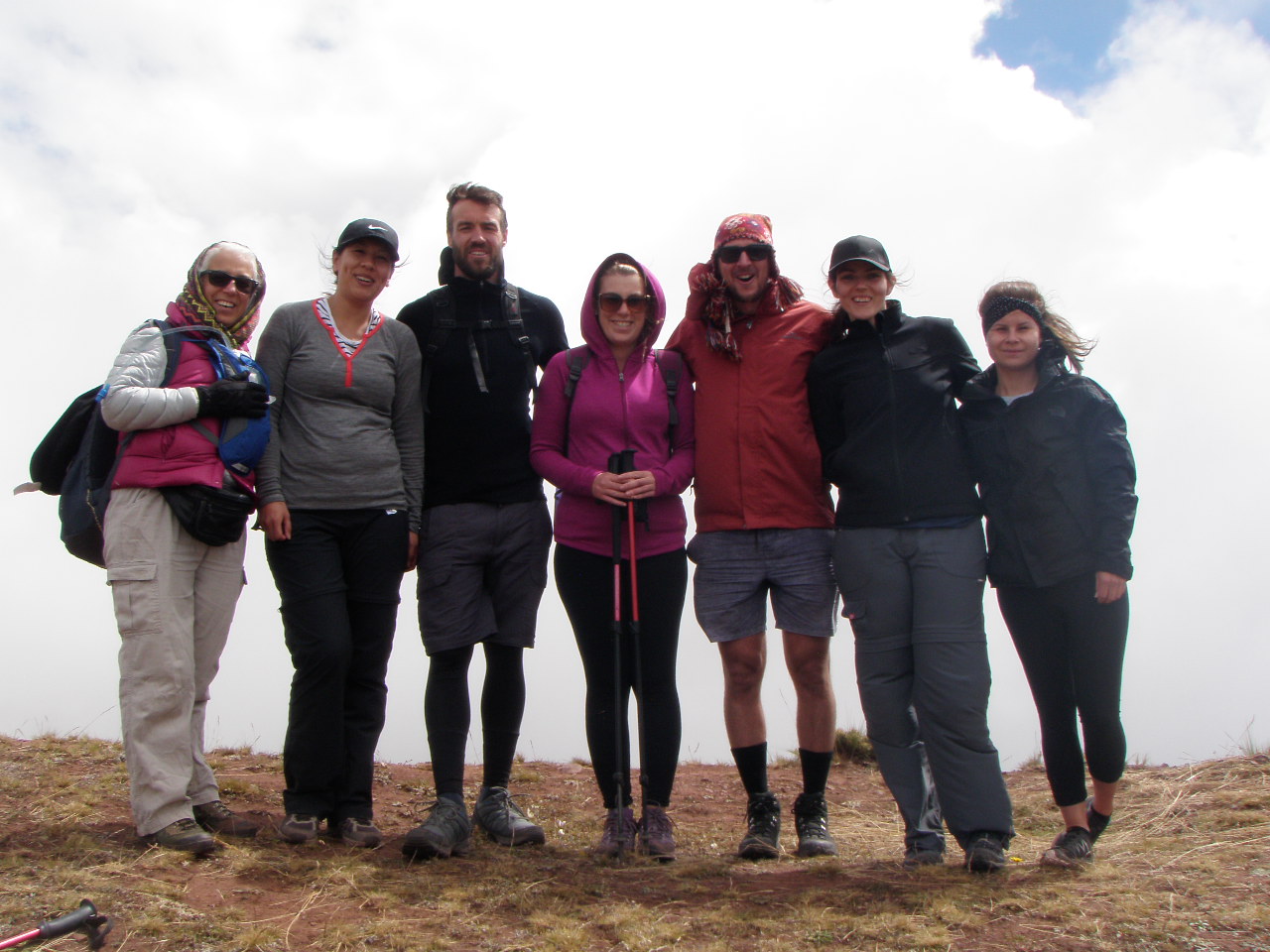
The group, at the highest point of the trek at 4450 m elevation

Reaching the highest point at 4450 meters (15000 feet) is like being on top of the world. When I lie on the ground, every single muscle and bone in my body become one with the earth, another episode of feeling the sense of interbeing. Such peaceful rest without a headache, without arrhythmia, without fear is the greatest gift Andean mountains could give me, of course not knowing what else it holds in store up the valley. We have our lunch here savoring the panoramic view below us. There is such energy in the harshness of the mountains, rising almost from the center of the earth. Yet, the rounded tops make them friendly and inviting. We are in the embrace of one of them at this moment.

From the summit, the villages down below appear and disappear to the content of the fog

After we have all been energized, the climb down starts on the surface of this very mountain, on hidden switchbacks through the bushes and trees, we make our way down toward Ollantaytambe. It is a long long hike, after some 5 kilometers of this harsh down-hike we finally come to somewhat more flat terrain. Some of the hikers go with the chief to see one more Inca artifact. All I want at this point is to get to a flat surface as quickly as possible. Half of us head to the campsite based on the chief’s instructions. Nickie is very tired, too. When we finally see the campsite from 1 km away, we cheer up.

The backdrop lost in the fog descending from the summit

It is a beautiful meadow about 100 m above Ollantaytambe. It is rainy, misty, overcast. We can’t see much around us, but our tents are up, kitchen staff clearly is busy getting ready to feed us with yet another delicious feast. It feels like I am back home! When we are finally there, Andreas is waiting by the “sink” to help me with the warm water container, soap and paper towel. I give him my thanks one more time and our eyes meet. He is still shy but has shimmering light and warmth in his eyes this evening with no fear or avoidance. We smile at each other, which will recur multiple times throughout the rest of our trek.
As we descend to our second and last campsite around 6 pm, our tents are all put up on a beautiful meadow overlooking Ollantaytambe

Thursday, August 10, 2017

MACHU PICCHU PERU 2017 - 5 - HIKING AWAY FROM OLLANTAYTAMBE MINGLING WITH LOCAL MOUNTAIN MEN


We will hike way behind these peaks right behind Ollantaytambe

We are heading toward our trailhead gradually for our first day of hike on Quarry Trail, toward Machu Picchu after having spent merely, 36 hours in Cusco. We come to a stop after a few kilometers of drive. I consider, we must have arrived. at our trailhead However, there is something funny going on, on the bus. Rather than getting off, everybody surrounds Becky, who is sitting on the single seat across from me. Apparently as I have been devouring the beauty outside the window, I must have not notices that she has vomited all over the place.


Dear John, victorious just before he starts vomiting due to Entamoeba Hystolitica dysentery hitting him viciously

The doctor and the mother in me are triggered right away, but other people have started helping the poor girl already, who seems very pale and upset, a bit embarrassed, too. She is barely the age of my daughter, perhaps younger, traveling alone, I will learn soon. We help her clean up when the team cleans up the mini-bus, on the floor of which there is now a small pool of what she must have eaten at breakfast.  We take her outside to fresh air. They decide it was because of the breakfast she shouldn’t have had. After all the cleaning up is done inside and outside the bus, we are asked to get back on. I then realize we had stopped just to help Becky, we have some more ways to go to reach the trailhead.

Our crew preparing our load to be carried up the mountains on horseback

When we arrive at the actual trailhead, there are several horses and horsemen in addition to our cooks and guides waiting for us in a lush green, open space. Spread on the small flat area along the railroad is vast number of bags, which apparently are carrying the tents and similar accommodation material we will need. There are plastic boxes loaded with vegetables, meat, and fruit, too. Seeing the meat out in the open on top of other food just as I saw it in the market the other day makes me wonder whether there will be any refrigeration of the food. I recall again Isabel’s order to be careful about diarrhea.

Crew and the hikers all busy getting ready for their own hike

As we are grouping for the hike, the crew is packing things further over the horses’ backs when I notice plastic stools. Apparently, they will have us sit on stools while eating, that is a nice touch. All the information I get about what is awaiting us up on the campsite comes from what I observe down below, which is not much, might also be incorrect and incomplete. As I am busy with these observations, the call “Vamos!” comes. We are ready to walk. As is my usual, I line up right behind the guide not to fall too much behind as we start exerting ourselves. The moment we start, the slope is already about 15-20 degrees, scary… That whisper of my monkey mind is there: “Will I be able to keep up with these youngsters here?”

Everybody in my hiking group is between 25-35 with a big hiatus of years between their age and mine, 58

To my great surprise, I will never fall behind on this first day. The young women especially are exhausted right away. Becky and another Brit John are way behind us with the assistant guide. Soon, chief guide gets a radio message from his fellow, who is bringing the rear end of our group, that Becky is feeling worse, in addition to her vomiting one more time, John, the other physician in the group also started vomiting. They decided to go back to Ollantaytambe. Wow, that is not good. We feel both sad and down wondering if anybody else might get sick. Soon we learn that Scott is also sick, but he is not planning to go back…

Scott, despite his severe gastrointestinal illness never giving up, makes the entire trip with no complaints and very little food in him

We are now down to one guide, who will bring the rear end? All of a sudden, another guide emerges out of nowhere and fills in the gap the assistant guide, who is now taking Backy and John back to town left. Wow, these guys are very well organized! By this time, we have passed through the village of Racq’a. Some communication takes place between horsemen from the village and our guide in the process of Becky and John’s delivery to Ollantaytambe, perhaps to use their horseback service. Our guide takes the first coca leaves bag hanging down his backpack shoulder strap and hands it to one of the horsemen as a gift. The men are happy. Shortly after this ritual, another bag out of our guide’s backpack replaces the one that changed hands. First-hand witnessing of this ritual that I have been reading in travel books warms my heart and brings memories from the Taurus mountains in Turkey. Mountain people are so similar wherever they may be on the earth’s diverse geography.

A variety of bags with diverse ornamentation are created as pieces of art to use as containers for coca leaves: One is supposed to accept these bags with two hands!

We haven’t seen the horses and horsemen in our own team at all, it is possible that they are taking a short-cut. Although short (6 kms), this trail is up and up and up. Focusing on our steps to make sure our footing is secure while stealing glimpses of the wild and harsh beauty around us is meditating. One must be mindful of every movement of the body, especially feet in this rugged terrain, hence the meditative nature of what we are doing.  You cannot multi-task. Even to enjoy our surroundings, we must stop and take in the visual beauty or take photographs. That is one of the many things I love about hiking in difficult terrains. And perhaps that is why life seems to have slowed down up in the mountains and remote parts of our earth.

After the crew leaves us on the trailhead, we don't see them until the campground again, they either go very fast or take a didfferent route than ours

We stop and look back every half hour or so to see how far we have climbed up and to enjoy the sense of elevation as we rise above the deep valley and Ollantaytambe disappears from our views. On the way to our campsite, we pass by a beautiful waterfall, where we all catch our breath while lots of pictures are taken. As we climb up further up the mountain, we pass by an Inca site, which seems like it was restored with some extra effort. This makes me recall a statement in one of the books I had read that was critical of some of the Peruvian government’s efforts to restore ruins into their original form. I wonder if this one is one of those excessive efforts. Our guide announces that we will go there late afternoon and will receive our first history lesson.
The waterfall we just passed by on our way up to the campsite from afar

Around one o’clock, we are all happy to have arrived at our campsite. The young women were told on the trail, this was the most difficult day and they are hoping tomorrow will be easier. That is not my understanding, tomorrow is 16 kms and it will be constant up and down with a net 800 m elevation gain (gross elevation gain, much more). How can it be easier? Sure enough, our chief guide makes it known that today’s difficulty and tomorrow’s are of different calibers. “We will make it ladies, no worries”. I smile… I am stunned when I look around our campsite: All our tents are put up. There are two big tents, I assume one is the kitchen, what about the other one? I peek into it, my goodness, there is a table  complete with a light plastic table cloth, plates and metal silverware already set! And the plastic stools I saw down below are around the table: This is our dining room!

Inka site on our way to the campsite, a bit too restored?

At the far end of the flat is the bathroom, another tent, in which there are two toilets with heavy plastic bags in each: One is for “light business the other for serious business” in our guide’s terminology. There is toilet paper and a salt shaker we can use for serious business that eliminates bad odor! I had never expected and never had this kind of luxury out in the nature in my close to 30 years of hiking all kinds of mountains both in Turkey and in the Americas…

Mercedes is in meditative trans with a most delicious vegetarian dish on our first lunch on the trail: this is in our dining room tent! 

As they announce that lunch is ready, we are asked to line up before a plastic container with a faucet to wash our hands with soap. A crew member helps us use the warm water out of the container and hands out paper towel when we are done. I feel like anew with clean hands. As we settle down around the table in our dining room, the most amazing corn soup I have ever had is served. I must confess with the first lunch, the thought that crosses my mind is “it tastes so delicious because we are so wasted and hungry.” But meal after meal, we have the best food I will have eaten in Peru out of Achiles’ kitchen. We hope and tell him that we wish he can open his own restaurant some day.

Achiles, our cook, in his kitchen with sue chef! 

The soup is followed with grilled hellumi cheese: They use the same name as we do in Turkey for this particular cheese, unbelievable! The same cheese is produced on two different continents and acquires the same name, can that have happened just by chance? I will be pleasantly surprised to find many common practices between Turkish culture and Inca culture including some words such as Hatun in Hatun Mamako, the name our guide gives me at the end of our trek:

Our dining room and kitchen tents on the second campsite!

Apparently, Hatun Mamako is the terminology used to address a respectable older woman in Quechua culture! I tell him that in old Turkish culture Hatun is the title of the Queen or of women of power. That will be quite an honor for me to win this title meaning as an “older woman” (ah, my white hair gets me this sometimes unspoken sometimes boldly expressed title) I didn’t do that bad after all among these young people.

Close up to our dining room tent!

Hellumi cheese is accompanied by avocado halves filled with chopped fresh vegetables. All is delicious and we all devour the food in an instant! Time to visit our tents and get established before dark. The chief tells us to rest a while with a promise that we will be woken up at 4 pm to go to the Inca site nearby. I am somewhat worried about whether I will be warm enough at night. We have rented sleeping bags from Intrepid along with walking sticks. Sleeping bags come with an additional fleece lining, which is good news for me.  I prepare my bedding, take off one layer of my clothes and get in it for a nap. In no time, my body is as warm as fresh-baked cookies. I start meditating to the mild breeze, birds chirping and foot steps of some of our campers.

The chief guide in the front plane gave me the nick name of Hatun Mamako (old woman, but respectable!)

I wake up from a delicious nap that I haven’t had for a long long time with the chief’s voice asking me if I will join them. Certainly I will, is he worried about me? I feel rejuvenated after my unintended exquisite nap and get dressed in no time. We form a line as we start climbing up the narrow path leading to the Inca site. As we approach it, I have yet another de ja vu experience. This site is so similar to Hitler’s Eagle’s nest near Berchtesgaden National Park in Germany.

Approaching the Inka site from the mountain side

On top of a hill, at the very edge of a cliff, looking down on a very deep valley and controlling the valley that we traversed from all directions! The structure of course is quite different, but geographic orientation is identical. As we move about it, I can’t help thinking again that this looks like a model Inca structure that was restored by the government a bit too much (as one my travel books claimed). When I share with our chief guide, what he thinks about the author’s thoughts, he adamantly denies it and I see that he is a bit upset.

The fortress has full command of the valleys and villages down below just like Hitler's Eagle's nest!

I realize that he may not be open to discussions and debate on what he presents. I will take this into account in my conversations with him from now on. After all, I need to be respectful of the natives’ views of their culture. His history lesson verifies a lot of what I already know from reading the Andean awakening. However, his presentation is very scattered, perhaps his English is not at the quality that a top notch guide should have. What I have read already helps me ask appropriate clarifying questions, too. All in all, it is a positive exchange although I feel like our guide glorifies the Inca culture a bit too much.

This original Inka stone structure that we saw at the fortress is totally different than the small stone/mud walls of the fortress

When I ask him about human sacrifice, although he accepts it, he loses eye contact, looks away giving me the message that this is not a topic he would like to discuss. I follow his lead... Later on assistant guide shares with us that both genders of virgin children/adolescents would be chosen for human sacrifice in the Inca culture. However, he also presents it from the volunteer martyrdom perspective and states that chosen ones would see this as the highest honor. There he loses me, but I am not going to challenge him since both of them seem to believe or want to present that Inca culture was the best in every aspect of the culture from their Incas (emperors) to the labor men; and the evil Spanish destroyed it.

The walls of the fortress and the above sacred seat are of totally different nature, aren't they?

I don’t have a sense that these two young people may be open to any intellectual discussion about the significance of Inca culture then and now. I even wonder whether economy plays a role in all this. Obviously, the travel agencies thrive on the fact that there is big global interest on Inca culture. This interest is what is behind all the economic activity that brings livelihood to our guides and their peers. I wonder if they feel glorification of Inca culture is a must to sustain this touristic interest on Machu Picchu. Just curious…

Fortress across from the ravine separating it from our campsite over the wild flower bushes

As the sun sets behind us, the valley seems like gradually falling asleep to wake up anew tomorrow morning. It starts getting chillier and we start our back-trek. The chief guide approaches and asks me “Are you sore, do you need any medication?” Hmmm, no I am not sore at all. I tell him that, he then asks me the funniest question “What do you eat at home, if I eat what you eat, I am sure I can be much better in hiking”. Well this is a bit of flattering since he is already quite a “mountain goat”. But I tell him that I mostly eat vegetables, lots of fruits, grains, and fish with some meat and chicken. He is surprised. I guess it is my white hair that’s all.

My white hair gets me into a lot of "bias" trouble!

As we arrive at the campsite, we are hungry again. A lovely, warm vegetable soup is waiting for us after heart-warming handwashing. This is followed with trout, rice and vegetables. The cherry on top of the cake is a grilled banana dessert presented in chocolate and wine sauce! We cannot believe the way we are fed at 3700 m elevation up on a mountain! It is lovely to have our guides eat with us. We are curious about the crew and feel comfortable when we learn that they also eat the same food in the kitchen tent. They are all from two mountain villages Markuray and Socma that we saw from a distance on our way up to the campsite.

Villagers working in their fields near our campsite

We also ask about where they will sleep. The guides have a shared large tent. But we don’t see any additional tents for the crew. We are stunned to hear that the five crew members will sleep in our dining room. This is just a tarp supported by side poles with no floor! Chief guide defends the fact that each crew member has a sleeping bag. I saw them carrying their own backpacks. I can’t imagine they have high quality sleeping bags, but there is nothing we can do under these circumstances. Cost reduction requires letting the mountain men live the way they are accustomed to, it looks like. As the young people start drinking, I ask for permission to go to bed with a heavy feeling in my heart.


Our campsite from up above as we start our upward journey as the horsemen break camp

As we are enjoying ourselves with our hobby, these people, yes they make money, but are allowed to live under suboptimal conditions as they do so. I wonder how they are paid, how their working conditions and payment are determined. Glad to hear that my fellow hikers are also perplexed on the same issues. During a meal, Chris asks the guides the same questions. We learn that with tips included the salary of each crew member is about 1.5 times of minimum wage in Peru, which is not much at all. Nobody including the guides has any benefits such as vacation time, health insurance etc.

Although we start hiking as the crew starts cleaning up, they always catch up with us!

Our chief guide tells me at some point “I am a freelancer”. The assistant guide, who in fact is the manager at the Intrepid office in town is hoping, the travel agency may recruit him to Australia to the headquarters so that he can have a real job. I wish the best for him. When we join with the groups that did the Inca trail, my jaw will drop one more time regarding how harsh work conditions may be for the crew. UNESCO working with Peruvian government banned horses on the Inca trail as well as limiting the number of humans on the trail to 500 per day. That means, everything that horses carry on our trail is carried on the backs of “porters”.

I wonder which one is carrying the "johnny" tent on the Inca trail since there are no horses on that path

As soon as I hear this, I feel relief that I was too late to sign on the Inca trail. When we don ourselves with layers of warm clothes, crew members have a sweater on top of their shirt at the most. The most heart wrenching scene is to see their feet on the last day: They wear only plastic flip flops on their feet with no socks that are covered with brown sticky mud all over. No wonder the chief had told us about the company giving them hiking shoes that caused blisters on their feet “they went back to using their traditional plastic sandals”.

Shoes our horsemen wore throughout our trek

There is a crew member, who is the most uncommunicative of all on our campsite. When I tell him “Buenos dias or gracias”, he never responds. The chief explains this as “These are mountain men, they are shy.” I can understand that since I have encountered the same in Turkey in mountainous areas. I will keep at it, and finally on day three, he starts looking at me when he responds “Buen dia, senora” or “de Nada” with a sheepish smile.

The two men I connected with the most are on my side wearing gray shirts

I love connecting with people in especially such remote areas. These are all good and innocent men, who are satisfied with a little bit more than what they can get in their own markets. Thanks to ibuprofen, coca paraphernalia, and reduced exertion, my headache is gone. The verdict is that we will wake up at 5:30 am tomorrow; I would like to get enough sleep and leave my friends on the crew with no headache but some heartache. In my sleeping bag, I meditate on loving kindness and compassion as Isa taught us just before leaving Iowa City focusing on the four pillars of Buddhism: Equanimity, loving kindness, compassion, and joy. There is a good core in all these sweet people, they want to be happy as much as I do. They have to work much harder under much worse conditions than I to get there. I feel for them, I love them, I wish the best for them.

The group and our two guides in the dining room of our campsite!
The sleeping bag is not as warm as it was in the afternoon when I retreat to my tent at the end of our phenomenal dinner. I have to wrap my thighs and shins with my down vest and jacket; in half an hour, my body will warm up the bag, and the fleece lining will keep in the warmth. I will reach a lovely equilibrium to conserve my body heat. My muscles are relaxed,as I start meditating. It can’t be any more than 8:30 pm. The chattering in the dining room tent becomes a whisper mixed in with the melody of the wind swirling through our campsite. I become one with the Andean Mountains as an "interbeing" in peace with a lightness taking over my entire existence in the arms of a sweet sleep.

Layers of nature up on the Andeans