Monday, September 12, 2016

CALGARY CANADA 2016 - 1 - CALGARY

After 7-8 years of hiatus, I am back in Canada. The first day of my first visit to Calgary. I woke up at 3:30 am to catch my 5:30 flight and I am exhausted. Yet, this may be the only half day I may have to explore Calgary a bit. I know I'd like to go to Glenbow Museum. If I can see Calgary and its surroundings from the Calgary tower at sunset, that may be pleasant, too. Downtown Calgary is easy to navigate on foot, in a week I will learn that not so, by car. Fortunately, until the end of the World Child Abuse Conference that brought me here in the first place, I will be a pedestrian, and I am very happy about that.


Part of Calgary from the Calgary Tower
Glenbow museum, Telus Convention Center, and Mariott Hotel are one big conglomerate spreading on both sides of Stevens Avenue pedestrian mall. I am drawn to the photography exhibit of Edward Curtis: One Hundred Masterworks. With Roosevelt's support, J.P. Morgan provided funding equivalent to $35 million in today's dollars. This allowed Curtis to document the Native American culture by telling the story of a dying race. Although Curtis lost his family and pretty much everything he owned in the process, this 30-year effort from 1900 to 1930 led to more than 40,000 negatives with a focus on the great tribes of the West; Arizona, New Mexico and the Plains states. Much of his work
documented striking portraits of individuals who are mostly from the Navajo, Sioux, Hopi and Acoma bands. However, he also documented these first peoples' dwellings and their life styles. Among the thousands of photographs, the most memorable 100 were selected to be displayed at Glenbow at this time.


One of the greatest Indian warriors in American history of invading native lands: Chief Joseph Nez Perce 1903
 
Chiefs of the old, young warriors, beautiful brides, children, old wise women are spread on the walls, all in black and white. Apparently, his photography became the single most valuable chronicle for indigenous cultures in North America. The rest of the museum is a testimony for the various details of first peoples' lives from their tipis, culture around tipi life, to humorous objects they depended on. Their lives depended on survival and the fittest prevailed, hence warrior cultures. No wonder, in the USA at least, Native American tribes have a disproportionately high number of  war veterans. If only they had known the difference between today's wars and their past ones dictated by the needs of survival. The entire museum displays their wars with one another as well as those with the European invaders. The museum is worth a 2-3 hour visit if not longer.
 

One of my most favorite pictures by Edward Curtis: Tsawatenok girl, the innocence on her face is unmistakable.
 
The tower is as I expected. For once, it is nice to see the city and its vicinity from up above. It is interesting to observe how the kids, the young people, and elderly alike enjoy the place in their own unique way. The planning is exquisite regarding keeping the visitor excitement at its top. Right across from the elevator doors is a glass platform that allows view of the city right underneath one's feet. Even for those with no altitude sickness, it is somewhat scary. Everybody walks onto the glass platform with an eerie suppressed whisper-like scream.  After all, everything we see under our feet is 626 feet below. What if the glass breaks, how much weight does it carry?

The 9th Avenue below the glass floor of the deck on Calgary Tower, not recommended for those with altitude sickness!

All of a sudden I realize that there is no obese person among the visitors. Is it because half of us is Asian, mostly Japanese? Or is it possible that Canadian laws regulate how much sugar is pumped into its citizens' stomach much better than its southern neighbor? This will become more and more apparent as the days go by. For a change it is such a refreshing feeling not to be surrounded with one third of the population being poisoned by extreme amounts of calories... As soon as I walk into US land, I will realize how distinctly higher the rate of obesity is in the USA compared to Canada. Sunset is disappointing since the sun disappears behind thick layers of clouds too early, leaving no trace of her colors for us to enjoy. Time to go back to my hotel to take a nap before finding a restaurant for dinner.
 
Beautiful rainbow from the Tower: This paid off for the trip up...

My nap turns out to be a two-hour rejuvenating absence from external stimuli. I wake up revived and ready to search for food. Serendipity takes me to Pho daddy, a modest Vietnamese restaurant on 13th Avenue and 4th Street SE. It was started by a Lebanese restaurant owner, and is run by a multitude of nationalities. I will continue learning how international Canadian urban population is through the next week. It is amazing and very similar to Iowa City, which makes me feel very much at home. Yet, I have to consider that Calgary is also the fastest growing large city of Canada. I wonder if there are university towns in Canada and what their mix is like.

My most favorite of all the sunset/sunrise paintings at Glenbow

Danielle, my cook and server is from Toronto and the sweetest person I met at a restaurant for a long time. I will gradually observe that servers in Calgary and Banff area are genuinely interested in their clients. Pretty much everywhere we go, we will have very lovely conversations with each one of our servers. My first encounter with a waitress wins her a full passing score of 100! Interestingly enough all waiters and waitresses in Canada will turn out to be temporary in this business planning to go to school for this or that. Danielle is planning to study restaurant management and culinary sciences.

Danielle the server at the Lebanese owned Vietnamese Pho restaurant in Calgary.

She walks me through all the steps of putting together my pho soup. She first warms up the rice noodles in hot water. After moving them into a white bowl, she adds green onions, chopped green herbs, hot sauce to taste, and lots of basil. Then comes the raw thinly sliced beef. Finally their special broth, cooked with multiple ingredients all day long is slowly added over the layer of meat, which is instantly cooked with hot, boiling juice. A few slices of lime squeezed into the soup makes it a simple but delicious meal. I hope I can come back here one more time...

Another spectacular painting depicting First People's life in Canada


The decree of my first 12 hours in Calgary: Canada you are a good land with good people. This is the first time I am visiting you by myself. Let's see what you will unfold for me. I'd like to get to know you better this time after several brief visits of the past. I hope my initial impressions are proven to be true as I dive deeper into your panorama...
 
A contemporary chief from Calgary region, who will be our company throughout the conference I will attend.


Saturday, July 9, 2016

GREECE 2016 -14 - LAST DAY ON CRETE AND MY RESOLVE

Old authentic homes in Rethymno

My last day of enjoying Crete and Greece. Again I have a lot of difficulty getting out of town! I end up on the old road to Iraklio, I don’t mind that for a while. It takes me through the coastal village of Arcadi, a totally commercialized beach village. I wonder how long it would take to get to Iraklio following the road that goes through every single village: I resolve that will not be very wise. Finally by asking multiple people how to get to the National Highway to meet with Lenea one more time, I manage to get on it (mind you, no signs that would have led me to it!). Lenea will have oranges for me and I have a lavender soap bar for her, I wonder if I will be able to convey to her “to use when you want to smell nice” since their olive oil based soap bars are lovely with the way they make the skin feel, but no scent, all the better perhaps. I also want to buy from her another jar of honey as a gift to my brother, who is crazy about variety and quality in honey.
 
The vegetable garden below the tavern I had coffee on my last day of excursions in Crete 

My goal is to stop at one of the hilltop tavernas on the way to Iraklio to have my morning coffee and I do find one at the perfect spot! Where I sit, I look at the last hill rising before us higher than the hill we are on. However, to my right is a wide and shallow cove that opens us up to the Cretan Sea with all its vastness. The horizon is fuzzy due to the haze in the air. The sky has a pale blue color today. To the left is what I think of when the Aegean comes to my mind: A series of six bays and coves of various sizes that I can count from the foothill down the ravine all the way to Iraklio I assume.

The view to the east of the tavern I stopped at to have coffee before meeting Lenea again


Along the first deep and narrow emerald colored cove is a village, I wonder if it is one of the commercialized ones, too. The coastal line is carved and curved by mini islands, peninsulas of various sizes and shapes from a drop from the heavens, to the generous bosom of a woman, to twin cups out of a mother’s kitchen to a commanding hill embracing the water with clear confidence. After yesterday’s “furtuna” (I will learn from Lenea to be storm in Greek, firtina in Turkish), the Aegean is back to a serene, calm mood. Her warm blue face is interrupted only with slate blue streak created by the boats
dancing on her bosom from one island to another…
My last Café Hellinico metrio in Greece for this visit

 bet the breeze caressing my face is cooling her off gently under the passionate Cretan sun, too. After enjoying my coffee as I devour the vistas to the east and west, I am ready to head to Lenea’s shop. ON the way out I notice the old man sitting on a chair in front of the taverna. He is leaning on his ace between his legs. He is almost folded over it, yet his head is up revealing his wrinkled,  forever tanned skin that has been scorched for who knows how many decades under the relentless Cretan sun. I greet him with a humble smile, but no response. Does he hear, is he depressed, is he lonely, is he cursing on us tourists wearing these "shameless" shorts and tank tops, is he thinking the end of the world must be approaching just like my grandfather would have thought and cursed? I give him silent loving kindness wishes and wave at him as I drive away. Did I see a subtle curiosity on his face?
 
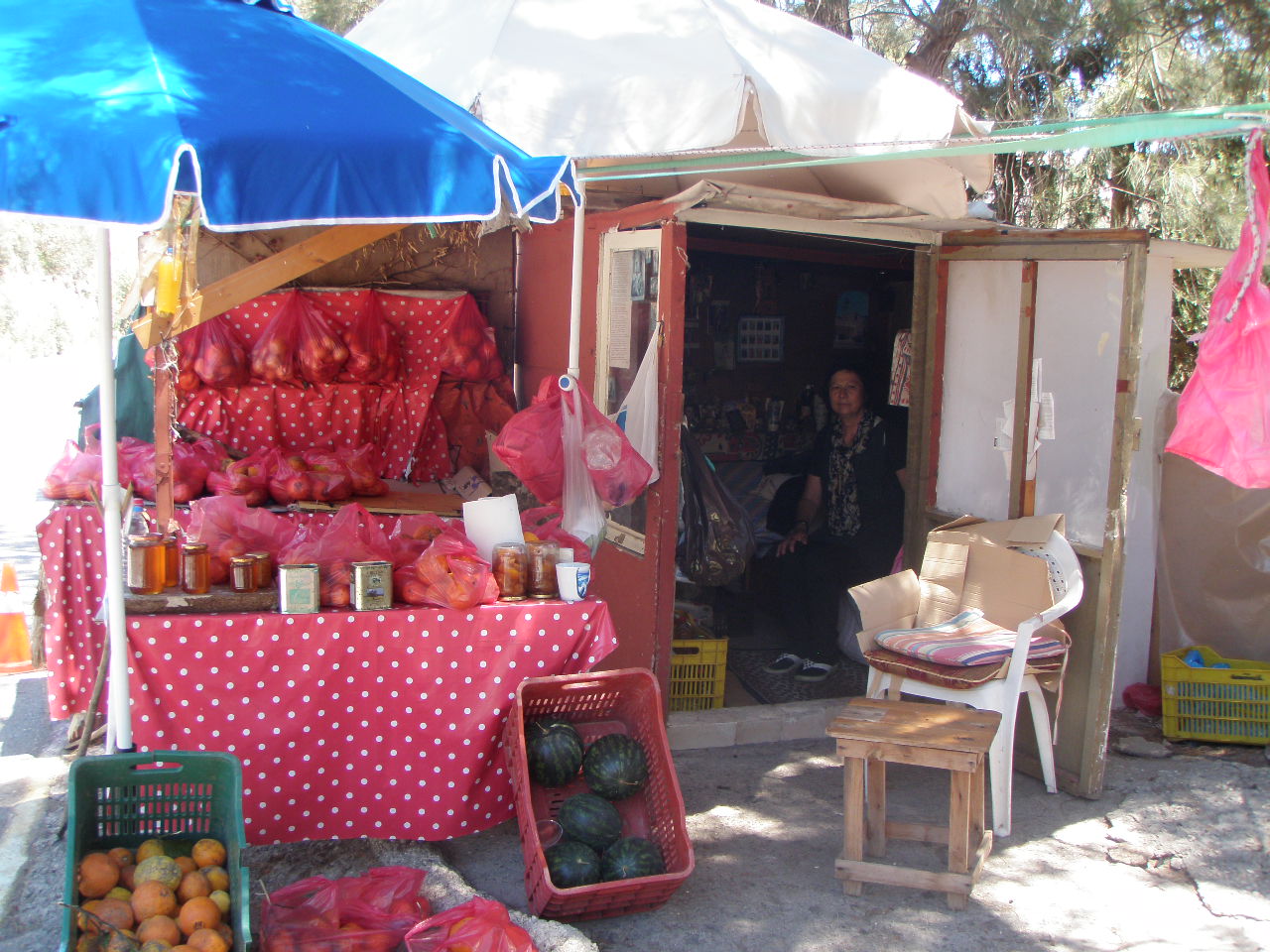
Lenea's enterprise: Fresh fruit and more...
 
By the time I get to Lenea’s place it is 11:30 already. She looks much better today, Clothes nicer, even put lipstick on! How sweet, if it is me that made her focus on herself a bit better, volla… I give her the soap bar and demonstrate smelling a beautiful rose, she understands! “I will smell nice with this?” and smiles. I wonder if she dates, or is she one of those forever widow Cretan women? She has my oranges as promised, I select another jar of honey. She is telling me I should come back for dinner. It is impossible, I tell her. But she has a full feast ready for me! What can I do? I tell her “How about lunch together?” Deal, she starts setting up the table for me, my gosh, she has all planned: Paper tablecloth, paper napkins, paper plates, metal silverware, glasses for water, and fried fish with horta (boiled vlita greens as salad), cheese, bread, boiled potatoes! A feast for this make-shift set up by the road side. I am glad I have my gluten-free bread with me. Although I am not hungry, I devour the horta, one fish, and the potato and fruit for dessert.

The most delicious lunch at Lenea's rustic roadside "café"..

She wraps my cheese to take with me and gives me a few tangerines along with my oranges. We get into this fake, polite push and pull over paying. I win, she is happy, I am happy, I take a few more pictures of her, I get her address, this time, I will develop some photographs for her and mail them to her as soon as I get back to the US. GPS loses its confidence and competence in Crete as well. Although I found the Archeological Museum and entered it into my GPS, it takes me to a place that has nothing to do with Archeological Museum. Locals are not much help this time, either, they lead me to the History Museum instead of Archeological Museum.

Pottery from the Minoan palaces at Archeological Museum of Iraklio

Of course in their minds museums are for tourists, not for natives, how would they know the difference between two museums. In an attempt to park, I find myself in a narrow dead end street that they call “steno” here. Another sweet Cretan woman comes to my help. She helps me park my car safely and tells me exactly how to get to the museum I want to go to, and on foot, too. As a result, I get the chance to walk through the Lions’ Square, in which there is a fountain the basis of which is made up by four lion heads. This must be the center of tourist attraction since it is almost like an open air bazaar.

Phaistos Disc from 17th century BC on which figures were used to form a text. 

The Archeological Museum of Heraklion can indeed compete with the National Archeological Museum in Athens, except that this one is dedicated to artifacts excavated in Crete, but with a history that goes all the way back to 6-7,000 BC. It is hard to believe that as early as 3000 BC, Minoans were reaching out to eastern Mediterranean and Asia Minor with their sailing ships, hence the terminology Minoan culture was a thallatocracy (marine dominance) in its peak. Something that I had noticed in Athens as well, the statues of Archaic times have features of Egyptian Art rather than the fine features of the Classical Greek style. Interestingly, though the Minoan culture created such fine, intricate art in their jewelry, in their pottery and frescos.   

Reproduction of wall paintings: Dark shades represent what was excavated, light shades what was imagined based on the excavated material 
 
As promised by the on-site staff at Knossos Palace yesterday, there are huge, restored frescos that cover the walls of the main court on the second floor. These paintings and even some wall carvings are recreated ones by archeologists/artists following the clues obtained from the excavated original remains. Especially wall carvings and huge big amphoras completed this way are very impressive. I don’t remember having seen this technique in other museums, I wonder if this is a method Cretan archeologists adapted from Art Evans’ method of recreating the Knossos palaces.

Golden jewelry from all eras of Cretan cultures: No wonder Odyssey is full of descriptions of serving wine out of golden cups

Moving on, I find myself in the jewelry rooms: The gold jewelry is stunning, I take pictures of them for my daughter who is crazy about antique and ancient gold jewelry. It is difficult to imagine how they were able to make such delicate and fine jewelry. By the time I am out of the museum it is almost 4 pm.


There is significant Helenistic era art represented at the museum as well

The only additional site I will be able to visit today is Anogia, which is a mountain village with some charm, the travel book reports. I love the drive, the road is like a snake licking now the left face of the mountain, then the right side of the next cliff cutting through a beautiful valley. Finally I find myself in a village on top of a mountain overlooking down at the Rethymno Bay in the distance. Initially, I go to the upper town since I was told more authentic stuff will be up there. Right on target: I find a neighborhood kafennia, run by a woman. She is serving food as well. I eat the best roasted leg of lamb served in boiled lamb juice with potatoes.

One of the taverns in Anogia, the last mountain village I visit in Crete

Treating it with a generous amount of lemon juice does it! I am in heaven with the delicious layers of flavors. Across the street is an old couple sitting on chairs in front of their door. They are both in black attire. They look so much like my grandmother and grandfather. As I eat my lamb, I also watch them affectionately, going back and forth between the moment and my childhood. Anogia brings together everything I have been experiencing in Greece but specifically Crete. I am glad I have the hour and a half of driving before rolling back into town, Rethymno, to reflect upon my three weeks in Greece, but more so the last two weeks in Crete. Exploring my roots had never crossed my mind some ten years ago. I was well-rooted in Turkish culture and being from Crete was a nostalgic, romantic nuance of my existence in the world. I discovered it wasn’t so. With its good and bad, I discovered especially during these last two weeks that what I grew up with was more Cretan/Greek than Turkish.

Last sunset from Sofia's balcony in Rethymno

The animated communication style in my family, the dedications to education as far as you can go, the devotion to one’s family and children, the gender equality while expecting men to be strong to protect and provide for their family, the pride with which people carry themselves that perhaps come from the Minoan grandeur on and on… These two weeks confirmed for me that I have always been a mixture of Turkish and Cretan with the good and bad. With my last 18 years in America and resolve to preserve the good of my roots and adding onto it the good from my new culture, I am in the making of a true mutt as Americans call it: A mixture of Turkish, Greek, and American. Thank you Fulbright and Greece for giving me this gift. I will treasure it all my life.
Till the next time dear land of beautiful sunsets, incredible history and humanism...
 

Monday, July 4, 2016

GREECE 2016 -13 - IRAKLIO AND MEETING WITH LENEA ONE MORE TIME AFTER FIVE YEARS


Vineyards and olive orchards ornament the hills and valleys of Crete 

The drive from Argyroupoli to Rethymno was a delight: Village after village as the road wound down from the mountains toward the valley then to the costal line, each with a different character, but all with a main road lined with kafennias, mini-restaurants, all with houses in front of which couple of people enjoying the evening breeze on a chair on the side walk, watching the passersby. I had a date with my friend Sofia in Rethymno to make, with the grape leaves I had picked from MIchaeli’s vineyard “dolmadakia” as they call stuffed grape leaves in Crete instead of the “dolmades” as they are known in America.

Rethymno Bay in the distance as I come down from Argyroupoli

With a pound of minced meat, and a bunch of fresh mint, parsley, and dill in it in addition to regular rice, onions and tomatoes that everybody in the market wraps the grape leaves with, it was delicious-simo or delicious-etero (as Greeks would say for the superlative)! Sofia jokingly regretted that she allowed that happen in her house since she was worried that her boys (husband and son) would now want her to make it after I leave. Our dinner was light and joyful with our final resolve that they would come out to Izmir every time I am there to have more of the dolmadakia.
 
Lenea in front of her citrus and tippy
 
Today is the day to explore Iraklio region. My goal is to get to Knossos, the infamous Minoan center/palace. I will discover in my travels today that in fact, in the entire wine country region right in the backyard of Iraklio, Knossos is but one evidence of the Minoan culture and how complex and comprehensive it had been at such an early time contemporary with Pharaos in Egypt. In addition to historic explorations, deep in my heart I am hoping I can bump into Lenea as well, the lovely citrus vendor, I had met 5 years ago, who had motivated me to start this blog in fact! As I drive toward Iraklio on the national highway as much as I try to take in all the beauty around me, I am also tremendously attentive to the road-side vendors of citrus and walnuts to see if any of them will fit the picture I have in my mind from my first encounter with her, which is as clear as if it happened just yesterday.

Lenea posing elegantly at the entrance of her tippy 

It is too early, I know since I am far far away from Iraklio, yet, so I turn my attention to the beaches and coves that emerge from around every corner with a different beauty, scenery, effect, and prose. Some well protected beaches are still asleep as the Cretan Sea (This part of Aegean, I discovered yesterday is called Cretan Sea) caressing their sand and pebbles gently as if smilingly. Some, on the other hand, being open to the passion of the open sea are in an excited mood already with the white, bubbly surf rushing toward the rocks and small pockets of sand, thrusting itself among them here and there with lust and longing. Whatever the serendipitous scenery may be, beyond all is the stoic, confident, serene, and all-embracing Aegean claiming the entire horizon as if to say, you play your little games out there with the land, I know where I stand sending us all her loving kindness thoughts (I hope).
 
Lenea's delicious café Helinico, metrio 

Although none of the citrus vendors so far fits the image in my mind, I decide to stop and ask somebody if they knew Lenea. This one is also a woman, but she doesn’t know her with disappointment clear on her face that I am not there to buy fruit from her. She also wants to understand why I want to find Lenea, “is she your friend, relative, why, ia-ti?” My Greek is not that sophisticated to use past tense to explain to her what happened 5 years ago. A customer arrives, she moves away, I am happy, hop in my car and drive away to see if I will meet Lenea again. Vendors are around every turn now, there must be a village beyond the hill that the highway meanders around, but I neither see a village in sight, nor any of the vendors fits the image in my mind. I read a sign that says Exit to Adides. I turn to my left and there is something there that is almost it!

One last shy pose from Lenea 

Bright sparkles in her eyes “Aaaa, I remember now, you are that woman, come sit, sit.” She is all a smile now, with two of her lower middle teeth decayed in the last five years. She is all about hosting me well now, opens an icebox and takes out a freshly squeezed orange juice bottle out of it and pours a glass of juice for me. Now that she recalled our encounter, I tell her “will you make me a coffee, medium sugar?” She is delighted, no sooner than I finish my sentence, she has the Greek coffee pot in one hand with coffee and sugar jars in the other. She uses a knife to transfer ground coffee and sugar into the pot in the make-shift but unique shack she had hosted me 5 years ago. I tell her where I had sat in this shack then, and where she had sat on her plastic stool and how she had told me about her daughter and son. She remembers and apologizes for the delay of all the details coming to her “I see a lot of customers…” It stings my heart a pinch, I thought of her all these years wondering how she and her remaining only child, her daughter had faired, but that is OK, thai birazi (no problem), Lenea.
 
She has more variety this year, watermelons, honey, olive oil, jam among other things
 
Just as I turned around the corner, I saw a woman the size of Lenea on the left side, where she should have been, the shelves and platforms are just as they would have been. And yes, there is a shack behind the shelves and tables, in front of which the woman is standing. There is a white structure that is to the right of all of this, which doesn’t exist in my memory of her place. But it’s been 5 years, this might be an addition. I make a quick U-turn as I pass her and stop at the very spot I had stopped five years ago. I can’t believe this but the image of the place is much clearer in my mind than the image of her face. Is this Lenea or not? This woman has the expressionless expression on her face just as Lenea did when I was just another customer for her 5 years ago. Am I seeing the 5 years passed on her face and posture, or is she somebody else?

Temple at Knossos restored as imagined by Arthur Evans
 
I ask her her name, she tells me a totally different name, of course, I had changed her name in my blog not to disclose her identity fully and I had taken no information to save at the time. I know that his son’s death in the sea was a unique piece of information she had shared with me. I ask her whether she has children. She tells me with a dismissive, suppressed yet real shade of sorrow that passes over her face that she had a son, who died in the sea… I tell her I am sorry again and ask her how is her daughter doing in Chania? She is perplexed with how I know this information. That is her! My Lenea. I give her a hug although she is still hesitant in receiving the hug. I remind her of everything I had shared with her from five years ago. I can see with each detail I share with her, the veil of not knowing on her face is torn a bit more and her eyes are filled with the implicit memories of affection, appreciation, and delight.
Darker colored patches on these pictures are what has been excavated, the lighter painted sections are completed by the archeologists/artists.
 
She is chatting like a machine in Greek, ¼ of which I can barely understand. As I am taking the last sip of my orange juice I show her my blog, unfortunately, I cannot get to the entries from 2011 that were mainly about her. But she understands with my broken Greek that I have a travel diary on the internet and her pictures from 5 years ago are there. I take her address, her phone number, her daughter’s phone number, and their full names to communicate. She takes my phone number. I tell her I will come back tomorrow and bring her something (I will find a gift for her from those that I brought to give to my contacts in Greece and Turkey). She tells me about a monastery/healing center she visited in Mitillini, across from Ayvalik in Turkey after her thyroid surgery, which most likely sent her into hypothyroid state. Now she is feeling much better!  Her shack is still full of orthodox church paraphernalia. I am sure this is her way of survival after losing a son to the sea and a daughter to who knows what… I will return between 6-7 pm on my way back to Rethymno and purchase portakalia and mandarini (oranges and tangerines) from her. She gives me 5-6 fresh tangerines to eat on the way to Iraklio and tells me “drive slowly” just like any Cretan mother would do. Somehow I have a very soft spot in my heart for this woman.  

4-5 feet high amphoras from Knossos used for storing olive oil and wine
 
I head to Iraklio, content. Signage in Greece, more so in Crete is horrible. Except for main highways, they are either hidden amid roadside overgrown some very pretty bushes, or plain nonexistent. After an hour and a half from my departure from Lenea, I find myself in a turn off for Archanes. I decide to take it exhausted from looking for Knossos! I will discover later on, the place with lots of busses 15 minutes back was in fact Knossos, with no signs whatsoever… After all, as one of my friends had said “I have had the most unforgettable experiences when I most felt lost!”, ditto, let’s see what this turn off will gift me with.

Arhanes, a charming village hiding Minoan treasures

First of all, I learn in this village divided into lower and upper halves that Minoan existence doesn’t consist of only the Knossos palace. There are much more real remains of this very advanced culture (except for their human sacrifice business) I discover in this very village. Apparently, Minoans were the first people making wine from grapes, the vines of which along with olive orchards embroider the hillsides in various shades and shapes as the road meanders upwards toward the top, the upper village.

Other restored paintings from Knossos 

I park the car away from the town square, still in walking distance. I get a fistiki (pistachio) ice cream and start strolling the town. All the tavernas my travel book mentions are in the middle of the town square, nothing too interesting. As I continue strolling, across from the square, I spot a kafennia; a unique café designated to men’s use in Greece, more in the country side, I assume. In Turkey, they are called “kahve” the same word for coffee. Men use these places to gather, chat, drink tea or coffee, and/or play all kinds of games. I guess men know how to take care of the child within better than us women! I know that anybody can tell I am a tourist, so I may be tolerated despite my gender. In fact there is a blond woman inside, so I walk in.  On the deck of the kafennia where all the customers that is the men are sitting, to the right there are two men, one looks like in his 70s, the other in his 50s, they are playing backgammon (tavli in Greek, tavla in Turkish), a common kaffenia/kahve game in addition to card games. The older one looks up at me questioningly, I greet them with a “Kali mera” and ask if it is OK for me to sit at the kafennia.

Throne room and its restored wall paintings in Knossos

He nods, not clear if he approves of this or not. After all he is also just a customer, I situate myself at a table facing the 9 men occupying 4 tables in 2s and 3s in an animated conversation, mostly talking together; how familiar, I had to learn not to talk over other people at age 16 when I was an exchange student to Wisconsin! The only woman in the kafennia walks toward me; turns out she is the waitress! A female wait-staff for an all-men place, this is different than Turkish kahves, that’s the European difference I guess.

The Knossos Palace is several stories high as excavated in some parts of it.  

I am pleased to discover that I can understand more and more of what others say as I listen to them. Since this is a public space and they are talking pretty loudly, another Greek/Cretan feature, I feel OK with eavesdropping. However, still, I can only understand a phrase here, a sentence there with many words, but cannot put them together to understand even the topic of the conversation. It is, to my surprise, much easier to understand the lyrics of songs, perhaps because Greek songs are almost invariably about love, you and I; and I have a pretty good vocabulary over those concepts from childhood on. Especially my paternal grandmother Resmiye had a unique affection toward me due to knowing that her name would live into the future through me and I heard lots and lots of words and phrases of love and affection in Greek not only from her but also from my parents and other relatives.
 
Fig Tree in the yard of the Knossos Palace
 
The tavli players are done, I guess the older one beat the younger one since the latter has the tavla box under his arm, which is traditional at least in Turkey: The winner tells the loser “take this to school, learn how to play then come back for a game”. I try to ask the older one who won,  who is leaving following the younger one, who already left. All of a sudden there is full silence on the deck. All the chattering men stopped their conversation trying to listen to what this weird woman with a computer, typing away all this long while sipping her coffee has to say! With my limited Greek vocabulary and the man’s no English, we cannot communicate, but he leaves with a big smile on his face. As I leave the kafennia and greet the remaining men with “Na eistai kala”, they respond in a chorus, hospitable rural Cretans, thank you for gifting me with spending some time with my grandmother and her family with your conversation. 
Finally, I find Knossos! Just as my travel book is clear about the controversy about this place, I find myself in a mixture of feelings. On one hand, the entire complex is impressive if not inspiring.

Restorations done by Arthur Evans' team somehow was disconcerting at Knossos Palace

On the other hand, it looks like fake with all the interventions the British archeologist Arthur Evans made at least some based on his own interpretation and imagination of what was known or not. Finally, this is also all about the ruling rich: the more I see of ancient ruins, the more I become aware that these remains tell more the history of the ruling class since the masses of people built these structures but did not necessarily enjoy them. Just like, 2 millenia from now, the banks and sky scrapers that corporates build might remain but none of the squatting communities, slums, falling apart tenement buildings will survive such lengths of time… I leave Knossos with a “I’ve come, seen, done” feeling.
 
On my way back, I stop by Lenea, she has my bags ready for me
 
I make it to Lenea’s place at 6:45, I had promised her that I would stop by between 6 and 7. She shows me her watch and tells me she was going to leave at 7. She is visibly happy to see me. She has prepared a bag of fresco tangerines and a bag of lemons for me, She wants to give me a bottle of liquor, I prefer a jar of honey. She refuses money, I don’t know if it is for real or not, I refuse to take them for free, I win. She tells me oranges today are not good for me. Tomorrow she will go through her orchards and pick fresh oranges for me. She gives me a last minute jar of bergamot jam to take to my friends with best regards from her. This is the elegance of a Cretan rural woman’s generous heart. Thus, as I leave for Rethymno for the day, I am convinced the highlight of my day was the two hours I spent at the Arhenas kaffenia and my time spent with Lenea. That is, human connection wins one more time as it always will for me.
Last pleasantry of my day is to stop at a tavern on top of a hill to enjoy the vistas...
 

Thursday, June 30, 2016

GREECE 2016 - 12 - HEADING TOWARD THE CRETAN MOUNTAINS


Fountains are scattered all over Crete
 
 
After, exploring the nature in Samaria Gorge and the history in Chania, here I am on my way to Argiroupoli, one of the most recommended villages to dive into Cretan country culture and authentic Greek food. As I drive up and around the mountains that will finally allow me reach my destination, I am still thinking of my new friend Costas, who took me to the airport before I left Athens last week. Little did I know then that he would turn out to be a very wise and intelligent man in terms of his understanding of human condition, politics in the world and Greek existence.
 
Argyroupoli from a distance
 
Since I knew I would return to Athens this week for one day to attend the annual Fulbright celebration at the American embassy, I had asked him before my first departure from Athens, whether he would be interested in driving me around through the 24 hours I would be in Athens. He delightedly accepted. I was already aware that his knowledge of Greek language was not bad at all. Whatever linguistic questions I asked him, he would come up with an answer and when he couldn’t, his limitation was more related to how to explain it to me in English not that he didn’t have the answer in Greek. That is the kind of man I respect to the greatest extent. Humility with his strengths and insight to his weaknesses; this is the key to healthy connection with one another, isn’t it? Had every man had these two qualities, wars would have been very difficult to breed…

"Modern" Argyroupoli through ancient ruins 

The reception at the American Embassy was lovely, acknowledging the success of the current and future awardees as well as targeting the attending funders for more support for the Greek Fulbright activities. I was very impressed with the Greek Fulbright Foundation’s activities!! I learned, first and foremost that Fulbright is the largest exchange organization in the world. The US State Department supports the international travel costs of trainees and scholars and provides minimal stipend for livelihood of the awardees in whichever country they are matched with. However, the costs of domestic travel and accommodation belong to the hosting country’s Fulbright organization, which requires constant fund-raising.
 
Beautiful doors and windows are all around Argyroupoli, too
 
 
Thus, it was partly Greek Fulbright’s success that they have hosted 34 American Fulbright awardees this year and will be sending out 35 Greeks to the USA for various lengths of time anywhere from one semester to 2 years this summer. Another very unique characteristic was that more than half the Greek awardees were accepted to programs such as jazz, classical music, art history, film making, etc totally different than many other countries, which usually go after projects related to almost exclusively business. After all, this is the land that gave birth to many forms of art, philosophy, and democracy among other intellectual creations of mankind. I was proud of these young people.

Brilliant young Fulbright scholarship awardees heading to the USA this summer 

Costas sends a friend of his to take me to the Embassy from my hotel. A very talkative man, Ianni. He wants to practice his English, I, my Greek, he gets it. We start chatting in Greek, but soon we slip into English since his English is much better than my Greek. The trigger for this is an interesting conversation that breaks out once I tell him that my grandparents were part of the catastrophe as Greeks call it when they were sent to Asia Minor when Greeks in Anatolia were sent to Greece. He tells me that was in 1922 as everybody else reports, but I know that my people went to Turkey in 1913.
 
Fig tree growing inside an ancient ruin
 
He corrects me that they cannot be part of catastrophe since the Greeks in Turkey were the victims of catastrophe, which took place in 1922. All of a sudden it is clearer in my mind: In 1922, the make-shift Turkish army of Ataturk had swept out of the Western part of Turkey, the invading Greek army supported by the British and at least some of the Greek population living in Turkey. The local Greeks were lured to the illusion that the Brits could help the native Greeks and the mainland Greek army bring the Byzantine grandeur back to them, which led to a true catastrophe! In official Turkish history, it was taught for over a century that the Greeks were “spilled into the Aegean” and had to be rescued by the British ships in Izmir Bay. The Turkish side reports the departing Greeks had set fire to downtown Izmir not to leave their belongings to Turks. The Greek side claims the Turkish army had set the city on fire to force the Greeks to leave. The only place the Greeks could go was the water, where they found refuge in British ships waiting on stand-by in Izmir Harbor. I doubt all the historical facts of that event have been released even after almost a century.

Roadside shrines come in all shapes and embellishment

Ianni defends that the muslims in Greece didn’t experience any hardship because of the events of that time, it was the Greeks that suffered. Hmmm, we are in a delicate place right now, it is impossible for me, being from Turkey, to convince him that both sides must have suffered and it was very unfortunate that both shores of the water, the Aegean have been cleansed from the rich cultural elements of the past just because of religion, which had never been a problem either in Greece or in Anatolia until the British sewed hatred seeds in communities against one another harvested by immense amounts of fear. He jumps into questioning why can’t Christians practice their religion in Agia Sofia in Constantinopolis? I try to get him to see that it is unfortunate that both churches in Turkey and mosques in Greece are basically empty. He is all about victimization of Greeks throughout the history. “And now nobody likes us. Macedonians want Scopia, Turks want the 12-Islands and Thrace. Look what Europe is doing to us. They all want us to disappear and we will. Soon there will be no Greece!”

In Argyroupoli, you either look through a ruin toward a modern building or through a modern building toward a ruin.. 

I feel for him but my comments on “Greek history and nation are so strong it is impossible to destroy Greece, don’t worry.” Bounce back as if he hasn’t heard a word of it. One last attempt from him is “They want to take away Scopia from us. People who live there are Greeks, they are not Macedonians!” I almost laugh deep inside: He could be one of the extreme right wing guys I saw at the Gold Dawn demonstration two weeks ago in Athens. Furthermore, his rhetoric is so similar to the official Turkish position on Kurdish people until a decade ago “Kurds are actually mountain Turks and they speak a dialect of Turkish, but they don’t know it!” I remember dear Manolis telling me during one of our lunch time discussions “Good thing, there is no minority to mention in Greece, Greek governments would have committed genocide without blinking their eyes”. I hope this is not true.

Beautiful and relatively well preserved old Cretan dwelling 

When I share with Costas that I was appalled with Ianni’s nationalist streak, Costas’ beauty comes out. He tells me almost exactly what I have been thinking about current Greek and Turkish national identities all along. He states that some lunatics in Greece want to bring back the past, they want Constantinople back, and they are in a total victimization mode. I share with him that it is so similar to current nationalistic Turkish identity that is a clash between the imperialist grandeur of the past and the relative unimportance of today. He gets it, his body language tells me that this is his exact sentiment.
 
 
One of the several churches in Argyroupoli
 
We agree that we, on both sides of the water, need to have an open mind and see that there is nothing we need to fight about. In fact, what would Turkish government do if it had the right to govern the 12-islands: install a few mosques on each island just as the Greek government would reconvert Aigia Sofia into a church and open up many additional churches, perhaps convert most of the mosques to churches as well. Otherwise, the food would remain the same, the music, the dances, the expression of self and community would remain the same. We wish everybody could see all the fight in fact is over which religion will dominate. With these thoughts and partly due to poor signage, despite my GPS, I miss my turn several times, but eventually make it to the beautiful village of Argyroupoli. As I usually do, I avoid following the crowds and park my car at the entrance of the lower town and start climbing toward the upper town center. First person I bump into turns out to be a retired Norwegian ophthalmologist, who lives part of the year in this lovely village in a house that is being renovated.
 
 
Tavern Ancient Lappa
 
 
We talk a bit about my work and she gets excited about discussing it with her pediatrician friends in Rethymno. Go figure, small world! I ask her about tavernas that are not frequented by tourists that much. She guides me to ArhiaiLappa named after the ancient city of Lappa, on top of the ruins of which this village is built. As I walk toward the tavern, I see many examples of how the ancient city actually is incorporated into the new village. Some buildings are falling apart, but nobody can touch them other than the government due to archeological site status, some ancient walls make up one side of a contemporary building, on and on… Finally I find a tavern on cross roads and meet a sweet sweet Greek woman named Constantinidi, short D, for tourists I guess. I order a Greek coffee as usual. As she serves other guests, she stops by and we chat in bits and pieces.
 
Gracious tavern owner  Constantinidi
 
As soon as she hears my grandparents are from Chania, she exclaims like an innocent child awarded the long awaited toy “Bravo!” as if I had a choice in it. What is it that even the best of us feels closer to a person when we discover s/he is one of us? Our implicit memories? Our suppressed othering of those not one of us? Knowing without knowing what a person holds if our roots are entangled with one another even in a distant distant past? What is a soul mate? Our mirror image? Someone that thinks, speaks, behaves, and feels more or less like ourselves? Or can soul mates complement and enrich one another with their differences as well as shared values? I still like her, innocence is all over her.
 
 
Another door window set from Argyroupoli
 
She guides me to all the places I should see in the village not knowing I will bump into a volunteer guide! I want to take a picture of her, she is delighted, but she prefers a picture of the two of us. A German tourist is more than happy to help. I give her my card and ask her to write to me so I can send her the picture. She is delighted even more. When I ask to pay, she tells me “It is on me, you come back for lunch”. I leave the payment as tip with an “Efharisto para para poli”. On my way up, I take a side street and greet a man sitting under an umbrella with my usual “Kali mera”. He responds joyfully and we start a chat. His name is Manolis and he tells me he would be happy to show me old Venetian and Roman ruins.
 
Manolis and an ancient (?) amphora he has on display...
 
He is pointing to the narrow alley that goes down to the ravine. I am a bit skeptical, thinking of all the rape stories from the western world… Something inside me says “Give him an innocent chance, perhaps he is after a few euros, who knows.”  The urban brainwashing in me tells me to keep my distance with him, though. Put him ahead of me, stay a yard behind him, and when he touches my arm in a friendly way at times, pull my arm and cut the contact right away. Part of me feels bad for being polite and respectful but somewhat distant to him, but my cortex tells me “better safe than sorry”. First thing he does is to give me a blossom from one of the vines in his yard. That is when I notice a freebag dangling over one of his shoulders, now it is clear that this is a businessman here. Opening whatever is in his backyard that he cannot touch to tourists! He gets it, he respects my personal space except for one time when I almost tumble over a Venetian marble block. At some point, he stops and picks for me two handfuls of purple little plumbs. Despite my polite protests, he insists that I take it and don’t feel shy about it. What can I do except for devouring the most delicious plumbs handed to me.
Where Manolis lives 

He shows me Venetian archways, Roman columns, Venetian untouchable buildings still standing upright, entrance to an underground “fortezza”. I understand only half of what he says, he decided I knew Greek and is bombarding me with information. Who knows if he is telling me the truth, but I scold myself “Trust him Resmiye and just resolve that you hired a guide and a lovely one at that, who has only a handful of teeth, but a sweet smile and who won’t harm you. At some point I ask him “Do you live here?” and regret the question right away. I don’t want him to think I want to go to his house! He says “Here” pointing to a door, I instantaneously stay behind one more time. He brings out a very old camera on foot, shows me how it works and takes a picture of me with the camera. Then he invites me inside, I just peek through the door when he is inside, it is a tiny little shack with all kinds of odds and ends, all over. He pours a shot of raki for me, which I have to refuse, then offers me a cookie with sesame seeds. Although I can’t eat that, either, I take it not to offend him.

Ornamentation of the walls in D's tavern 

He is not surprised when I give him his well-deserved tip. This reminds me of the conversation Costas and I had this morning one more time. It is Costas’ position that Greeks that migrated to America were regarded as “taking what didn’t belong to them very easily”. He even goes too far to say they were known as kleftis, for which one could go to jail. I take it as thieves/stealing. My position on the other hand is that Greeks in Turkey were known as being successful businessmen. I interpret what Manolis did this afternoon as turning a situation that I started by conversing with him into a business opportunity for himself without forcing me into anything. I wonder how Costas would have interpreted this. 
I go to the town center and buy some gifts for my friends in the USA from a lovely young Greek woman. She also has decayed teeth. What happened to the good Greek health care, is it decaying under the austerity measures, too?  I share with her my experience with Manolis and my curious skepticism, we get a good laugh out of it. She tells me he is a good man, but just does this thing with tourists. I tell her to tell Manolis that I had a great time and thank him one more time for me. I am sure they will share it with the entire village for a while, and sure enough, the moment I walk out of her store, she is sharing what I told her with the store owner across hers!

Vegetable garden Manolis walks me through. 

As I am looking for the springs, I come across the cemetery and the old church in it on a hill that dominates the entire valley. It is interesting that all Orthodox cemeteries that I visited both in Turkey and Greece happen to be on top of hills that has a panoramic view. I wonder if they feel the dead deserves space and being closer to the sky than the living. Had I known, the springs would have turned out to be merely a tourist trap, I would have spent more time in the cemetery with the peace of the dead, savoring the mountains all around us diving into deep valleys under the warm breeze filling my lungs with delicious scents of sage, thyme, and who knows what else that grows in this fertile land…
Series of villages scattered between Argyroupoli and Rethymno